
Stephen
Founder of HealthyData.Science · 20+ years in life sciences compliance & software validation · MSc in Data Science & Artificial Intelligence.


This guide is grounded in Atomwise’s published evidence base, not vendor slideware. It draws on the AIMS study (“AI is a viable alternative to high throughput screening”), which reports 318 prospective AtomNet‑guided virtual screening projects across 482 labs at 257 institutions in 30 countries—a breadth of prospective, real‑world usage that no other AI small‑molecule platform has disclosed at this scale. Those campaigns achieved project‑level success rates of roughly 73–75%, meaning that in about three‑quarters of cases at least one bioactive hit was confirmed experimentally, not just predicted in silico. Average primary hit rates across these runs were around 7–8% from ultra‑large virtual libraries, dramatically higher than the sub‑1% confirmation rates often seen with plate‑based HTS on comparable novel targets, which directly reduces false‑positive burden on your medicinal chemistry teams. Those results include historically difficult classes such as protein–protein interactions and allosteric sites, where success rates still remained above 70% in the AIMS dataset, providing rare quantitative reassurance for some of the most failure‑prone target categories. It also reflects peer‑reviewed work on the AtomNet architecture and pose‑ranking approaches in structure‑based virtual screening; the original AtomNet paper describes a 3‑D convolutional neural network trained on atom‑level protein–ligand interaction grids that outperformed traditional docking (e.g., Smina) on held‑out benchmarks, giving internal reviewers a mechanistic, rather than purely statistical, story to defend. Where relevant, we link directly to these sources so you can review the underlying data and judge whether the claims and risk assessments match your organisation’s bar.
The first screening question most pharma executives ask is simple:
“Has this platform produced molecules that actually survive real-world clinical development?”
The biggest structural problem across AI drug discovery vendors remains the translational gap between algorithmic success and clinical outcomes.
A cross‑platform analysis of AI‑discovered drugs now suggests Phase I success rates in the 80–90% range for AI‑originated molecules, versus roughly 60% for the historical small‑molecule baseline, which indicates that AI can improve early developability—but also highlights how little Phase II+ data yet exist. Even among AI‑native peers, only a handful have multiple AI‑designed molecules in human trials; for example, Insilico Medicine reports 10 AI‑generated candidates that have reached clinical development with a claimed 100% IND‑enabling success rate so far, underscoring how early the field still is when you compare that figure to the thousands of active pharma programmes. [1]
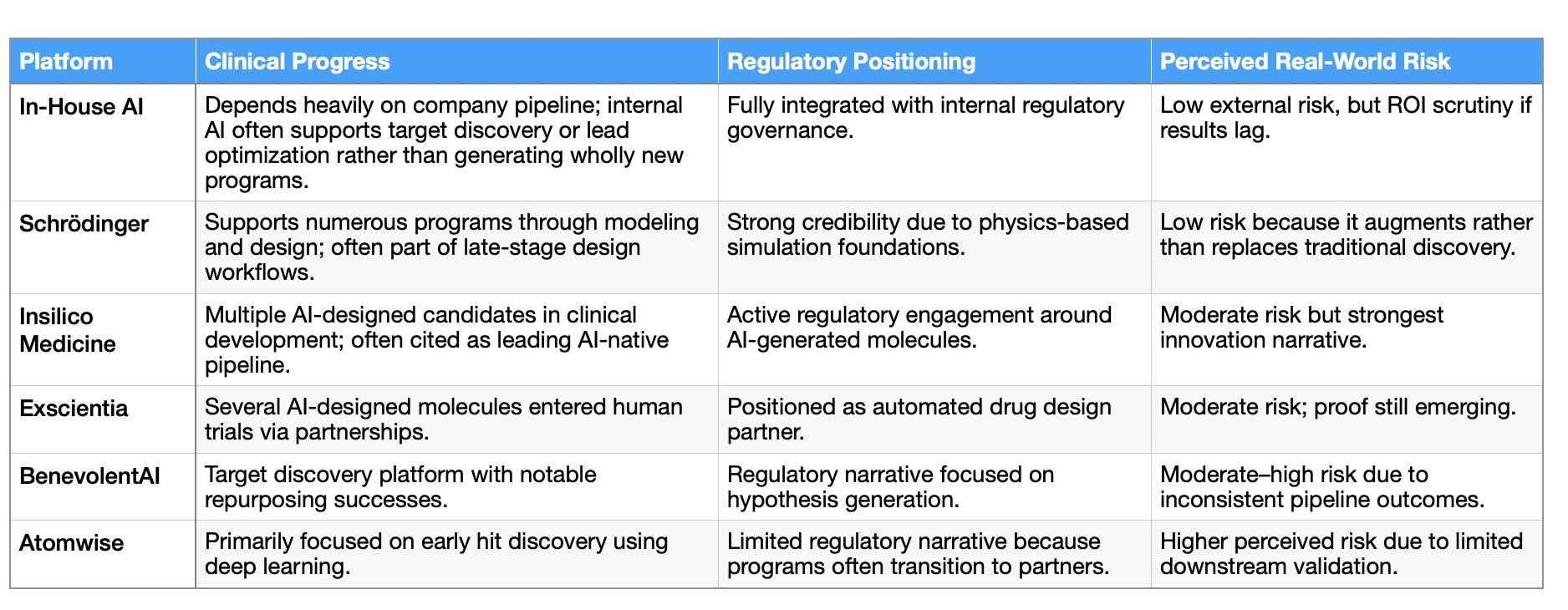
Lack of Phase 2+ data tied directly to AI-originated molecules
No clear link between algorithmic predictions and clinical outcomes
Over-reliance on discovery metrics rather than translational milestones
For Atomwise specifically, buyers often view the platform as valuable early in the discovery funnel but insufficient as a standalone discovery engine. The AIMS study helps counter that perception by showing that AtomNet delivered at least one experimentally confirmed hit in 74% of 120 internally tracked AIMS projects, even when broken out by structural data regime (no structure, homology models, X‑ray, etc.), giving portfolio‑level evidence that its outputs routinely progress beyond “interesting predictions. [2]
(Regulatory + Partner Demand)
AI predictions that cannot be scientifically defended or reproduced create significant friction in:
Regulatory review
Internal translational science committees
Partner diligence processes
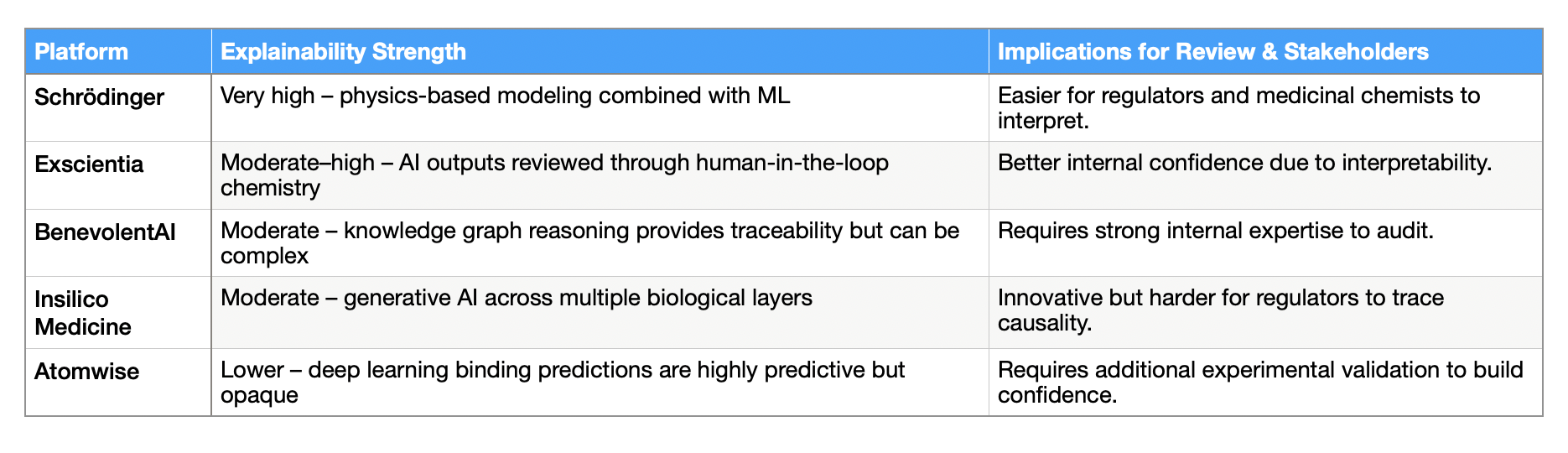
If AI outputs cannot be clearly explained:
Safety committees hesitate to approve targets
Regulatory documentation becomes more difficult
Internal scientists may reject the results outright
This is a frequent silent dealbreaker. Unlike black‑box language‑model systems trained primarily on text, AtomNet’s architecture is explicitly tied to molecular physics: it encodes proteins and ligands as 3‑D grids of atom types and interaction features and learns convolutional filters over those physical representations, which means medicinal chemists can inspect which structural motifs are being prioritised instead of trying to interpret opaque token embeddings. BenevolentAI provides a different kind of transparency by building its predictions on a multimodal knowledge graph that integrates more than 85 curated data sources (structured databases, literature, omics, clinical data, chemistry, and protein structure annotations), giving internal reviewers a clear data lineage when they ask, “Where did this hypothesis come from?”. Exscientia pushes explainability through process rather than architecture; its platform is built around iterative “active learning” cycles where AI proposals are continuously reviewed and accepted or rejected by human chemists, so partner teams can audit not only model outputs but the decision trail that led to each candidate. [3]
Even if the science is compelling, technical integration frequently determines adoption success.
Key integration challenges include:
ELN/LIMS compatibility
Data governance restrictions
Cloud vs on-premise deployment
Model retraining workflows
5 = strongest alignment / lowest risk
1 = highest friction risk
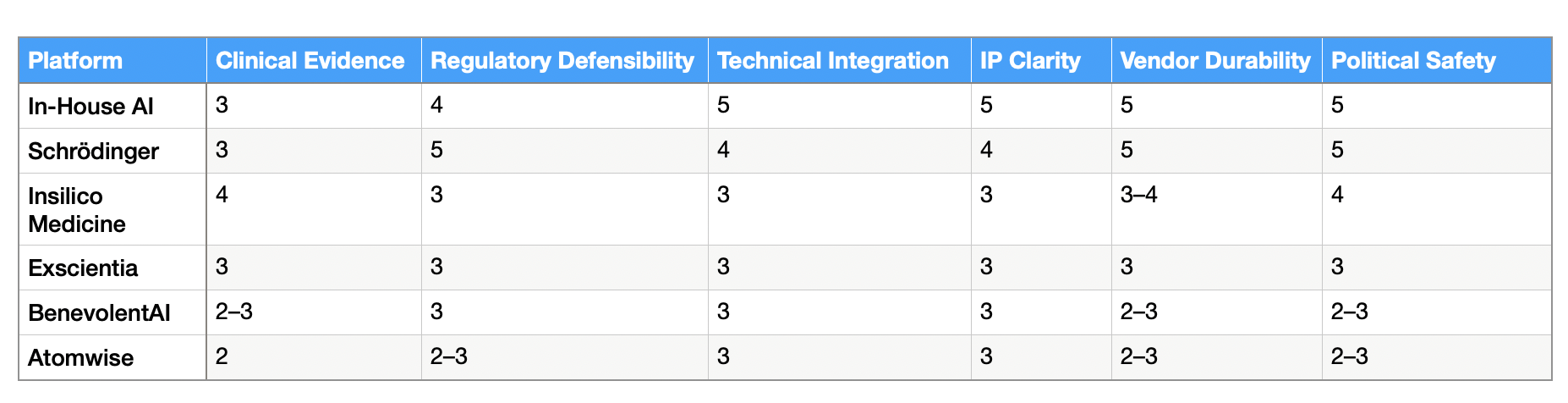
Platforms that require major workflow changes
Vendors that cannot operate within enterprise security frameworks
AI outputs that cannot easily integrate into medicinal chemistry workflows
These technical issues can quietly kill partnerships long before scientific evaluation concludes. Schrödinger, for example, mitigates some of this risk by deriving the majority of its $341.1 million 2024 revenue from software licences ($290.8 million, up 13% year‑on‑year), with drug discovery services contributing a much smaller $27.2 million, signalling that its tools are already embedded in many organisations’ day‑to‑day discovery stack rather than existing as standalone pilot projects. [4]
Pharma partnerships typically span 5–10 years, making vendor durability a major risk factor.
Decision-makers consider:
Funding runway
Leadership stability
Strategic focus
Dependence on single partnerships
AI drug discovery startups face additional scrutiny because the industry is still consolidating rapidly.
Internal teams often ask:
“Will this partner exist when our molecule reaches Phase 3?”
This question disproportionately affects younger AI companies, including Atomwise. [5]
Even strong technology can fail if it creates organisational resistance.
Internal political concerns include:
AI perceived as replacing scientists
Internal AI teams feeling threatened
Procurement teams uncomfortable with startup dependencies
Board-level skepticism toward hype cycles
Platforms positioned as augmenting existing discovery workflows (rather than replacing them) face fewer internal obstacles. Schrödinger is often seen as politically “safe” because its tools augment late‑stage design and lead optimisation via physics‑based simulation rather than trying to own the entire discovery stack, and that augmentation narrative is reinforced by recent partnerships such as its up‑to‑$2.3 billion multi‑year collaboration with Novartis, which explicitly combines Schrödinger’s modelling software with Novartis’s in‑house discovery engine instead of supplanting it. Insilico Medicine, by contrast, leans into the innovation narrative: a recent independent review notes that its flagship ISM001‑055 anti‑fibrotic programme advanced from target to clinical candidate in about 18 months with only ~70 synthesised molecules, versus the thousands often required in traditional discovery, a story that excites R&D leadership but can trigger extra scrutiny from internal modelling and chemistry groups who worry about being bypassed. [6]
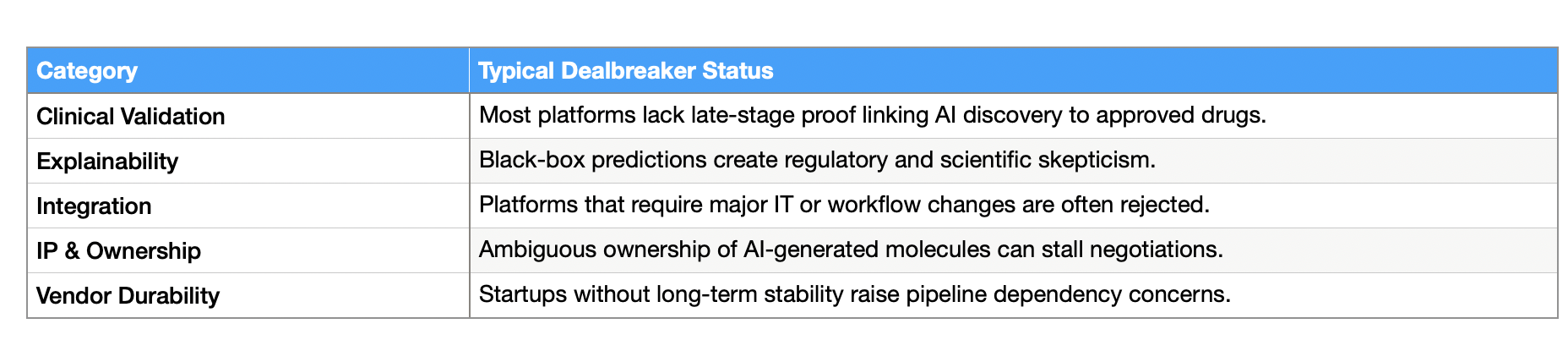
For pharma buyers in 2026, the decision is rarely “Which AI platform is most advanced?”
Instead the question becomes:
“Which platform introduces the least risk while still accelerating discovery?”
In that context:
Schrödinger is often the safest augmentation tool.
Insilico Medicine leads the innovation narrative.
Exscientia positions itself in automated design.
BenevolentAI focuses on knowledge-driven discovery.
Atomwise remains strongest in early hit discovery.
In-House AI offers maximum control but slower innovation.
No single platform yet eliminates the translational uncertainty between algorithmic discovery and approved medicines. The ultimate risk factor behind most stalled partnerships.
Prospective 318‑target AIMS study (Atomwise / AtomNet vs HTS)
AI is a viable alternative to high throughput screening: a 318‑target study. Scientific Reports, 2024. Focuses on 318 AtomNet‑guided virtual screening projects across academic and internal programs, reporting project‑level success rates, hit rates, potency, performance on PPIs/allosteric sites, and behaviour with zero target‑specific training data. [7]
AI vs traditional HTS: hit rates, false positives, and workflows
Artificial intelligence in drug discovery and development. Comprehensive review of how AI‑driven virtual screening compares with plate‑based HTS in terms of hit rates, library sizes, false‑positive burdens, and practical integration into discovery pipelines. [8]
AtomNet architecture and benchmark performance vs docking
AtomNet: A deep convolutional neural network for bioactivity prediction in structure‑based drug discovery. Describes the original AtomNet CNN architecture, training regime, and performance on held‑out benchmarks relative to traditional docking (e.g., Smina), including AUC distributions and enrichment metrics. [9]
Press release summary of 318‑target study and chemical novelty
Atomwise publishes results from 318‑target study showcasing AtomNet AI platform’s ability to discover structurally novel chemical matter. Summarises key outcomes from the AIMS study, emphasising scaffold diversity, novelty relative to known ligands, and scale (billions of virtual compounds screened). [10]
Commercial maturity: deals, collaborations, and scale of operations
Sanofi signs $1.2B pact with Atomwise; Atomwise, Hansoh Pharma enter into up‑to‑$1.5B AI‑based drug discovery partnership; Lilly inks up‑to‑$560M AI drug discovery collaboration with Atomwise; Atomwise deal terms and funding history. These sources collectively document the size and structure of Atomwise’s major pharma collaborations and overall funding, used here only to support claims about commercial maturity and risk profile. [11]
For a deeper dive into Atomwise’s core platform capabilities and evidence base, see our main Atomwise listing, Atomwise: The AI Powering Smarter Small‑Molecule Discovery.
This buyer guide comparison of Atomwise vs key competitors first appeared on HealthyData.Science and major search indexes, and is protected as original, independently curated content.
Disclaimer
This page is for information only and does not constitute regulatory, clinical, or commercial advice. The assessments and comparisons are based on publicly available information and vendor inputs at the time of writing and may change without notice. Organisations should conduct their own technical, legal, and governance due diligence before selecting or deploying any AI solutions in healthcare.