
For this case study, I spoke with Meghan Oates-Zalesky, Chief Marketing Officer at MadeAi, about how pharmaceutical, biotech and medtech teams are using AI to cut evidence review timelines by up to 60%.

About MadeAi
The Platform
“MadeAi™ is an AI-enabled platform built specifically for life sciences organizations,” explains Meghan Oates-Zalesky, Chief Marketing Officer at MadeAi. The platform accelerates evidence synthesis workflows including AI-aided end-to-end SLRs, TLRs, rapid reviews, scoping reviews, medical information response generation, HTA submission package creation, and value dossier development.
“What makes MadeAi different is how we combine agentic AI, workflow orchestration, and human expert validation,” Meghan notes. “This helps teams produce faster, more traceable, and audit-ready outputs across clinical, medical, regulatory, and commercial functions”.
Who MadeAi Serves
MadeAi customer organizations include:
- pharmaceutical manufacturers
- biotech
- medtech
- medical device companies
- clinical research organizations (CROs)
- consultancies
- and HTA organizations.
The platform supports health economics outcomes research (HEOR), medical affairs, market access, R&D, and real-world evidence (RWE) professionals.
The Problem(Meghan describes the challenge)
The Challenge: Manual Evidence Generation
“Evidence generation workflows were requiring hundreds of hours of manual work and expert judgment from high-demand, high-cost HEOR, clinical, R&D, and regulatory experts,” Meghan explains. “This made reviews slow, expensive, and difficult to scale. Our customers needed a better way.”
The Solution(Meghan walks through the workflow)
How MadeAi Works: AI-Assisted Workflow Orchestration
According to Meghan, the platform is designed to support PRISMA-aligned SLRs, TLRs, rapid and scoping reviews for HTA, clinical evaluation reports (CERs), global value dossiers (GVDs), joint clinical assessments (JCAs), safety monitoring, and clinical guideline support.
Example Workflow: PRISMA-Aligned Systematic Literature Review
“Let me walk you through a typical systematic literature review workflow using MadeAi-LR,” Meghan offers:
- Protocol and search strategy: “We create the review protocol and AI-assisted search strategy based on the research question and inclusion/exclusion criteria, followed by expert human review”
- Automated screening: “The platform runs automated title/abstract and full-text screening with AI relevance scoring, duplicate detection, and reviewer validation”
- Extraction and synthesis: “We extract and synthesize study data, generate PRISMA-aligned evidence tables and summaries, and produce a submission-ready report with final expert review and authorship”
"MadeAi transformed evidence generation from a slow, manual process into a faster, scalable workflow with greater consistency and transparency."
Meghan Oates-Zalesky, Chief Marketing Officer, MadeAi Tweet
Results & Impact (Meghan shares customer outcomes)
Measurable Outcomes Across Five Dimensions
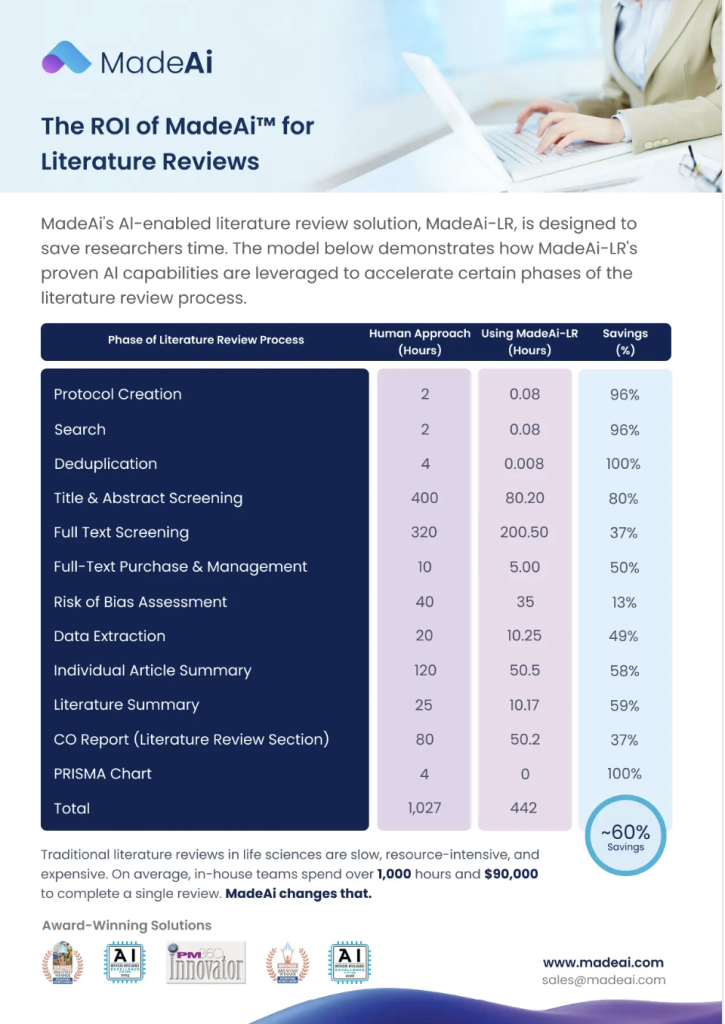
“Here’s what we’re seeing from MadeAi customers,” Meghan shares. These outcomes are supported by published studies and conference presentations evaluating MadeAi and MadeAi-LR in regulated evidence synthesis workflows, and by MadeAi internal analyses and ROI studies [3].
Time-to-Insights
"We've reduced literature review timelines by~40–60%, significantly decreasing manual screening and extraction hours for medical, HEOR, and regulatory teams" [1] [2].
Content Quality
"Teams are achieving approximately 90%+ accuracy in AI-assisted screening and extraction workflows, while improving consistency of inclusion/exclusion decisions and evidence synthesis."
Attribution & Auditability
"We deliver greater than 96% traceability and auditability with PRISMA-aligned documentation, explainable AI outputs, and full decision tracking for regulated environments."
Submission Speed
"Our customers are enabling faster HTA submissions and evidence package creation while freeing internal experts to focus on higher-value scientific and strategic work."
Cost Savings
"When paired with MadeAi's expert Services Team, platform customers can enjoy as much as 70% in cost savings" [1] [2].
Guardrails & Validation (Meghan addresses the critical safety question)
Validation in Practice:
When asked how MadeAi ensures outputs are safe for regulated submissions, Meghan is emphatic: “Human experts review and validate all AI-generated outputs, with full traceability, explainability, audit trails, continuous model benchmarking, and validation against golden datasets to support safe use in regulated life sciences workflows and critical decision-making”.
These validation practices help ensure consistent performance across different review types and therapeutic areas. Similar results have been reported across multiple MadeAi customer implementations [4].
"We keep human experts involved throughout the workflow to review, validate, and approve all AI-generated outputs before use in decision-making or HTA submissions, with traceability, audit trails, and evidence-grounded validation processes in place to minimize hallucinations and ensure reliability."
Meghan Oates-Zalesky, CMO, MadeAi
Who Is MadeAi For? (Meghan defines the ideal customer)
Is MadeAi Right for Your Team?
“MadeAi is a strong fit for life sciences teams that manage recurring evidence generation, literature review, HTA, medical affairs, or regulatory workflows and need faster, scalable, and traceable outputs,” Meghan notes.
Sources & Additional Reading:
[1] MadeAi ROI Overview: Performance and efficiency data for MadeAi-LR, including literature review time and cost savings. Available at: https://madeai.com/products/literature-review/ (see “View MadeAi ROI Details” for ROI metrics).
[2] Unlock the ROI of GenAI-Enabled Literature Reviews (White Paper): Detailed ROI analysis for GenAI-enabled literature review workflows using MadeAi-LR, including methodology and quantitative outcomes. Available via gated access at: https://madeai.com/resources/white-paper/unlock-the-roi-of-genai-enabled-literature-reviews/
[3] MadeAi Scientific Publications: Collection of peer‑reviewed and conference papers on MadeAi’s AI‑enabled literature review and evidence synthesis capabilities. Available at: https://madeai.com/resources/scientific-research/
[4] MadeAi Customer Case Studies: Case studies highlighting how life sciences and healthcare organizations use MadeAi and MadeAi-LR to accelerate literature reviews, strengthen evidence packages, and improve regulatory and commercial outcomes. Available at: https://madeai.com/resources/case-studies/
Ready to explore MadeAi for your evidence workflows?
If your team manages recurring SLRs, HTA submissions, or medical affairs evidence packages and needs faster, traceable outputs, consider evaluating MadeAi-LR alongside your current process. Visit the MadeAi literature review product page or request a demo to see the workflow in practice.
Explore more AI tools for evidence and regulatory workflows.

Author: Stephen
Founder of HealthyData.Science · 20+ years in life sciences compliance & software validation · MSc in Data Science & Artificial Intelligence.