

AI-powered counterfeit detection is shifting from slow, lab-dependent verification to field-ready authentication that can be used by brand protection, QA, customs, and supply chain teams in real time [1, 10]. For organisations focused on hidden branding and covert packaging security, the strongest options combine invisible identifiers, smartphone-based inspection, and evidence capture that can support broader brand protection and compliance workflows [1, 3, 4].
Who this guide is for
This guide assumes a primary audience of brand protection and quality assurance leaders at mid‑to‑large pharmaceutical manufacturers, medical device firms, supply chain security organisations, and national inspection bodies.
It assumes a regulatory lens focused on supply chain integrity and suspect‑product verification, rather than pharmacovigilance case processing [1, 2].
It assumes an environment using a best‑of‑breed security stack that may include covert packaging controls, mobile inspection, serialization, and back‑office investigation tools rather than a single monolithic platform. [1, 3, 4].
It assumes readers already understand anti‑counterfeit basics and are evaluating platforms based on covert branding, deployment friction, inspection speed, and evidentiary value. [10].
The counterfeit problem
Counterfeit and falsified medicines remain a serious public health and supply chain problem [2, 10], and regulators frame suspect or illegitimate product handling around rapid quarantine, investigation, verification, and notification workflows rather than passive monitoring [1]. WHO guidance also emphasizes secure segregation, investigation records, and chain-of-custody practices for suspect falsified products [2], which means the value of an AI detection tool depends not only on detection but also on how well it fits operational handling and evidence workflows [1, 2].
For the audience in this article, typical owners include directors of brand protection, global product security leads, QA directors, supply chain integrity managers, and regulatory or forensic analysts. These teams need tools that can identify suspicious product quickly in the field while still supporting downstream actions such as escalation, reporting, investigation, and potentially regulator or customs collaboration [1, 7].
That is where AI-powered counterfeit detection is becoming useful [10]. The market now spans covert digital watermarking [3, 4], smartphone-based computer vision [6], packaging microstructure analysis [5], and portable authentication workflows [8] that reduce dependence on specialised lab setups while improving field responsiveness [10].
1. Digimarc: Best for Covert Artwork Watermarking & Native Packaging Security
Digimarc is the clearest fit for “hidden branding” because it embeds covert digital watermarks into packaging artwork or security labels, then enables field authentication and threat visibility through the Digimarc Validate app and Illuminate platform [3, 4].
Healthcare/Drug Safety Use Cases: Pharmaceutical packaging authentication, anti-counterfeiting, anti-diversion, secure field agent verification, and back-office inspection support are all explicit use cases in Digimarc’s anti-counterfeiting materials [3].
Detection & Evidence: Digimarc’s model is based on covert digital watermarks embedded at SKU, serialized, or security-label level rather than purely visual anomaly detection [3], and authorised inspectors can authenticate products in the field using only a smartphone camera through Digimarc Validate [4].
Regulatory Alignment: Digimarc explicitly positions serialized or batch-level identifiers as relevant to traceability requirements [3, 4], and its pharma materials emphasize product integrity, tamper visibility, and field authentication rather than standalone lab verification [3].
Deployment Model & Integrations: The platform supports secure mobile apps, web-based authentication, SDK-based extension into customer apps, and centralised reporting in Illuminate, where real-time validation checks can be visualised or exported for investigation and threat monitoring [4].
Best for: Brand owners that can influence packaging design and want covert, packaging-native hidden branding that scales across product lines [3, 4].
Key limitations: Digimarc generally requires packaging or label implementation upfront, so it is less suited to organisations that need immediate counterfeit detection on legacy products without packaging changes [3].
2. VRAI AI: Best for Non-Additive Smartphone Packaging Forensics on In-Market SKUs
VRAI AI is strongest where teams want counterfeit detection on existing products without adding markers, tags, or new hardware [6]. Its positioning centres on identifying microscopic print flaws and packaging inconsistencies from a single smartphone photo [6].
Healthcare/Drug Safety Use Cases: The vendor positions the product for medicines and highlights use by customs, warehouses, and public-sector enforcement contexts where instant counterfeit detection is needed before product moves further through the supply chain [6].
Detection & Evidence: VRAI AI reports 99.71 per cent accuracy in real-world deployments and states that its 133M-parameter Vision Transformer analyses microscopic flaws from a smartphone photo to return an authenticity result in seconds [6].
Regulatory Alignment: While it is not framed as a serialization platform, it is highly relevant to customs, enforcement, and suspect-product triage workflows where rapid screening and photographic evidence matter [1, 6].
Deployment Model & Integrations: The platform requires no additional hardware, no tags, and no supply chain changes, which lowers friction for distributed inspection teams and supports use on products already in market [6].
Best for: Organisations that need rapid deployment across existing SKUs and want a smartphone-first inspection workflow with minimal operational disruption [6].
Key limitations: The strongest published performance figures are vendor-reported, and success in practice will still depend on packaging variation, image capture conditions, and validation on the user’s own products [6, 10].
3. TrueMed: Best for Mobile Forensic Authentication and Evidence-Led Field Inspection
TrueMed is designed as a portable digital forensic approach to counterfeit detection, using mobile imaging, AI, and comparison tools to identify counterfeit packages, pills, powders, and vials across the value chain [7].
Healthcare/Drug Safety Use Cases: TrueMed is presented as usable from raw material suppliers to hospitals and consumers, with applications in customs, brand owner investigations, pharmaceutical distribution, and public-sector collaboration [7].
Detection & Evidence: OECD OPSI’s innovation profile says the platform can identify targets in only a few seconds and reports pilot detection accuracy of 99.97 percent, while also emphasizing forensics, analytics, reporting, grouping, and versioning of counterfeit detections [7].
Regulatory Alignment: The product is relevant to enforcement and cross-border collaboration because it is designed to support law-enforcement-style analytics and shareable data across governments and brand owners [7].
Deployment Model & Integrations: TrueMed emphasises a non-additive model that does not require changes to medicines, packages, or the supply chain, and the platform is cloud-scalable with mobile-device use in the field [7].
Best for: Brand protection teams, customs, and regulators that want a forensic inspection workflow without altering packaging or deploying specialised hardware [7].
Key limitations: Field performance still depends on environmental factors such as lighting, and even the independent innovation profile notes that solving variable lighting conditions has been a material technical challenge [7].
4. Cypheme: Best for AI Fingerprint Labels and Packaging Microstructure Analysis
Cypheme is a good fit when the goal is to verify packaging using subtle surface traits, microstructure, and smartphone-based computer vision [5]. It occupies the middle ground between covert security and practical field authentication [5].
Healthcare/Drug Safety Use Cases: Cypheme can support packaging authentication, anti-counterfeit verification, and consumer or inspector-led authenticity checks where smartphone accessibility matters [5].
Detection & Evidence: Cypheme is described as AI that detects counterfeit products by analysing the microstructure of packaging from a smartphone photo, and its public materials say users can receive an instant genuine-or-fake result after scanning [5].
Regulatory Alignment: The platform is relevant for supply chain and inspection use cases, though the public evidence is lighter on formal regulatory positioning than on the technical authentication concept [5].
Deployment Model & Integrations: Cypheme describes smartphone-based verification against a secure cloud database and emphasises seamless packaging integration for its fingerprint label approach [5].
Best for: Teams that want AI-led covert authentication without depending entirely on obvious visible features such as QR codes or holograms [5].
Key limitations: Publicly accessible technical and validation detail is relatively limited, so procurement teams would need deeper diligence on deployment model, packaging requirements, and enterprise integration depth [5, 10].
5. RxScanner: Best for Field-Level Chemical Authentication When Packaging Cues Are Insufficient
RxScanner is the most regulator-oriented tool in this list [8]. Publicly available references describe RxAll’s RxScanner II as a field authentication device for checking the authenticity and quality of prescription drugs in tablet, powder, or liquid forms [8].
While the previous tools analyse exterior artwork and packaging micro-traits [3, 5, 6, 7], RxScanner extends field verification directly to the active pharmaceutical ingredient and dosage form itself when suspect packaging has already been breached or bypassed [8].
Healthcare/Drug Safety Use Cases: The product is positioned for authenticating medicines in the field and is relevant for regulators, inspectors, and supply chain partners that need fast screening beyond packaging-only checks [8].
Detection & Evidence: A Deloitte case study excerpt hosted by RxAll states that RxScanner II can identify authenticity and quality in 20 seconds with 99.9 per cent accuracy [8].
Regulatory Alignment: Its stated use case aligns well with field inspection and enforcement settings where rapid product-level checks are more valuable than covert packaging deployment [8].
Deployment Model & Integrations: Public evidence suggests a portable scanning workflow rather than artwork-embedded hidden branding, making it suitable for inspection operations but less directly aligned to covert packaging strategies [8].
Best for: Regulators, customs bodies, and supply chain partners that need rapid field authentication across different dosage forms [8].
Key limitations: Compared with the other tools in this article, public source availability is thinner and the best-known performance figures are cited through secondary coverage rather than a robust current product documentation set [8].
What the numbers say about AI in counterfeit drug detection
VRAI AI reports 99.71 percent accuracy in real-world deployments [6], which suggests that smartphone-only packaging analysis can now reach operationally meaningful detection performance for field use, at least in vendor-tested environments [6, 10].
TrueMed’s OECD OPSI profile reports 99.97 per cent pilot accuracy and results in only a few seconds [7], which matters because customs and brand protection teams need high-throughput screening rather than slow lab escalation for every suspect item [7].
RxScanner II is described as authenticating drugs in 20 seconds with 99.9 per cent accuracy [8], which is especially relevant for regulators and inspectors who need fast triage across tablets, powders, and liquids in the field [8].
Digimarc’s watermark-based model is not framed around a single public accuracy percentage, but it is designed for smartphone-based field authentication and global reporting through Digimarc Validate and Illuminate [3, 4], which matters when hidden branding and scalable rollout are more important than standalone forensic imaging [3, 4].
Digimarc also cites detection in less than a second for its watermark-based authentication in pharma packaging security messaging [3, 4], reinforcing its strength for fast, repeatable field verification after the packaging layer has been deployed [3, 4].
Across these tools, the strongest published quantitative claims are still often vendor-led or partner-published rather than independently benchmarked head-to-head [6, 7, 8], so buyers should treat them as promising but incomplete and validate performance on their own packaging, lighting conditions, and counterfeit threat models [7, 10].
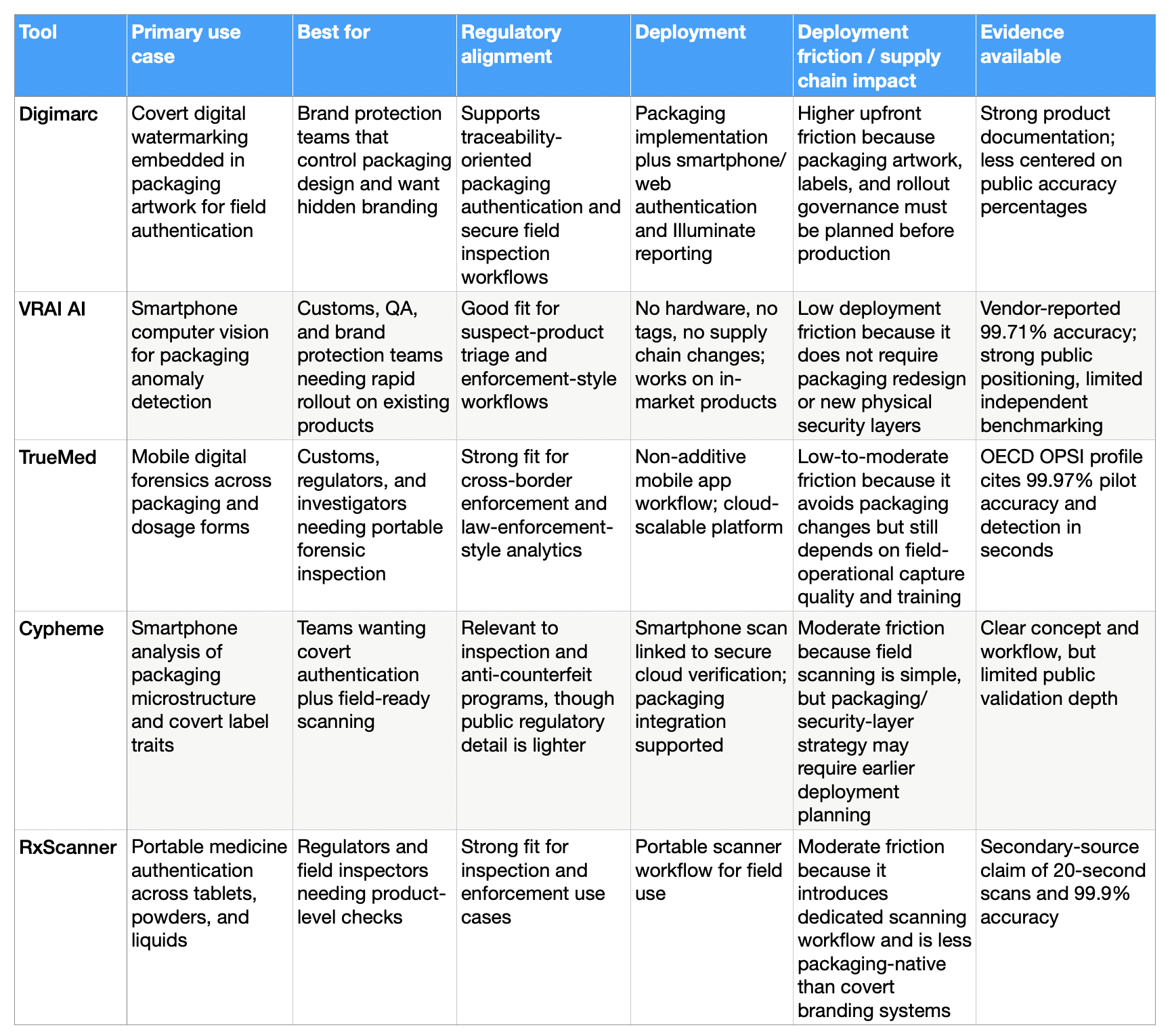
Table 1: Comparison of Top 5 AI Tools for Hidden Branding and Counterfeit Detection in Pharma
How to choose the right AI tool for counterfeit detection
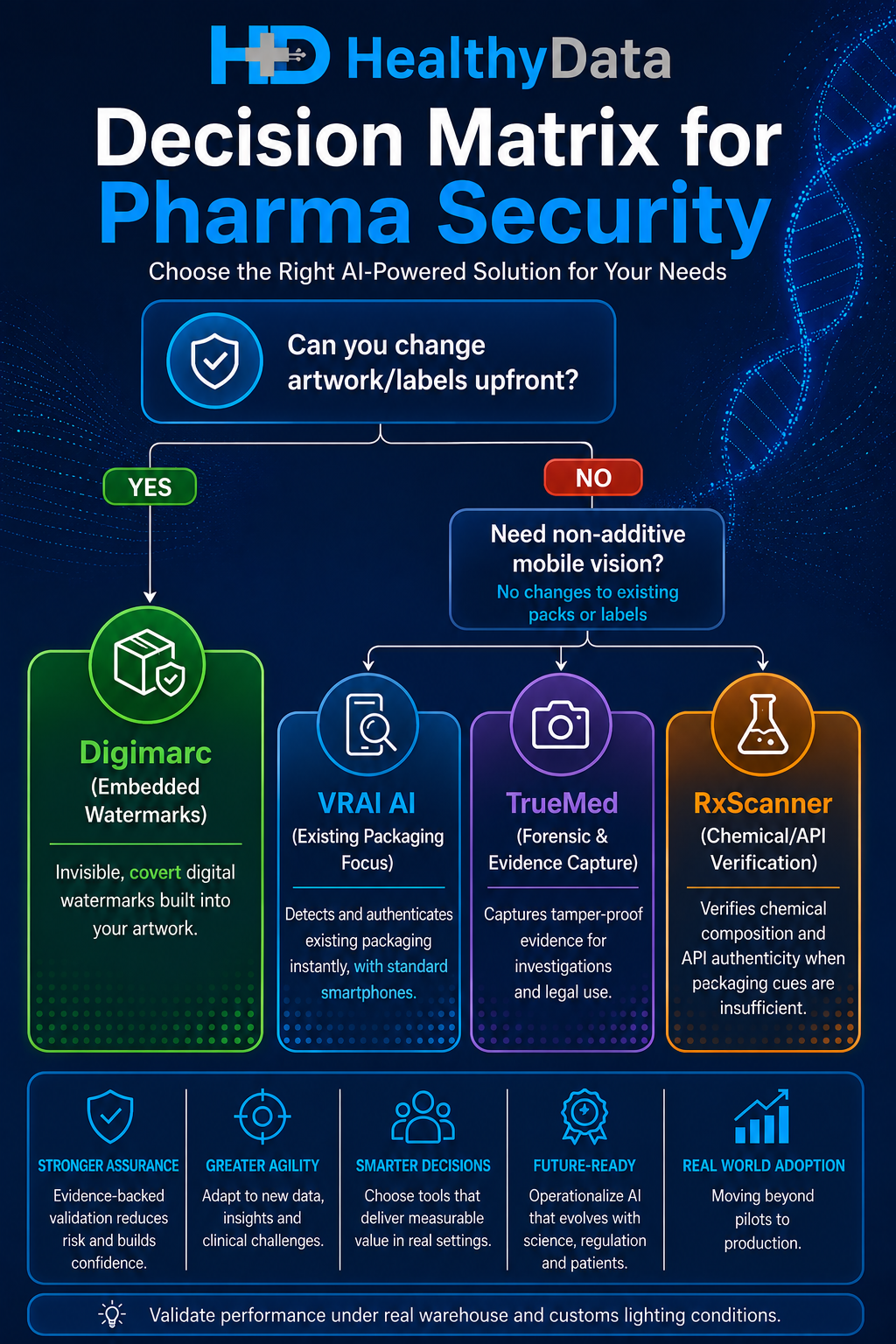
- Start with the additive versus non-additive distinction. Additive systems such as Digimarc require packaging or label changes upstream [3, 4], while non-additive systems such as VRAI AI and TrueMed are designed to inspect products already in market without introducing new package-level security elements [6, 7].
- Consider the regulatory effect of artwork or label changes. In the EU system, some packaging and labelling changes may need updated mock-ups, electronic submissions, or formal variation-related review depending on the nature of the change [9], so packaging-native security can create governance overhead even when it is operationally powerful [3, 9].
- Evaluate whether your main problem is copied packaging or suspect drug substance. The first four tools focus mainly on packaging, artwork, or surface-level authentication [3, 5, 6, 7], while RxScanner is more relevant when the packaging has already been compromised, removed, or cannot be trusted as the main inspection layer [8].
- Treat lighting, glare, and optical calibration as a core procurement criterion for all vision-based systems. Real-world logistics environments often include dim warehouses, shrink-wrap glare, uneven light, and reflective surfaces, all of which can impair camera-based verification unless the workflow and optics are validated under realistic conditions [7, 10].
- Match the tool to the evidence chain you need. FDA suspect and illegitimate product processes emphasise quarantine, investigation, and prompt notification [1], so tools that capture structured results and support escalation are more useful than tools that only provide a raw authenticity signal [1, 4, 7].
- Decide whether hidden branding or low-friction rollout matters more. Hidden-branding systems are harder for counterfeiters to see and copy [3, 5], but non-additive smartphone inspection tools may be easier to deploy quickly across legacy stock and multinational distribution nodes [6, 7].
- Validate every performance claim on your own SKUs, print vendors, substrates, and threat scenarios. Public figures such as 99.71 percent, 99.97 percent, or 99.9 percent are useful screening inputs [6, 7, 8], but they are not substitutes for product-specific qualification under your operating conditions [10].
FAQs on AI, drug safety, and counterfeit detection
Can multiple platforms be used together?
Yes. Many organisations will benefit from a layered model in which covert packaging security, smartphone inspection, and back-office investigation workflows complement rather than replace one another [3, 4, 7, 10]. A hidden-branding platform can make packaging harder to replicate [3, 5], while an AI vision platform can improve field triage speed on suspect product [6, 7].
How do regulators view field authentication tools?
Regulators generally care less about whether the detection layer is AI-based and more about whether suspect product can be quarantined, investigated, documented, and reported quickly and consistently [1, 2]. That means field tools are most credible when they support evidence capture and clear operational workflows rather than only delivering a yes-or-no screen [1, 4, 7].
Is smartphone-based detection enough on its own?
Sometimes, but not always. Smartphone-based tools can be highly effective for first-pass screening and field triage, especially when they avoid special hardware and operate at scale [6, 7], but higher-risk cases may still need escalation into formal investigation or lab-based confirmation workflows [2, 10].
Are hidden branding and serialization the same thing?
No. Hidden branding usually refers to covert authentication elements embedded in packaging or labels [3, 5], while serialization refers to traceability and unique identifiers used across the supply chain [1]. Some platforms, such as Digimarc, can support both covert watermarking and serialised or batch-level identifiers, but the functions are distinct [3, 4].
Which tool is best for customs or regulators?
Based on public positioning, TrueMed and RxScanner are the most inspection-oriented [7, 8], while VRAI AI is also highly relevant for customs-style smartphone screening on in-market products [6]. Digimarc is strongest when the organisation can influence packaging implementation and wants covert hidden-branding control embedded upstream in the packaging process [3, 4].
Ready to go deeper on AI counterfeit pharmaceutical detection options? Explore the full directory to compare more AI-powered counterfeit detection platforms, see detailed validation evidence, and benchmark your stack against other regulated healthcare and life sciences teams.
References
- U.S. Food and Drug Administration, “Drug Supply Chain Security Act (DSCSA) Law and Policies,” FDA, 2013–2026. Available: https://www.fda.gov/drugs/drug-supply-chain-security-act-dscsa/drug-supply-chain-security-act-law-and-policies
- U.S. Food and Drug Administration, “Drug Supply Chain Security Act (DSCSA),” FDA, 2013–2026. Available: https://www.fda.gov/drugs/drug-supply-chain-integrity/drug-supply-chain-security-act
- World Health Organization, “Substandard and falsified medical products,” WHO Fact Sheet, Dec. 2024. Available: https://www.who.int/news-room/fact-sheets/detail/substandard-and-falsified-medical-products
- Digimarc Corporation, “Anti-counterfeiting Solution: Product Authentication with Digital Watermarks,” Digimarc, accessed Aug. 2026. Available: https://www.digimarc.com/solutions/anticounterfeiting
- Digimarc Corporation, “Digimarc Launches New Brand Protection App to Combat Counterfeit Products,” press release, Oct. 29, 2024. Available: https://www.digimarc.com/news/press-releases/digimarc-launches-new-brand-protection-app-combat-counterfeit-products
- Cypheme, “AI-Driven Anti-Counterfeiting Using Packaging Microstructure Analysis,” Cypheme, accessed Aug. 2026. Available: https://www.cypheme.com
- Vrai AI, “Counterfeit Detection AI for Medicines,” Vrai AI, accessed Aug. 2026. Available: https://www.vrai.ai
- OECD Observatory of Public Sector Innovation, “Rapid, Optical and Global Detection Tool Against Counterfeits in Every Pocket (TrueMed),” OECD OPSI, 2022. Available: https://oecd-opsi.org/innovations/rapid-optical-and-global-detection-tool-against-counterfeits-in-every-pocket/
- European Medicines Agency, “Variations,” EMA Human Regulatory – Post-Authorisation, accessed Aug. 2026. Available: https://www.ema.europa.eu/en/human-regulatory/post-authorisation/variationseur-lex
- European Medicines Agency, “Changing the labelling and package leaflet (Article 61(3) Notifications),” EMA Post-Authorisation Guidance, accessed Aug. 2026. Available: https://www.ema.europa.eu/en/human-regulatory/post-authorisation/changing-labelling-and-package-leaflet-article-61-3-notificationsema.europa

Author: Stephen
Founder of HealthyData.Science · 20+ years in life sciences compliance & software validation · MSc in Data Science & Artificial Intelligence.
Follow HealthyData.Science on Google Search & AI
Get our latest healthcare and life science AI tool evaluations, regulatory updates, and buyer intelligence in your Google AI Overviews.
Add as Preferred Source