
Here’s the thing about compliance training: checking a box doesn’t mean anyone learned anything.
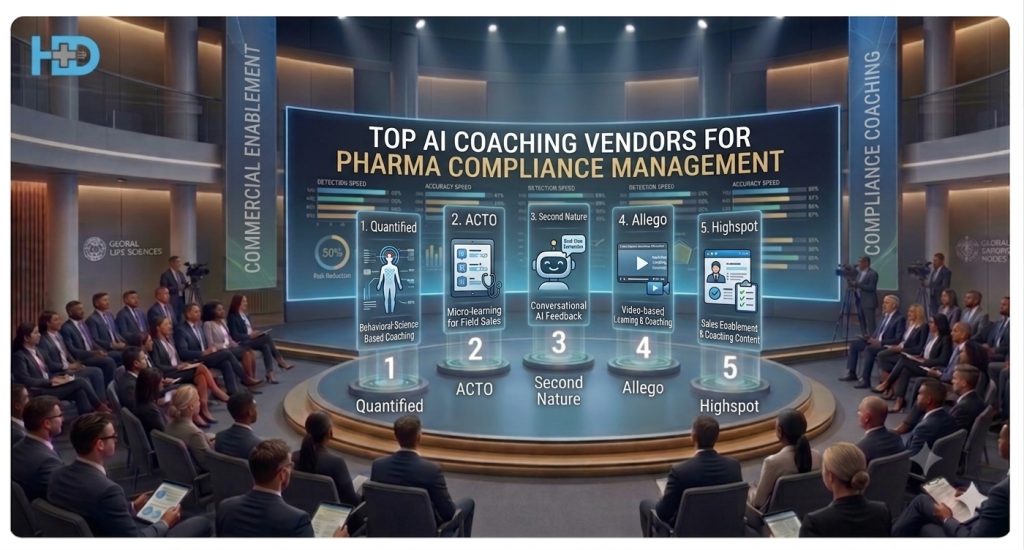
AI coaching can help commercial enablement, Medical Affairs, and sales-compliance leaders reinforce approved messaging, practise tough conversations, and catch coaching gaps before they turn into field-execution risks. Five tools stand out for different reasons: Quantified [7], ACTO [8], Second Nature [9], Allego, and Highspot [10], spanning AI role-play through to full life-sciences enablement and governed content delivery. Below is the breakdown, plus a comparison table if you just want the quick version.
Who This Guide Is For
The audience: Commercial pharma organisations. Think commercial enablement, field-force effectiveness, Medical Affairs, and sales-compliance teams.
The regulatory lens: Promotional compliance, medical commercial separation, approved-content use, controlled-message adoption, records governance, privacy, and applicable GxP principles wherever the intended use touches regulated training. Plus the relevant electronic-record controls [2, 6]. You’ll still need to confirm Part 11, Annex 11, or GxP suitability vendor by vendor, and use by use [2].
The real compliance problem? It’s not about proving reps or MSLs completed their assigned training. It’s about ensuring consistent, contextually appropriate use of approved messaging. Which is much harder to demonstrate [5].
IT reality check: Most orgs are running a best-of-breed setup, so expect possible connections into CRM, LMS, DAM/DMS, content-approval systems, eQMS, HRIS, identity providers, collaboration tools, analytics, and Medical Affairs platforms.
The governance baseline (non-negotiable): Anything below that isn’t tied to vendor documentation or public evidence should be treated as an assumption. Customer validation, supplier qualification, risk assessment, change control, and quality ownership are still on you, no matter how good the feature set looks [2, 4]. Research on AI in regulated healthcare keeps landing on the same themes: accountability, transparency, validation, governance [1, 3, 4, 6].
Why This Is Harder Than ‘Assign the Training’
Let’s be honest: annual certification modules and slide decks tell you someone opened a course. They don’t tell you whether that person can handle a probing HCP question, stay on the right side of the medical–commercial line, use the current approved claim, or know when to escalate [5]. That gap gets a lot more dangerous when messaging changes, safety info updates, a new indication launches, or local markets do things differently.
And the evidence trail is a mess more often than not. Learning records live in the LMS. Source material sits in a DAM or content platform. Approved claims are buried in an approval workflow. Call activity’s in the CRM. Observations and remediation live somewhere else entirely: QA, compliance, case management, take your pick. Good luck telling an isolated coaching issue apart from a systemic content, policy, manager-capability, or deployment problem when the data’s scattered like that.
Likely owners here: commercial compliance, sales training and enablement, Medical Affairs excellence, field leadership, regulatory and legal reviewers, infosec, enterprise IT. And, wherever the platform touches regulated training or controlled evidence, QA and validation too [2]. AI coaching can genuinely help with scenario-based practice, contextual knowledge checks, manager review, role-specific reinforcement, and spotting patterns [5]. What it shouldn’t do is replace approved procedures, qualified trainers, accountable SMEs, controlled content, formal training governance, or decisions made by the people authorised to make them [4].
That’s why interoperability matters so much. A standalone chatbot rarely earns its keep. What works is a governed coaching layer that stays inside approved-source boundaries and plays nicely with CRM, LMS, document and content management, HRIS, identity, analytics, and collaboration tools. Health and life-sciences AI governance literature says pretty much the same thing: define accountability, keep controls transparent, govern the data, and validate proportionate to intended use [1, 2, 4].
How to Choose an AI Coaching Tool for Pharma Compliance Management
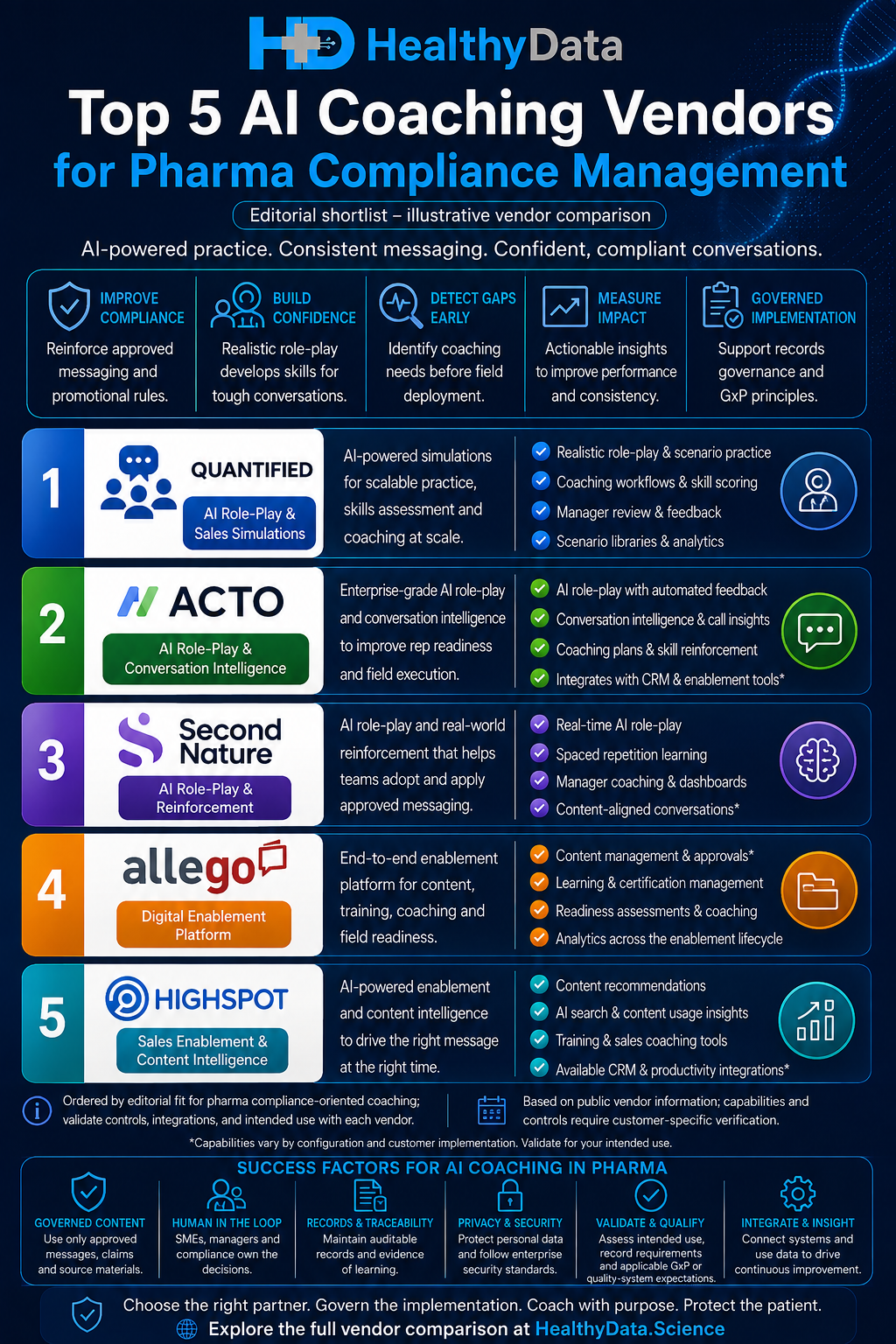
1. Quantified
Quantified is an AI-powered sales simulation and coaching platform built for commercial teams that want scalable practice and skills assessment [7]. For pharma compliance, the interesting angle is controlled practice. Approved messages, objection handling, escalation decisions, coaching workflows. All shaped by whatever content and governance the customer defines [7].
Healthcare/regulated use cases: Before treating this as pharma-specific, verify the publicly available material for confirmed pharmaceutical or life-sciences deployments [7]. A believable commercial-compliance use case is simulated practice of approved brand narratives and scenario escalation. But that’s an assumption unless the implementation runs on governed customer content and has been signed off by compliance stakeholders.
Coaching and learning model: It’s positioned around AI-driven simulation and practice [7]. Its real compliance value hinges on whether the scenarios, scoring rubrics, feedback criteria, and knowledge sources are built from approved material and reviewed by authorised commercial, medical, and compliance SMEs [2].
Evidence and compliance impact: No comparable public, vendor-independent numbers turned up for training completion, SOP adherence, audit readiness, error reduction, or time-to-competency in pharma settings [7]. Set your own baseline and measure post-implementation. Don’t infer compliance impact from the simulation alone.
Regulatory status: Don’t assume Part 11 support, Annex 11 alignment, GxP validation, or any life-sciences-specific certification [2, 7]. Ask for security documentation, data-processing terms, access controls, audit-log capability, retention policy, and supplier-assurance evidence during procurement [2].
Deployment and integrations: Enterprise deployment and integration details need vendor confirmation for your specific use case [7]. In a best-of-breed setup, you’d want SSO/identity, LMS learning and completion data, CRM context, approved-content repositories, and analytics near the top of the priority list. But treat these as implementation requirements, not confirmed integrations.
Best for: Commercial teams wanting to pilot AI role-play and coaching for field staff. Especially if the first goal is measuring skill gaps and boosting manager-led reinforcement, before this becomes part of formal compliance evidence [7].
Key limitation: The public evidence available doesn’t establish pharma-specific regulatory suitability or compliance outcomes [7]. Any AI-generated feedback still needs controlled-content governance and human review sitting on top of it [4].
2. ACTO
ACTO is a life-sciences-focused commercial learning and enablement platform built to support field-team readiness, content delivery, and coaching [8]. In pharma compliance management, it’s most useful where leaders want commercial and Medical Affairs enablement running closer to governed, role-specific workflows [5, 8].
Healthcare/regulated use cases: With its life-sciences positioning, the most relevant areas to dig into are commercial enablement, Medical Affairs training, product-launch prep, and field-force learning [5, 8]. Whether a given workflow actually supports promotional compliance, medical–commercial separation, or controlled training evidence still needs confirming within your intended-use and configuration scope [2].
Coaching and learning model: The relevant model here is structured enablement: learning, content access, field readiness, coaching processes, all tailored to life-sciences teams [8]. Confirm directly with the vendor what’s available in terms of AI coaching, simulations, adaptive learning, feedback controls, manager dashboards, and approved-source grounding [8].
Evidence and compliance impact: No listing-level dataset or independently comparable numbers were supplied for this article [8]. That absence doesn’t mean no impact. It means you should ask for outcome definitions, customer-reference context, measurement methods, and the boundaries of any vendor-reported results.
Regulatory status: Life-sciences market focus isn’t the same thing as Part 11 compliance, Annex 11 alignment, validated status, or GxP suitability [2, 8]. Push for documented security controls, privacy commitments, audit-trail capability, validation-support materials, data-residency options, supplier-quality evidence, and a clear line on where ACTO’s responsibility ends and yours begins [2].
Deployment and integrations: The commercial value here is strongest when the platform exchanges governed data with CRM, LMS, content/DAM systems, approval workflows, HRIS, and identity services [8]. Confirm integration availability, data ownership, interface validation, and change-control processes for every integration you’re proposing [2].
Best for: Commercial pharma and life-sciences organisations that want a vendor with explicit sector orientation, and a more unified field-enablement approach spanning learning, content, manager reinforcement, and readiness [8].
Key limitation: Life-sciences branding isn’t proof of suitability for every compliance use case [2, 8]. You’ll still need defined approved-content boundaries, role design, records retention, supplier oversight, and evidence that the configured workflow meets your actual training and compliance objectives [2, 4].
3. Second Nature
Second Nature provides AI-based role-play and conversation practice for go-to-market teams [9]. In a pharma context, think of it as a rehearsal and coaching layer for approved-message delivery, question handling, and escalation judgement. Not a system of record for regulated training [2, 9].
Healthcare/regulated use cases: Verify any pharmaceutical or Medical Affairs use cases before making sector-specific claims about this one [9]. Plausible uses include practising compliant product conversations, handling common objections without straying beyond approved content, and routing scientific or safety-related questions correctly [5]. But these are customer-governed use cases, not confirmed regulatory functions.
Coaching and learning model: The core proposition is AI role-play. Practise conversations, get feedback [9]. For pharma, the content model matters more than the simulation mechanics: prompts, expected responses, prohibited claims, escalation paths, and scoring all need to come from controlled, versioned source material [2].
Evidence and compliance impact: No reliable public numbers specific to pharma compliance: fewer promotion deviations, higher policy adherence, better audit readiness. Showed up in the available sources [9]. Don’t use generic sales-performance metrics as a stand-in for compliance effectiveness.
Regulatory status: No Part 11, Annex 11, GxP validation, or pharma-specific regulatory claim is assumed here [2, 9]. Assess privacy, security, model-data handling, retention, access logging, role permissions, and how easily you can export coaching evidence against your own risk profile [2, 6].
Deployment and integrations: A workable setup would need identity integration and a defensible interface into whatever system holds your approved learning and content data [9]. Whether LMS, CRM, collaboration, or content integrations exist. And whether they’re appropriate, needs validating during technical discovery.
Best for: Teams wanting fast conversational rehearsal for commercial roles and managers, particularly where content governance and a clear human escalation process get designed before deployment, not after [9].
Key limitation: Don’t assume the platform verifies scientific accuracy, promotional appropriateness, or regulatory compliance on its own [2, 9]. A simulation can surface capability gaps. It can’t replace medical, legal, regulatory, or quality review [4].
4. Allego
Allego is a sales-learning and enablement platform with conversational learning, content, and coaching features. For pharma compliance management, it’s worth evaluating for reinforcing approved-message use, manager coaching, and evidence-supported field readiness.
Healthcare/regulated use cases: Relevant applications include commercial onboarding, launch readiness, approved-message reinforcement, manager-led coaching, and knowledge reinforcement. Confirm life-sciences customer scope, specific Medical Affairs use cases, and any controlled-content or compliance-workflow support before folding this into a regulated training process [2].
Coaching and learning model: Allego’s positioning covers sales learning, content enablement, and coaching. Whether its AI features deliver simulations, role-play, automated feedback, searchable knowledge, or recommendation workflows. And how tightly those are controlled: needs confirming via demo and documented evaluation.
Evidence and compliance impact: No comparable quantitative outcome data was available for this article. Ask to see the definitions behind activity, participation, completion, proficiency, manager review, and performance metrics. Then decide which of those could credibly count as training-effectiveness or compliance-readiness evidence.
Regulatory status: General sales-enablement positioning doesn’t tell you anything conclusive about Part 11, Annex 11, or GxP validation [2]. Supplier assessment should cover security attestations, auditability, user access controls, data handling, service continuity, and support for your validation activities where relevant [2].
Deployment and integrations: Fit improves when it integrates with your LMS, CRM, SSO, approved-content environment, HRIS, and analytics stack. Fold these integration needs into architecture review, interface-risk assessment, and change-control planning [2].
Best for: Larger commercial organisations wanting learning, content enablement, and coaching considered together, while still treating dedicated quality, document-control, and compliance systems as the authoritative record.
Key limitation: Don’t presume an enablement platform independently meets formal regulated-training or record-retention needs [2]. You still have to define which records are authoritative, how they’re retained, who approves content, and how changes get reviewed [2, 4].
5. Highspot (Life Sciences Edition)
Highspot’s Life Sciences Edition is an enablement platform built for life-sciences commercial teams [10]. In pharma compliance management, its strongest contribution is governing access to current field-facing content, while supporting readiness and coaching around approved commercial materials [10].
Healthcare/regulated use cases: The life-sciences edition is relevant to commercial enablement and approved-content distribution for field organisations [10]. Verify its exact support for Medical Affairs, market access, sales-compliance workflows, content approval status, country-specific controls, and how it plays alongside your existing medical–legal–regulatory review systems [5, 10].
Coaching and learning model: Highspot is associated with enablement and content-led readiness [10]. Confirm the availability, boundaries, and governance of AI assistance, coaching, guided selling, learning assignments, role-play, knowledge checks, or manager analysis in the specific edition you’re evaluating [10].
Evidence and compliance impact: No directory statistics were supplied for this article, and no specific compliance outcome numbers are asserted here [10]. Content and learning analytics being available doesn’t, by itself, prove personnel understand policy or apply approved messages correctly in live interactions.
Regulatory status: A life-sciences-specific edition isn’t proof of Part 11 compliance, Annex 11 alignment, validation, or overall promotional-compliance sufficiency [2, 10]. Confirm customer responsibilities, audit logs, permissions, content version control, export options, privacy terms, and security evidence through the vendor’s formal documentation [2, 6].
Deployment and integrations: The strongest best-of-breed fit connects enablement to CRM, LMS, DAM/DMS, SSO, collaboration tools, and reporting. All while preserving controlled-content status and traceability [10]. Integration availability, configuration scope, and interface controls need vendor confirmation.
Best for: Commercial pharma organisations with a large or distributed field organisation that need current, governed enablement content, practical field readiness, and a coherent experience across commercial roles [10].
Key limitation: Content governance, promotional review, learning-record requirements, and QA oversight don’t just disappear because content is easier to find or coaching is AI-assisted [2, 4]. Public information needs supplementing with real supplier qualification and intended-use review [2].
What the Numbers Say
The five platforms in this guide are not ranked by user adoption. Our review did not establish comparable, dated life-sciences user counts across all five vendors; the list instead compares their use cases, capabilities and available evidence.
Short answer: not much, yet. Our review did not identify a comparable public dataset covering all five vendors for life-sciences user adoption, time-to-competency or compliance outcomes. Available figures should be assessed individually for their date, population, measurement method and relevance to the intended use. Which rules out a defensible ranking on time-to-competency, training completion, policy adoption, inspection readiness, or deviation prevention [7, 8, 9, 10].
And a commercial-performance metric shouldn’t be treated as proof of compliance effectiveness without a defined measurement methodology and real quality oversight behind it [2, 4].
Deployment time? Same story .No verified cross-vendor stat. Go-live speed depends on content readiness, integration scope, jurisdictional requirements, data privacy review, identity design, user acceptance testing, validation expectations, and how much change-management capacity you actually have [2, 6].
No common, verified count of languages, integrations, regulated customers, or supported users turned up either [7, 8, 9, 10]. Ask each vendor for current, scoped evidence. And test whether it actually applies to your commercial or Medical Affairs workflow, not some other industry or product module entirely [5].
The one thing that does hold up: these tools aren’t all playing the same game. ACTO and Highspot lean explicitly life-sciences [8, 10]. The rest are better evaluated as AI role-play or broader sales-enablement layers [7, 9]. Every single one still needs customer-specific governance layered on top [1, 2, 4, 6].
Table 1: AI-Enabled Field Enablement Platforms: Compliance, Deployment, and Evidence Review
How to Choose
Nail down intended use and the regulatory boundary first. Is this for informal skill practice, formal training, controlled-content reinforcement, assessment, coaching documentation, or compliance evidence? Tie the answer to your approved SOPs, commercial conduct policies, training matrices, role profiles, and learning-governance model [2, 4].
Stress-test the controlled-content boundaries. Which documents, claims libraries, playbooks, product information, and escalation guidance are allowed in? Who approves them? How are versions tracked, and how does retired material actually get removed? Get a documented approach to source authority, change control, and prohibited-content management before you sign anything [2, 4].
Assess privacy, security, access, and AI governance properly. Review data classifications, user roles, least-privilege design, authentication, audit trails, retention, deletion, training-data use, model-output controls, incident processes, and supplier commitments [2, 6]. Good AI governance means accountable owners, clear boundaries on automated feedback, human review requirements, and real escalation pathways. The health-AI governance literature keeps saying this for a reason [1, 3, 4, 6].
Map the architecture before you procure anything. Figure out the actual systems of record for training assignments, completions, competency decisions, approved content, field activity, and quality actions. Then evaluate the real (not assumed) interfaces to eQMS, LMS, DMS/DAM, HRIS, CRM, MES, LIMS, ERP, clinical and safety systems, ITSM, collaboration tools, analytics platforms, and identity providers [2].
Fit the platform to your actual organisation. User population, countries, languages, local-market controls, device access, manager capacity, content maturity, budget, implementation support, change-management readiness. A capability-rich tool won’t save you if the content, ownership, and field-coaching processes underneath it are still a mess.
Use your own risk history to build scenarios. Look at recurring audit observations, monitoring findings, deviations, CAPAs, nonconformances, retraining triggers, off-label risk patterns, and common field questions [2, 4]. Turn the lessons you’ve already learned into scenarios, rubrics, escalation pathways, and targeted reinforcement. Not generic scripts that have nothing to do with your actual risk.
Validate, monitor, and keep evidence that actually means something. Risk assessments, supplier assessments, validation plans where required, acceptance criteria, test records, model-output review procedures, periodic performance review, change management, retrievable evidence. Track completion alongside scenario performance, manager review, remediation, current-content acknowledgement, and links back to the controlled procedures that define what “acceptable” actually looks like [2, 4].
FAQs
Can pharma companies use AI coaching alongside an existing eQMS and LMS? Yes. AI coaching can run as an enablement or practice layer while the eQMS, LMS, and controlled-document environment keep their defined system-of-record roles [2]. Just be clear about which platform owns assignments, approved content, assessment evidence, retraining, exceptions, and audit-trail retention [2].
Can an AI coaching tool provide regulated training records on its own? It might contribute records, but don’t assume it satisfies formal regulated-training requirements by itself [2]. That depends on intended use, applicable regulations, electronic-record controls, validation evidence, procedural governance, retention, access controls, and your own quality-system design [2, 6].
How should QA govern AI-generated answers or coaching recommendations? QA, commercial compliance, and designated SMEs need to approve the platform’s permitted content sources, scoring logic, escalation rules, output-use boundaries, and monitoring plan [2, 4]. No uncontrolled substitution of AI output for approved procedures or medical, legal, regulatory, and quality decisions. Full stop [4].
How do auditors view cloud-based AI coaching tools? Cloud delivery isn’t a problem on its own. What auditors and inspectors actually care about is whether you can demonstrate supplier oversight, security, access control, data integrity, record retention, auditability, change management, a clear intended-use definition, and risk-based validation appropriate to the system’s role [1, 2, 6].
Does AI coaching replace SOP training, qualified trainers, or subject-matter experts? No. It can make practice more frequent and more role-specific, but it doesn’t replace approved SOPs, controlled learning, qualified trainers, or accountable SMEs [4]. It works best when it’s reinforcing and testing application of approved material. Not generating unreviewed policy or scientific guidance [4, 5].
What evidence should a company retain to show AI-supported training is effective? Approved training design, source-content versions, role profiles, training assignments, completion records, assessments, scenario rubrics, manager reviews, remediation actions, periodic effectiveness reviews, change records, and relevant audit trails [2, 4]. Link it all back to real risk themes: audit observations, CAPAs, field-monitoring findings, retraining triggers. Wherever it applies [2].
Can multiple platforms be used for QMS, document control, learning, and AI coaching? Yes. A best-of-breed stack works fine when responsibilities are spelt out clearly. Define authoritative sources, content versioning, identity and permissions, interface ownership, data transfer controls, retention, reconciliation, and change control, so users and auditors alike can actually trace how evidence moves across systems [2].
Which vendor is best for pharma compliance management?
Based on public positioning, Quantified and ACTO are the most life-sciences-specific choices for teams prioritising compliant field readiness, certification, coaching, and messaging consistency. Quantified is particularly relevant for AI practice scenarios and compliance-scored commercial rehearsal, while ACTO is a broader field-excellence platform spanning Commercial and Medical Affairs workflows. Highspot Life Sciences Edition is a strong fit for organisations focused on governed content enablement across distributed field teams. Second Nature and Allego can be valuable for scalable role-play, coaching, and reinforcement, but buyers should validate their pharma-specific controls, auditability, integrations, and approved-content workflows during procurement.
Ready to explore more AI platforms for pharmaceutical commercial enablement? Browse the full HealthyData.Science directory to compare AI-powered field enablement, coaching, and analytics tools, review available validation evidence, and benchmark your stack against other regulated healthcare and life-sciences teams.
References
- M. R. F. de Andrade et al., “Global Regulatory Frameworks for the Use of Artificial Intelligence (AI) in the Healthcare Services Sector,” Healthcare, vol. 12, no. 5, Art. no. 562, 2024.
- D. C. Higgins and C. Johner, “Validation of Artificial Intelligence Containing Products Across the Regulated Healthcare Industries,” Therapeutic Innovation & Regulatory Science, vol. 57, pp. 797–809, 2023.
- F. Brandl et al., “Artificial Intelligence Integration in the Drug Lifecycle and in Regulatory Science: Policy Implications, Challenges and Opportunities,” Frontiers in Pharmacology, vol. 15, 2024.
- R. D. Agrawal et al., “Implementing Quality Management Systems to Close the AI Translation Gap and Facilitate Safe, Ethical, and Effective Health AI Solutions,” npj Digital Medicine, vol. 6, Art. no. 218, 2023.
- E. Fröling et al., “Artificial Intelligence in Medical Affairs: A New Paradigm with Novel Opportunities,” Pharmaceutical Medicine, vol. 38, no. 5, pp. 331–342, 2024.
- M. R. F. de Andrade et al., “Gaps in the Global Regulatory Frameworks for the Use of Artificial Intelligence (AI) in the Healthcare Services Sector and Key Recommendations,” Healthcare, vol. 12, no. 17, Art. no. 1730, 2024.
- Quantified, “AI Sales Coaching & Roleplay Platform for Life Sciences,” vendor website. Accessed Aug. 23, 2026.
- ACTO, “Life Sciences Intelligent Field Excellence Platform,” vendor website. Accessed Aug. 23, 2026.
- Second Nature, “AI Role Play Sales Training Software,” vendor website. Accessed Aug. 23, 2026.
- Highspot, “Life Sciences Enablement,” vendor website. Accessed Aug. 23, 2026.

Author: Stephen
Founder of HealthyData.Science · 20+ years in life sciences compliance & software validation · MSc in Data Science & Artificial Intelligence.
Follow HealthyData.Science on Google Search & AI
Get our latest healthcare and life science AI tool evaluations, regulatory updates, and buyer intelligence in your Google AI Overviews.
Add as Preferred Source