
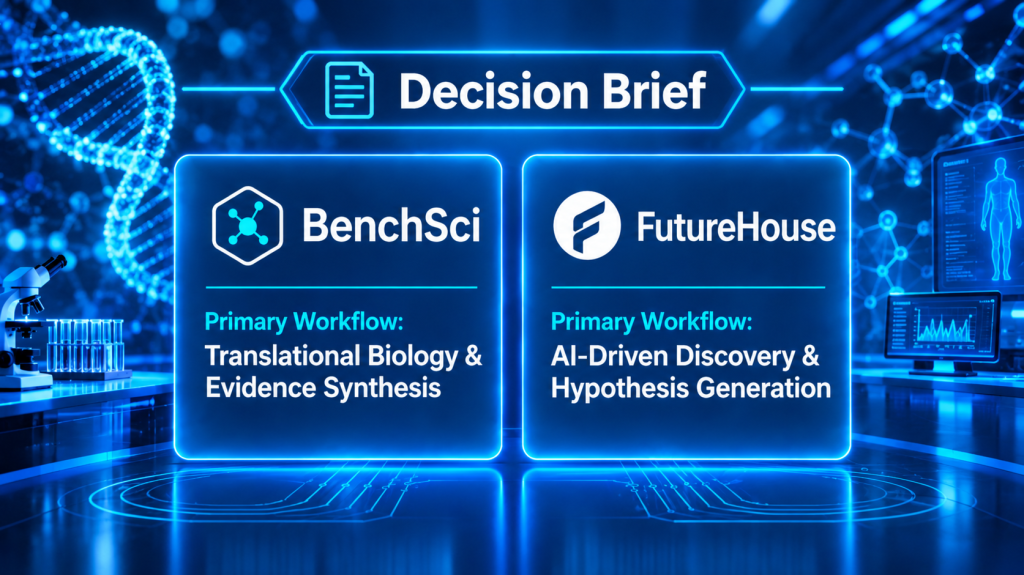
Executive Verdict
BenchSci is optimal for bridging biology to patient relevance when the objective is to produce traceable, enterprise-ready translational evidence that links disease mechanisms, biomarkers, genetic evidence, safety signals, clinical-trial context, and an organization’s internal data, while FutureHouse is preferred for exploratory, hypothesis-led research programs that need to generate and experimentally iterate on novel biological mechanisms. For a biopharma R&D organization making portfolio, biomarker, indication-expansion, or patient-stratification decisions, BenchSci is the the better fit for these translational workflows, based on the documented capabilities reviewed. Because its platform is specifically configured for translational and biomarker workflows, governed internal-data integration, and reproducible evidence synthesis.[1]
Critical Domain Insight
“Translational / Biomarker [workflows] identify biomarker candidates and companion diagnostics to derisk translation.” [1]
The operational implication is clear: bridging a laboratory mechanism to patient relevance requires more than generating a plausible hypothesis. It requires integrating human genetic, clinical, biomarker, safety, and disease-context evidence into a defensible program rationale.
Table 1: Workflow & Capability Snapshot
| Parameter | BenchSci | FutureHouse |
|---|---|---|
| Primary Workflow Target | Enterprise preclinical, translational, biomarker, safety, and regulatory evidence workflows | AI-assisted scientific discovery, hypothesis generation, experiment planning, and data analysis |
| Typical Data Inputs | Publications, patents, omics, clinical trials, ontologies, reagent/model data, and proprietary internal biopharma data | Scientific literature, user-provided experimental data, and iterative laboratory results |
| Fit for Bridging Biology to Patient Relevance | High: supports biomarkers, companion diagnostics, causal evidence, indication strategy, clinical context, and safety framing | Moderate: strong for discovering or testing a biological mechanism, but patient-translation workflows are less explicit |
| Regulatory & Integration Depth | BenchSci reports enterprise governance, internal-data integration, and customizable workflows; its regulatory workflows are described as assembling preclinical evidence packages and “submission-ready documentation | Open-source/research-oriented multi-agent workflow; physical experiments remain human-executed |
| Best Use Case | Evidence-backed target, biomarker, and indication decisions that must withstand portfolio governance | Generating unconventional therapeutic hypotheses and rapidly designing experimental validation cycles |
| Primary Limitation | Commercial enterprise deployment and platform claims should be independently qualified during procurement | Limited demonstrated focus on regulated, organization-wide translational evidence governance |
Note: Regulatory capabilities are vendor-described. “Submission-ready documentation” should not be interpreted as independent confirmation of regulatory acceptance or validated compliance.
BenchSci reports a scientific knowledge layer comprising 38 million publications, 16 million closed-access papers, more than 80 omics databases, 100 million ontological entities/relationships, and 2.2 billion relationship edges; it also states that internal datasets can be incorporated into the reasoning layer. FutureHouse’s Robin demonstrated an end-to-end workflow that generated hypotheses, proposed RNA-seq experiments, analyzed experimental data, and identified ripasudil as a candidate for dry age-related macular degeneration; human researchers executed the wet-lab work.[2]
Specific Pros & Cons
BenchSci
Pros
Connects mechanistic biology to translational decision inputs: biomarker candidates, companion-diagnostic strategy, genetic causality, patient-population estimates, clinical-trial evidence, and safety context.[1][2]
Integrates proprietary internal datasets with external evidence, enabling program-specific rather than literature-only assessment of biological validity and patient relevance.[1] [2]
BenchSci states that its platform supports governance-heavy outputs, including preclinical evidence packages and “submission-ready documentation.”[1][2]
Cons
Its core strength is evidence synthesis and translational reasoning, not autonomous generation of entirely novel experimental research programs.
Reported data scale and performance figures are vendor-provided; procurement teams should validate coverage, source licensing, audit trails, and benchmark relevance against their therapeutic-area workflows.
FutureHouse
Pros
Demonstrates a tightly coupled discovery loop: literature review, candidate prioritization, experimental design, experimental-data analysis, and follow-up hypothesis generation.[3]
Can surface non-obvious mechanistic hypotheses; Robin identified a potential role for ROCK inhibition and RPE phagocytosis in dry AMD, then supported iterative testing of candidate compounds.[3]
Its open-source Robin code supports technical inspection, reproducibility experiments, and internal adaptation by organisations with substantial computational-science capabilities.[3]
Cons
The demonstrated workflow is principally preclinical; it does not establish an equivalent enterprise platform for systematic biomarker, patient segmentation, clinical-development, or regulated evidence-package workflows.
Human researchers still execute laboratory experiments, so value realization depends on lab capacity, experimental quality, and a mature human-in-the-loop validation process.[3]
Decision Rule for R&D Teams
Choose BenchSci when the decision must explicitly connect a target or mechanism to human genetic evidence, biomarkers, patient subgroups, clinical precedent, safety, and internal program data. And the output will influence an indication, biomarker, or portfolio-governance decision.
Choose FutureHouse when the primary trigger is a high-uncertainty discovery problem. Especially one that requires novel hypothesis generation and iterative experiment design. Before patient-relevance evidence becomes the dominant decision criterion.
HealthyData Directory Links
BenchSci: translational biology and biopharma R&D intelligence profile
- Explore AI for Scientific Research
Primary References
BenchSci. “Platform: EMET.” BenchSci. Available: https://www.benchsci.com/platform.
BenchSci. “Translational.” BenchSci. Available: https://www.benchsci.com/solutions/translational.
FutureHouse. “Demonstrating end-to-end scientific discovery with Robin, a multi-agent system.” FutureHouse, May 19, 2026. Available: https://www.futurehouse.org/research/demonstrating-end-to-end-scientific-discovery-with-robin-a-multi-agent-system

Author: Stephen
Founder of HealthyData.Science · 20+ years in life sciences compliance & software validation · MSc in Data Science & Artificial Intelligence.
Follow HealthyData.Science on LinkedIn
Get concise decision briefings, vendor comparisons, and regulatory AI updates for healthcare and life sciences teams.
Follow HealthyData.Science on Google Search & AI
Get our latest healthcare and life science AI tool evaluations, regulatory updates, and buyer intelligence in your Google AI Overviews.
Add as Preferred Source