
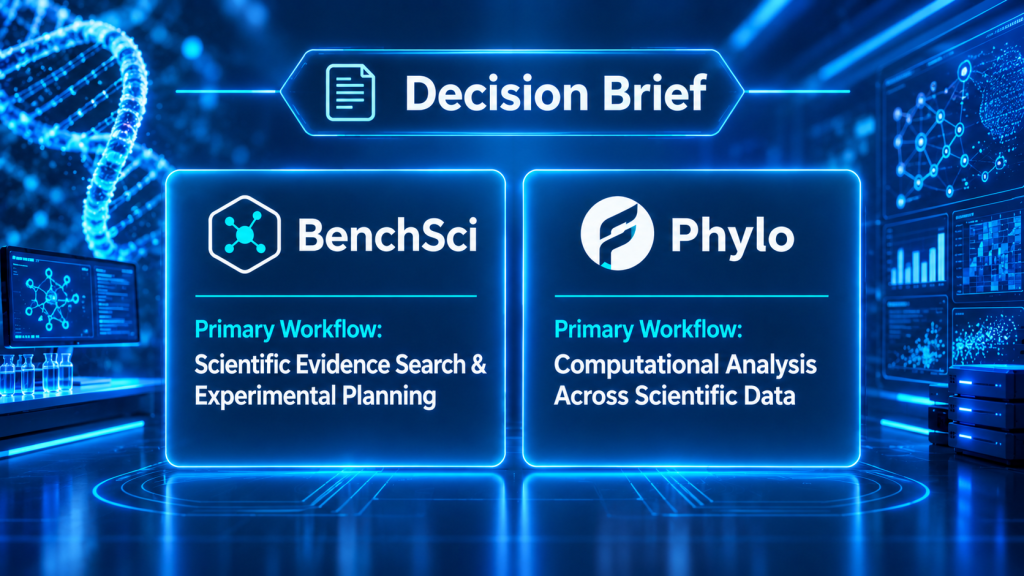
Executive Verdict
Phylo is optimal for running computational analysis across scientific data when the requirement is to execute, inspect, and iterate bioinformatics or multi-omics workflows on datasets, while BenchSci is preferred for preclinical evidence synthesis, target due diligence, and selecting validated experimental approaches from a structured biomedical knowledge base. For the stated task, Phylo wins because Biomni Lab is designed to plan and run analyses, generate visualizations and reports, and preserve code, methods, source references, and execution details [1], [2]; BenchSci ASCEND is principally an evidence and decision-support environment rather than a general-purpose computational-analysis workbench [3].
Critical Domain Insight
“Biomni Lab provides AI for bioinformatics workflows spanning genomics, transcriptomics, proteomics, single-cell data, spatial biology, and other biomedical data modalities. It can help researchers plan and execute computational analyses, work with datasets, interpret results, create visualizations, and generate reports while preserving the code, sources, and execution details behind the work.” [1]
For a biopharma R&D leader, the distinction is operational: use Phylo where the bottleneck is transforming a research dataset into an inspectable analytical output, and use BenchSci where the bottleneck is establishing the biological evidence and experimental rationale before analysis begins [1], [3].
Table 1: Workflow & Capability Snapshot
| Parameter | BenchSci | Phylo |
| Primary Workflow Target | Preclinical disease-biology evidence synthesis, target due diligence, experimental strategy, and reagent/model selection [3] | Computational biology, bioinformatics, multi-omics analysis, scientific interpretation, and research-workflow execution [1] |
| Typical Data Inputs | Publications, preprints, clinical-trial records, patents, curated third-party sources, internal experimental data, and biological knowledge-graph entities [3] | User datasets and common biomedical file formats, scientific literature, biological databases, software tools, and proprietary enterprise research data [1], [2] |
| Fit for Running Computational Analysis Across Scientific Data | Limited for direct dataset computation; strongest for contextualizing targets, pathways, disease mechanisms, risks, and experimental evidence [3] | Stronger fit; supports planning and executing analyses across genomics, transcriptomics, proteomics, single-cell data, and spatial biology [1] |
| Regulatory & Integration Depth | Enterprise licensing and custom-integration support are described; public materials do not establish clinical regulatory clearance for ASCEND [3], [4] | Enterprise option includes dedicated infrastructure, SSO, audit logs, RBAC, custom agents, and proprietary-data integration; SOC 2 and ISO certifications are stated as in progress [2] |
| Best Use Case | Evidence-backed target prioritization, experiment design, reagent selection, and preclinical scientific due diligence [3] | Exploratory and repeatable biological-data analysis, code-linked interpretation, visualization, and report generation [1] |
| Primary Limitation | Public documentation emphasizes evidence retrieval and knowledge-graph workflows rather than executing user-supplied omics or bioinformatics pipelines [3] | Research-preview product; users are advised to validate outputs and review methods, while computation capacity and integrations can vary by plan [2] |
BenchSci states that ASCEND’s biomedical experiment-focused dataset contains more than 30 million publications, preprints, clinical trials, and patents, with ontological libraries containing more than 100 million entities and relationships [3]. Phylo states that Biomni Lab supports 120+ software packages, 70+ databases, and 190+ specialized tools, with 16 CPU cores, shared auto-scaling 1 TB memory, and high-performance-computing access for specialized workloads; these are vendor-reported specifications [2].
Specific Pros & Cons
BenchSci
Pro: Its Biological Evidence Knowledge Graph is well suited to grounding computational-analysis questions in disease biology, experimental literature, pathways, and target-to-disease evidence [3].
Pro: Multi-Target Analysis can triage lists of up to 1,000 targets within an evidence-defined context, useful before committing resources to downstream computational work [3].
Pro: Specialized workflow tools support preclinical due diligence, risk and causality assessment, experimental design, validation, and structured reporting [3].
Con: Available documentation does not present ASCEND as an environment for executing an end-to-end RNA-seq, single-cell, proteomics, or spatial-biology pipeline on uploaded scientific data [3].
Con: Enterprise access is selectively licensed, and product access may depend on an organisational agreement with BenchSci [3], [4].
Phylo
Pro: Biomni Lab is explicitly designed to help scientists plan and execute computational analyses across genomics, transcriptomics, proteomics, single-cell data, and spatial biology [1].
Pro: It preserves the code, methods, tools, citations, and execution details used in an analysis, enabling scientists to inspect and reproduce AI-assisted outputs [1], [2].
Pro: The platform offers dedicated computational resources: 16 CPU cores, shared auto-scaling 1 TB memory, and HPC connectivity for specialised models and bioinformatics software [2].
Con: Biomni Lab remains in research preview, meaning a cautious R&D organization should establish internal acceptance criteria, validation procedures, and output-review requirements before using results in consequential decisions [2].
Con: Phylo advises users to validate results and use its review function to identify potential hallucinations, scientific-reasoning errors, statistical inconsistencies, and code issues [2].
Decision Rule for R&D Teams
Choose Phylo when the team must analyse its own scientific datasets. For example, differential expression, variant annotation, single-cell analysis, multi-omics interpretation, or visualisation. And needs a code, and execution, traceable workflow rather than only a literature-derived answer [1], [2].
Choose BenchSci when the key decision is which target, pathway, model, reagent, or experiment merits investment, particularly when the workflow depends on systematically navigating published and internal preclinical evidence rather than computationally processing a dataset [3].
HealthyData.Science Directory Links
References
[1] Phylo, “Biomni Lab: AI for Biology, Genomics & Drug Discovery,” 2026. [Online]. Available: https://phylo.bio/biomni.
[2] Phylo, “Biomni Lab Frequently Asked Questions,” 2026. [Online]. Available: https://phylo.bio/faq.
[3] BenchSci, “Overview of ASCEND by BenchSci Platform,” 2025. [Online]. Available: https://knowledge.sanofi.benchsci.com/home/platform-overview.
[4] BenchSci, “BenchSci Announces Three-Year License Agreement with Sanofi to Access and Use ASCEND,” Oct. 8, 2025. [Online]. Available: https://www.benchsci.com/news/benchsci-announces-three-year-license-agreement-with-sanofi-to-access-and-use-benchsci-s-ascend

Author: Stephen
Founder of HealthyData.Science · 20+ years in life sciences compliance & software validation · MSc in Data Science & Artificial Intelligence.
Follow HealthyData.Science on Google Search & AI
Get our latest healthcare and life science AI tool evaluations, regulatory updates, and buyer intelligence in your Google AI Overviews.
Add as Preferred Source