
Executive Assessment
Genpact Cora appears to be a credible enterprise option for pharmaceutical and biotechnology organisations seeking AI-enabled pharmacovigilance automation, regulatory-process support, and broader operational transformation. Particularly where the buyer also values Genpact’s managed-services, process-design, and domain-expertise model [1]. Its strongest fit is not as a standalone clinical AI application or safety database, but as a configurable combination of automation, data, AI, workflow orchestration, and professional services applied to high-volume business processes [1].
For drug-safety teams, the relevant Cora/PVAI proposition centres on extracting and structuring adverse-event information from unstructured sources, supporting case-intake and coding workflows, and helping safety teams identify emerging patterns across large data volumes [1], [4]. Public materials describe the use of natural-language processing, optical character recognition, robotic process automation, and machine learning in these workflows [5].
The main buyer caution is that “Genpact Cora” is a broad enterprise AI and automation brand, rather than one consistently defined, self-contained life-sciences product [1]. Procurement teams should define the required workflow precisely, such as ICSR intake, literature surveillance, regulatory intelligence, health-authority responses, RIM analytics, or supply-transfer planning. Then obtain product-specific evidence on functionality, deployment architecture, integrations, validation, support responsibilities, performance measures, and commercial scope [1], [3].
What the Platform Is
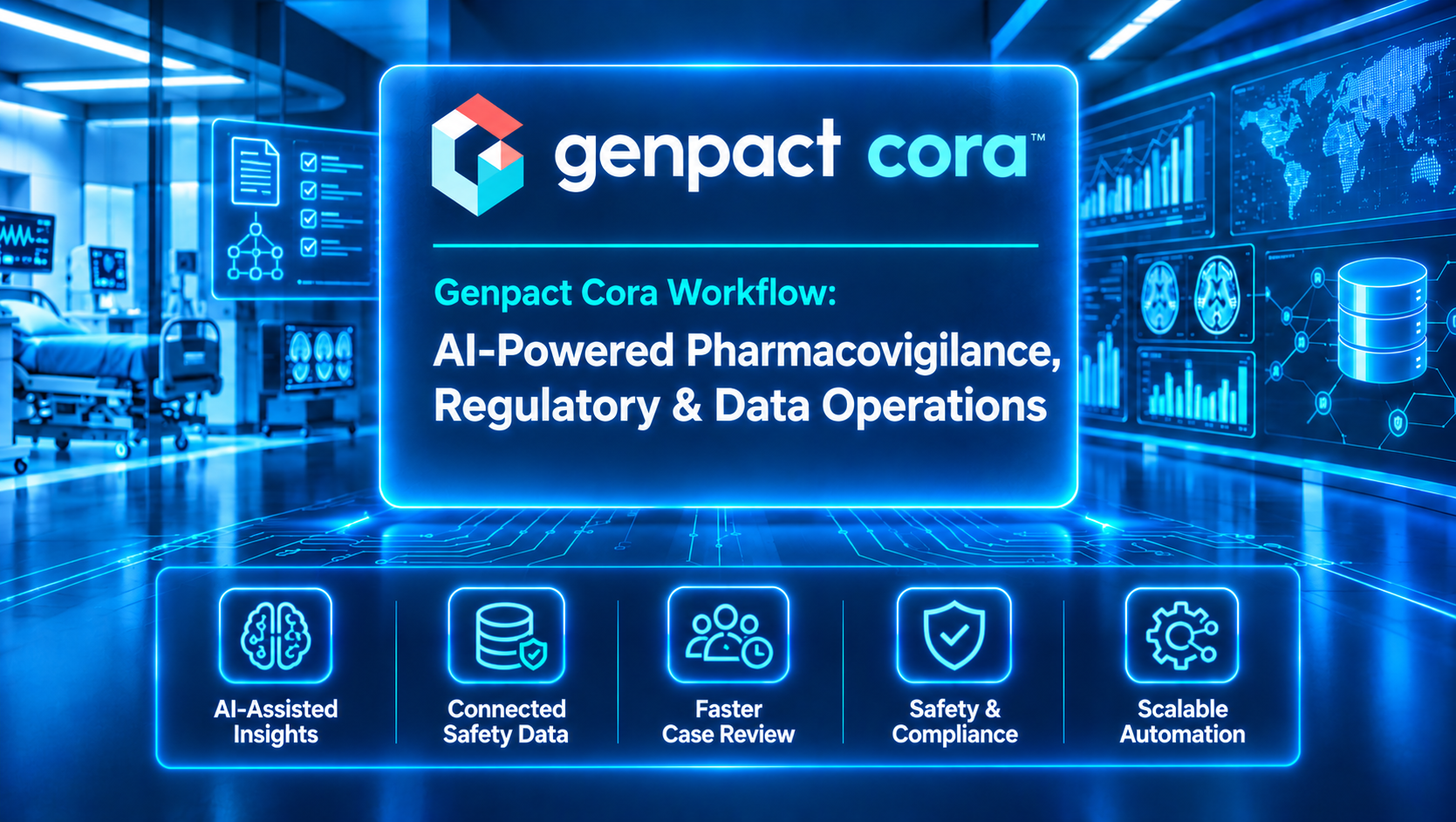
Genpact Cora was introduced as an AI-based, modular enterprise platform combining automation, analytics, AI, cloud services, workflow capabilities, and open-architecture integrations [1]. Genpact’s original description grouped its technology into a digital core, data analytics, and artificial intelligence capabilities, including conversational AI, computational linguistics, computer vision, machine learning, and data science [1].
In life sciences, Genpact positions its offering around operational transformation using AI, process intelligence, data, and industry expertise [3]. Its public life-sciences materials cover pharmaceutical and medtech workflows, including regulatory operations, medical affairs, commercial analytics, IT operations, supply-chain activities, and broader business-process services [3].
The Genpact Cora name is associated with several distinct solutions and operational applications rather than a single universal user interface [1], [3]. Relevant life-sciences capabilities publicly identified by Genpact include:
Cora PharmacoVigilance / PVAI: Focused on AI-enabled patient-safety and pharmacovigilance processes, including extraction and analysis of safety data [1], [4].
Cora RegAssure: A cloud-based solution for submission planning, tracking, labelling, and compliance-programme management [3].
Cora RegIntel: An AI-powered regulatory-intelligence solution that gathers, captures, summarises, and categorises health-authority requirements and updates [3].
Health Agency Q&A: Describes using generative AI and natural-language processing to automate or accelerate responses to health-authority enquiries [3].
RIM Business Intelligence Hub: Generates insights from regulatory-information-management data, including regulatory status, volume patterns, and health-authority questions [3].
Workflow Fit
For pharmacovigilance teams, Genpact Cora is most relevant when the operating challenge is high-volume manual handling of safety information from sources such as call-centre transcripts, literature, social media, healthcare-professional reports, faxes, scanned documents, or other structured and unstructured inputs [1], [4]. The intended outcome is to transform those inputs into structured information for case-processing, coding, reporting, review, and safety-signal workflows [1], [4].
The platform may be particularly relevant where an organisation needs to modernise a process rather than merely purchase a software seat [1], [3]. Genpact’s model combines technology with domain and operational services, so its practical value may depend on process redesign, implementation support, data preparation, workflow standardisation, human review, and ongoing operations [1], [3]. That may suit global pharmaceutical companies with complex legacy environments, but can increase implementation and governance complexity compared with a narrowly scoped SaaS tool [1], [3].
For regulatory organisations, Cora-related solutions appear more relevant to submission planning, labelling, compliance activities, regulatory intelligence, health-authority engagement, and RIM reporting than to authoring a complete end-to-end regulatory dossier without associated process and systems integration [3]. Genpact states that Cora RegIntel gathers global health-authority requirements and automatically captures, summarises, and categorises updates, while Health Agency Q&A applies generative AI and NLP to health-authority responses [3].
Table 1: Capability Snapshot
| Evaluation Parameter | Assessment |
| Primary workflow target | Enterprise pharmacovigilance operations, adverse-event case processing, safety-data extraction, regulatory-process support, regulatory intelligence, RIM analytics, and life-sciences operational transformation [1], [3]. |
| Relevant data inputs | Adverse-event narratives, call-centre material, medical literature, social-media content, healthcare-professional reports, scanned documents, regulatory requirements, RIM data, labelling information, and submission-planning data [1], [3]. |
| Core outputs | Structured safety-case information, coding and case-processing support, regulatory reports, safety-trend insights, health-authority-response support, regulatory intelligence updates, RIM dashboards, and workflow performance insights [1], [3]. |
| Best-fit buyer team | Pharmacovigilance operations, drug-safety teams, regulatory affairs, regulatory operations, medical affairs, RIM teams, global process owners, enterprise IT, data, and automation leaders [1], [3]. |
| Evidence and source traceability | Public materials support the existence of AI-enabled workflow and process-automation capabilities, but buyers should request product-specific evidence for extraction accuracy, coding performance, signal-detection performance, source traceability, audit trails, and validation suitability [1], [3]. |
| Integration and interoperability | Genpact describes Cora as open-architecture and API-oriented, while the directory listing describes integrations with safety databases and regulatory-reporting workflows. Exact connector availability, data standards, ownership, and implementation responsibility require buyer validation [1], [5]. |
| Governance and regulated-use considerations | Validate electronic-record controls, audit trails, access management, AI-output review, model-change governance, data residency, privacy, 21 CFR Part 11 applicability, GxP validation strategy, and accountability for regulated decisions. Public information does not provide sufficient product-level detail to assume these controls [5]. |
| Best use case | Large or complex life-sciences organisations seeking AI-enabled process transformation across pharmacovigilance or regulatory operations, especially when they require services, implementation support, and workflow redesign alongside technology [1], [3]. |
| Primary limitation | “Cora” covers a broad set of enterprise technologies and solutions. Buyers cannot assume that a capability marketed elsewhere in the Cora portfolio is available, mature, validated, or commercially included in a pharmacovigilance or regulatory deployment [1], [3]. |
Strengths
Clear pharmacovigilance relevance: Genpact has publicly described its PVAI and Cora PharmacoVigilance capabilities as supporting the identification and analysis of patient-safety data, including safety trends within large volumes of information [1], [4]. Its 2018 collaboration with Bayer was specifically framed around using AI capabilities for patient-safety and pharmacovigilance workflows [4].
Automation across unstructured safety data: The directory listing describes a combination of NLP, OCR, machine learning, and RPA for extracting, standardising, and coding information from diverse safety-data sources [5]. This is potentially valuable for organisations facing large backlogs, fragmented intake channels, or extensive manual data-entry work [5].
Enterprise process-transformation model: Genpact’s positioning combines technology with operational expertise and services [1], [3]. This can be an advantage where the constraint is not only software functionality but also inconsistent processes, limited automation maturity, fragmented data, or insufficient internal implementation capacity [1], [3].
Regulatory-operations portfolio: The regulatory offering extends beyond PV. Genpact identifies Cora RegAssure, Cora RegIntel, Health Agency Q&A, and RIM Business Intelligence Hub as solutions for submission planning, labelling, compliance programmes, regulatory intelligence, health-authority interactions, and RIM analysis [3].
Life-sciences industry presence: Genpact presents active pharmaceutical and medtech offerings and client work across life sciences [3]. Everest Group named Genpact a leader in its 2024 Life Sciences Regulatory and Medical Affairs Operations PEAK Matrix assessment; this is analyst recognition of the company’s services and capabilities, not independent validation of every Cora product feature [2].
Potential scale for global workflows: The Cora proposition was designed as a modular enterprise platform with open-architecture integration, making it more relevant to multinational process environments than lightweight point solutions [1]. However, actual scalability, regional support, data segregation, and operating-model suitability should be established during diligence.
Limitations and Due-Diligence Questions
Portfolio versus product ambiguity: Confirm exactly which named solution, modules, models, services, workflows, and integrations are included in the proposed implementation [1], [3]. A buyer evaluating Cora PharmacoVigilance should not assume access to Cora RegIntel, RegAssure, Health Agency Q&A, or other Genpact capabilities without explicit commercial and technical confirmation.
Validation and compliance evidence: Ask for a product-specific validation package appropriate to the intended use. This should cover system configuration, electronic records and signatures, audit trails, role-based access, data retention, change control, testing responsibilities, supplier documentation, and the division of responsibilities between Genpact and the customer.
AI performance and human oversight: Request workflow-level evidence for extraction accuracy, classification, MedDRA coding support, duplicate detection, narrative handling, confidence thresholds, exception management, false-positive and false-negative controls, and review workflows. Any AI output affecting case triage, data entry, medical assessment, signal review, or regulatory reporting should remain subject to qualified human review.
Signal detection is not autonomous safety decision-making: Public descriptions support earlier identification of safety trends and faster processing, but they do not establish independently validated clinical performance or demonstrate that the system can autonomously confirm a safety signal [1], [4]. Safety governance should define escalation, medical review, causality assessment, and final regulatory accountability.
Integration burden: Determine whether the platform supports the organisation’s existing safety database, document repositories, RIM systems, data lake, master data, identity-management environment, reporting stack, and global affiliates [1], [3]. Require an implementation plan that identifies API availability, bespoke integration work, data-mapping requirements, testing obligations, and maintenance ownership.
Commercial and operating-model fit: Genpact’s strength in managed operations can be valuable, but buyers should establish whether they are procuring software, implementation services, business-process outsourcing, ongoing managed services, or a combination. Pricing, service-level agreements, data-control rights, exit provisions, and knowledge-transfer terms may materially affect the total cost of ownership.
Evidence limitations: Publicly accessible materials substantiate the broad capability claims and enterprise orientation, but they provide limited independently published evidence on pharmacovigilance model performance, clinical outcomes, detailed explainability functionality, bias testing, or product-specific GxP validation [5]. Treat operational-improvement and cost-reduction claims as vendor- or customer-reported unless independently verified.
Buyer Verdict
Shortlist Genpact Cora when your organisation needs an enterprise partner for AI-enabled pharmacovigilance or regulatory-process transformation. Not simply a standalone software product [1], [3]. It is most compelling for pharmaceutical and biotechnology companies with large safety-data volumes, complex global operations, legacy systems, significant manual case-processing work, or a need to combine technology deployment with process redesign and managed operational support [1], [3].
Cora may also merit consideration for regulatory organisations that need AI-assisted intelligence gathering, submission and labelling coordination, health-authority response support, or analytics across RIM data [3]. Its portfolio gives Genpact a broader regulatory-operations proposition than a purely PV-focused automation tool [3].
Choose an alternative, or require a tightly scoped pilot, when the requirement is a transparent out-of-the-box safety SaaS product, independently published model-performance evidence, a dedicated validated safety database, native E2B(R3) case-management functionality, documented real-time signal-detection performance, or fully specified regulatory controls available without substantial implementation and services engagement.
A sensible pilot should begin with one clearly bounded workflow. For example, initial adverse-event intake and structured data extraction from a defined set of source documents. Measure extraction accuracy, reviewer override rates, case-cycle time, coding consistency, audit-trail completeness, exception-handling performance, integration effort, and the burden of maintaining the configured workflow before scaling to global safety operations.
HealthyData.Science Directory Links
Primary References
Genpact, “Genpact Launches Artificial Intelligence-Based Platform, Genpact Cora,” 2017. [Online]. Available: Genpact newsroom.
Genpact, “Everest Group Names Genpact a Leader in Life Sciences Regulatory and Medical Affairs,” 2024. [Online]. Available: Genpact.
Genpact, “Life Sciences.” [Online]. Available: Genpact.
Genpact, “Genpact and Bayer to Co-Innovate to Leverage Artificial Intelligence Capabilities for Patient Safety,” 2018. [Online]. Available: Genpact newsroom.
HealthyData.Science, “Genpact Cora: How Pharma Leaders Are Cutting PV Costs by 40% with AI.” [Online]. Available: HealthyData.Science.

Author: Stephen
Founder of HealthyData.Science · 20+ years in life sciences compliance & software validation · MSc in Data Science & Artificial Intelligence.
Follow HealthyData.Science on Google Search & AI
Get our latest healthcare and life science AI tool evaluations, regulatory updates, and buyer intelligence in your Google AI Overviews.
Add as Preferred Source