
Research & Evidence Timestamp: November 2026.
Research conducted: November 24, 2026.
Evidence cutoff: November 24, 2026.
Capabilities, model versions, commercial terms, and access may change; this guide evaluates the specific public sources identified below.
For provider operations leaders:
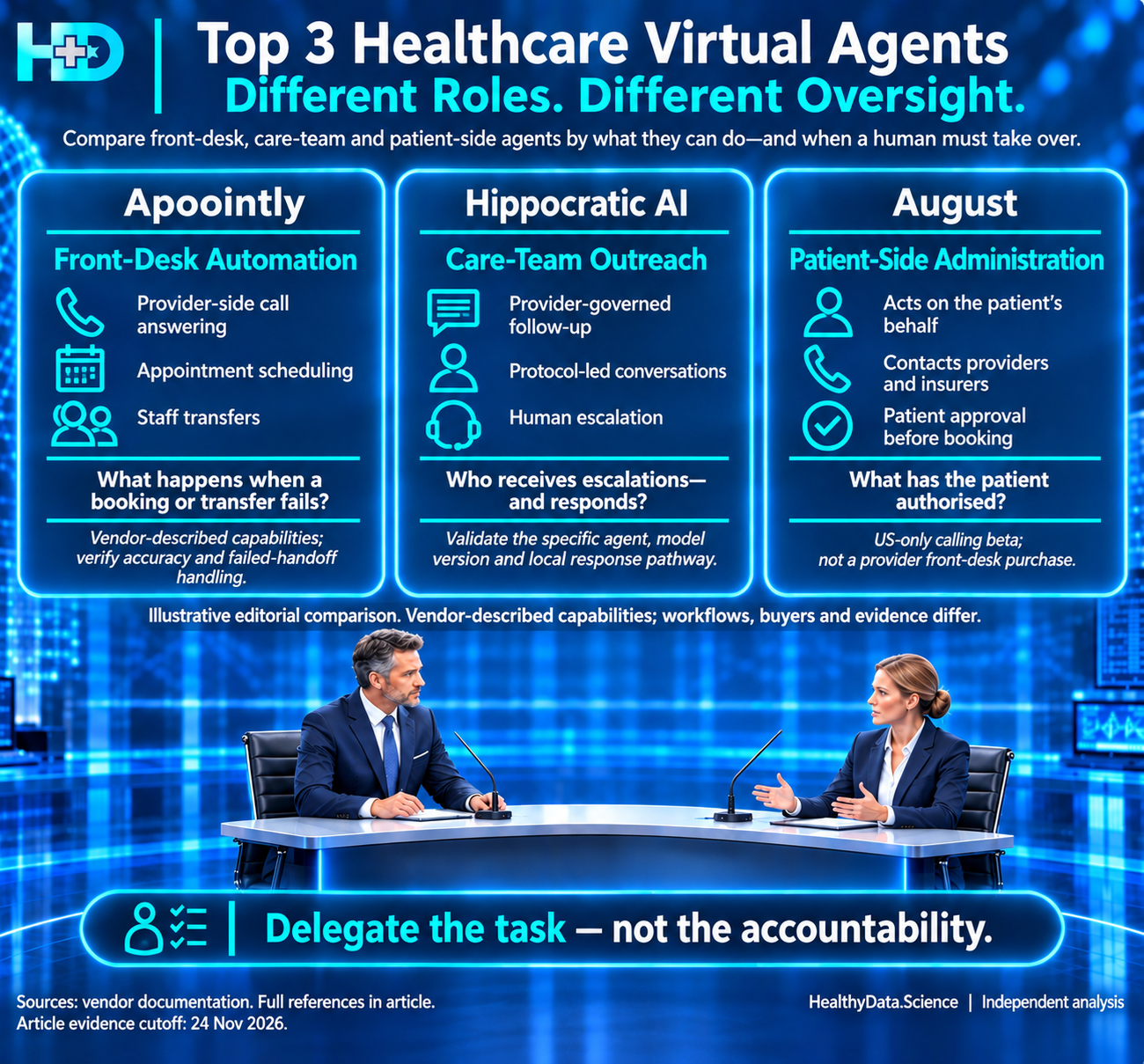
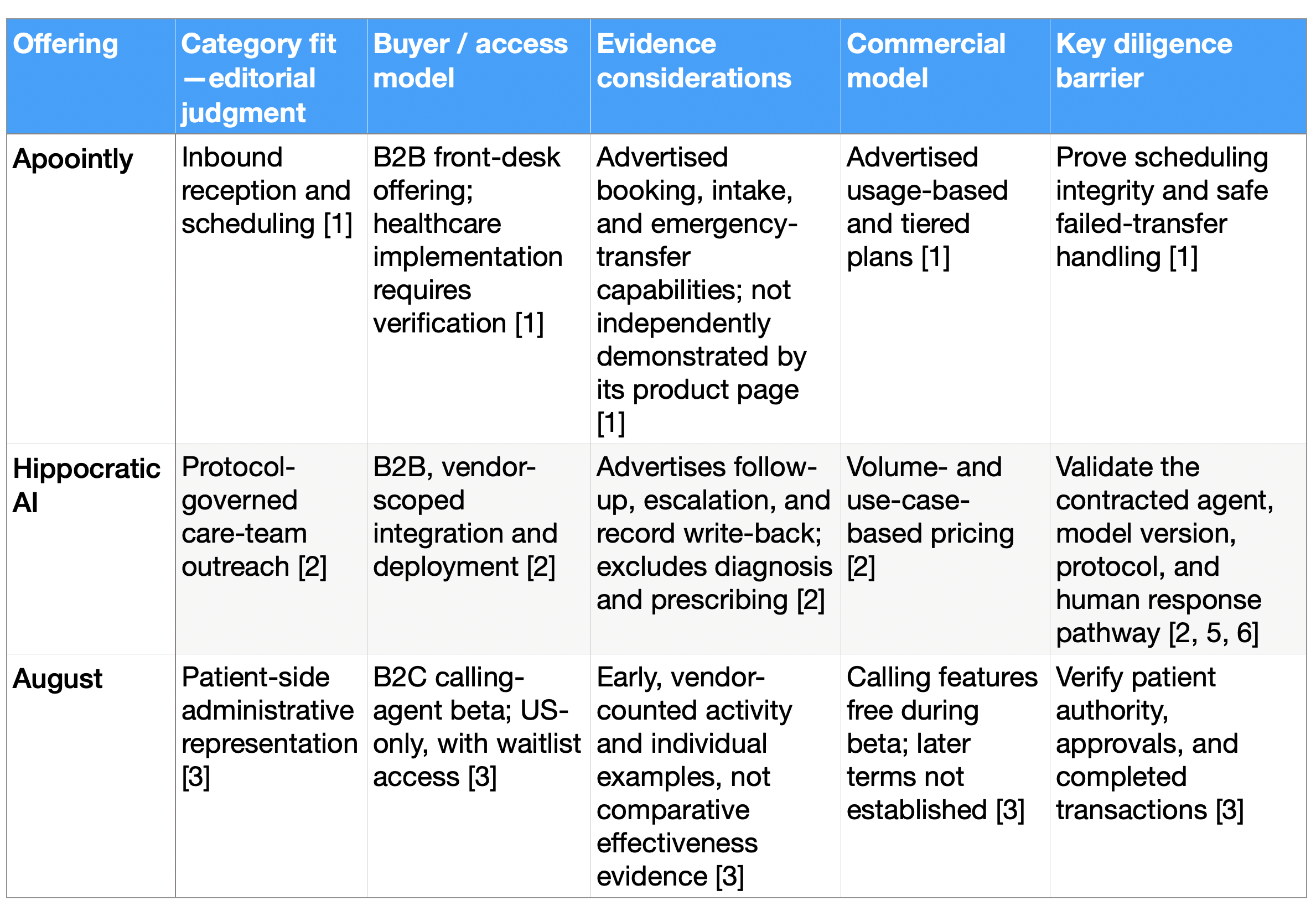
- Apoointly fits front-desk evaluation [1]
- Hippocratic AI fits protocol-governed outreach evaluation [2]
- and August illustrates patient-side administration rather than provider procurement [3]
Choose by delegated authority and escalation design, not conversational polish. These are three editorially selected approaches, not interchangeable purchases or a measured market-wide ranking.
Table 1: Healthcare Virtual Agents Comparison: Workflow Fit, Evidence and Diligence
Who This Guide Is For & How We Evaluated
This guide supports:
Practice administrators evaluating overflow and after-hours reception.
Patient-access executives assessing scheduling and intake automation.
Clinical-administrative leaders considering follow-up and care-gap outreach.
IT, security, privacy, procurement, and clinical reviewers deciding whether a pilot can proceed safely.
The three offerings were selected to expose different delegation models:
- a practice’s front desk [1]
- a provider’s outreach team [2]
- and a patient’s representative [3]
Category fits are editorial judgments, not benchmark wins.
Evaluation covers workflow permissions, escalation, integration evidence, access, economics, and jurisdiction-specific diligence. Research used public vendor documentation [1–5], an original research preprint [6], and official governance sources [7–10]. It did not include hands-on testing, private contracts, security reports, customer interviews, or independent integration verification.
The order follows workflow, not performance. August remains in the comparison because provider leaders should understand patient-represented automation, not because they can procure it as a replacement front desk [3].
The Healthcare Virtual-Agent Challenge
A call-answering agent and a post-discharge agent may sound similar while exercising different authority.
- Apoointly advertises scheduling and reception [1]
- Hippocratic AI describes health-related follow-up [2]
- August acts for patients contacting providers and insurers [3]
The meaningful distinction is whose instructions the agent follows and what consequences its actions create.
The evaluation should therefore follow a task through to completion. Was the correct appointment committed? Did an escalation reach an accountable person? Did the record update correctly? Did the patient approve the transaction? These are recommended acceptance questions, not outcomes established across this shortlist.
For procurement purposes, define three boundaries before selecting a voice:
- what the agent may say
- what it may change
- and when it must stop
A natural conversation should not substitute for evidence that those boundaries hold.
1. Apoointly: Front-Desk Automation With a Scheduling-Integrity Test
Apoointly is a cross-industry conversational voice platform with a healthcare front-desk offering for practices seeking call answering, appointment booking, routine information, and staff transfers [1].
Core Use Cases & Category Fit: Shortlist for inbound reception, overflow, and scheduling [1]. Its healthcare page also advertises insurance intake and emergency transfers [1]. These are vendor-described capabilities [1].
Intended Use & Evidence Relevance: Keep administrative delegation distinct from clinical discretion. Its dental workflow example includes symptom questions and emergency-slot booking, making the actual configured boundary especially important [4].
Measurable Results: The vendor’s dental page is labelled a “WORKFLOW EXAMPLE” and describes a modelled clinic [4]. Its booking and financial figures must not be presented as observed customer outcomes [4].
Regulatory, Safety & Data Considerations: Apoointly says audio is discarded after calls while text summaries and appointment details remain [1]. It advertises a BAA and uses “HIPAA-aligned,” “SOC 2 standards,” and “designed to meet” language; this page is not an inspected audit report [1].
Commercial Model & Access: The healthcare page advertises pay-as-you-go pricing of $0.18 per minute and tiered plans [1]. Confirm healthcare-specific inclusions, geography, support, and contractual obligations before budgeting.
Ideal For: A practice prepared to test a narrowly bounded administrative workflow before expanding permissions.
Transparent Limitations & Unsuitable Use Cases: Independently measured booking-error rates, emergency-detection performance, and representative EHR acceptance results were not established in the public sources reviewed [1, 4].
What Buyers Should Request
Request a scheduling sandbox, supported-interface documentation, a field-level data map, security evidence, the proposed BAA, and retention schedules for summaries and logs.
Test simultaneous booking attempts, cancellations, wrong-provider selection, uncertain insurance answers, and failed EHR writes. For urgent calls, require an approved escalation decision tree and demonstrate what happens when nobody answers.
Do not accept a statement that database locking “eliminates double-booking” as proof that the entire scheduling workflow cannot fail [1]. The vendor makes that claim [1]; the buyer should test the complete transaction and recovery process.
2. Hippocratic AI: Care-Team Outreach Requiring Version-Specific Validation
Hippocratic AI offers provider-facing agents for appointment access, post-discharge follow-up, chronic-care check-ins, and care-gap outreach, with advertised escalation to human nurses [2].
Core Use Cases & Category Fit: Shortlist for protocol-governed outreach that combines patient conversation, documentation, and escalation. Not merely reception [2].
Intended Use & Evidence Relevance: The supplied product page excludes diagnosis, prescribing, hospice, mental-health disorders, and children under two [2]. Treat these as stated product boundaries, not proof that every conversation remains within them.
Measurable Results: Its RWE-LLM preprint reports clinician-reviewed improvements across older Polaris iterations [6]. The research is vendor-funded and does not independently establish current-agent effectiveness in a buyer’s workflow [6].
Regulatory, Safety & Data Considerations: The outreach page references Polaris 5.0 [2], while a separate current page promotes Polaris 6.0 Ultra [5]. Buyers need the contracted version, configuration, and evidence package identified explicitly.
Commercial Model & Access: The vendor describes volume- and use-case-based pricing and integration scoping [2]. Public standardised implementation costs are Data Point Not Disclosed [2].
Ideal For: Organisations with approved protocols, staffed escalation pathways, clinical governance, and integration-testing capacity.
Transparent Limitations & Unsuitable Use Cases: Public claims of reduced readmissions, increased capacity, and average ROI lack sufficient study detail on the supplied sales page to serve as transferable purchasing assumptions [2].
What Buyers Should Request
Request version-specific validation, protocol deviation definitions, escalation sensitivity and false-positive results, language-specific testing, and representative call reviews.
Require named escalation recipients, coverage hours, maximum response intervals, acknowledgment tracking, and a failed-handoff process. “Human nurse one step away” is a product description [2]; staffing and response obligations must become an operating agreement.
For integration, request evidence of correct patient matching, cohort selection, write-back reconciliation, and correction handling. Define who owns errors introduced by the agent, upstream records, or local configuration.
Older-model research may inform diligence [6], but it should not automatically validate a newer model [5] or newly configured agent.
3. August: The Patient-Side Agent on the Other Side of the Phone
August’s administrative calling agent represents patients seeking appointments, prescription availability and prices, or help with bills and insurance denials [3]. It is not presented here as a provider-purchased reception system [3].
Core Use Cases & Category Fit: Its strategic value is the change in representation: the patient delegates work to an agent that contacts providers and insurers [3].
Intended Use & Evidence Relevance: August says patients approve bookings, doctors review and sign appeals, and clinicians retain treatment and prescribing decisions [3]. These are stated workflow safeguards, not independently verified adherence results [3].
Measurable Results: August reports 24,286 minutes on hold during a small early beta [3]. It explicitly says it counted the figures itself [3]. User counts, task denominators, and completion rates are Data Point Not Disclosed [3].
Regulatory, Safety & Data Considerations: Provider teams should define how they verify the patient’s authority, the agent’s identity, and the permitted disclosure or transaction. These are recommended intake controls, not confirmed August integrations.
Commercial Model & Access: The calling features are US-only and free during beta, with admission in batches through a waitlist [3]. This is restricted beta access, not evidence of unrestricted availability [3].
Ideal For: Provider leaders examining external-agent intake and patient-authorized administrative interactions.
Transparent Limitations & Unsuitable Use Cases: It is not a substitute for a provider-operated front desk, an emergency service, or demonstrated UK/EU calling-agent availability [3].
What Buyers Should Request, or Prepare
Provider organisations should prepare an agent-contact procedure rather than assume there is a provider procurement process.
Define acceptable authorisation evidence, identity checks, disclosure limits, booking confirmation, and correction routes. Keep “the agent called” separate from “the appointment is confirmed” or “the appeal was accepted.”
August says it identifies itself as AI when asked [3]. Practices can make agent identity a standard intake question without assuming proactive disclosure has already occurred.
Table 2: Measurable Results & Evidence Gaps
The available numbers describe different things. They should not be pooled into a ranking.
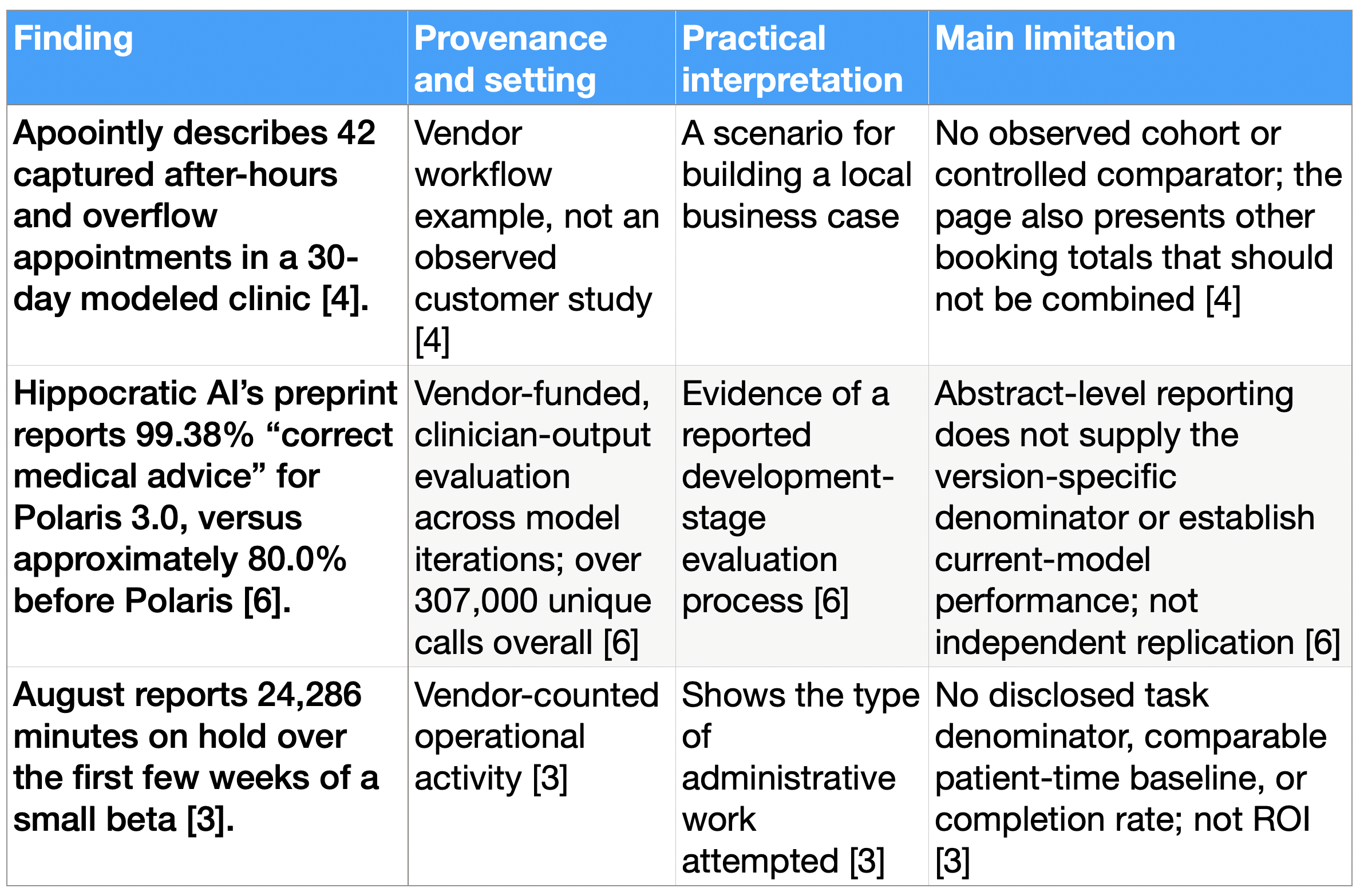
Table 3: Healthcare Virtual Agents: Missing Decision-Relevant Evidence
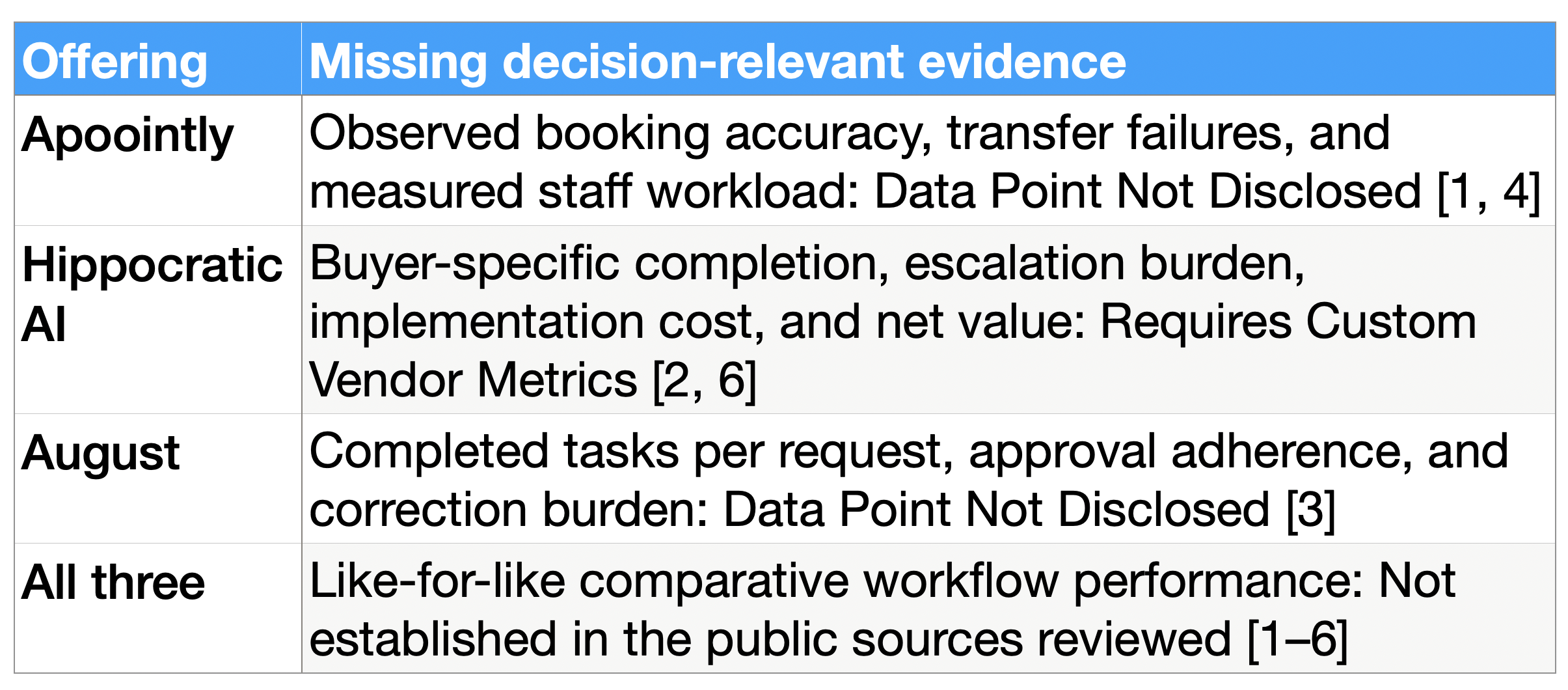
Absence of public evidence does not prove that a capability or private evaluation does not exist. It limits how strongly this guide can recommend it.
Decision Framework: How to Choose
Write a delegated-authority specification: List permitted statements, record changes, bookings, disclosures, and prohibited actions. Obtain operational and, where relevant, clinical approval. The acceptance artefact is a signed workflow specification, not a broad description such as “patient engagement.”
Define completion before counting automation: Require reconciled evidence: an appointment identifier, an accepted record update, an acknowledged handoff, or a documented patient approval. Track failed and corrected tasks as well as completed ones.
Test the entire escalation chain: Run difficult scenarios, including interrupted speech, uncertain intent, unavailable staff, and disconnected calls. Record trigger detection, successful connection, acknowledgment, and resolution separately. Set thresholds before the pilot; do not invent universal acceptable rates.
Complete market-specific governance:
For US covered-entity workflows, HHS guidance requires an appropriate BAA when a cloud provider creates, receives, maintains, or transmits ePHI on the organization’s behalf, alongside the organization’s own compliance and risk analysis [7]. A vendor badge does not replace this work.
For UK processing, document the lawful basis and additional condition for special-category data [8]. The ICO’s AI guidance distinguishes development from deployment and currently notes that it is under review following legislative changes [8].
For EU processing, assess the applicable GDPR lawful basis, health-data condition, processor terms, impact assessment requirements, and international transfers [9]. These are separate questions from whether an offering is commercially available locally.
Obtain jurisdiction-specific advice on calling, recording, disclosure, and consent requirements rather than assuming one market’s configuration transfers unchanged.
Resolve intended use and version control: Ask for the precise intended use and any applicable regulatory assessment. EU software qualification depends on intended medical purpose; being used in a clinic does not itself settle medical-device status [10]. This guide establishes no product-specific authorisation. Contract for model identification, change notification, regression testing, and rollback. Hippocratic AI’s differing Polaris references demonstrate why page-level claims cannot substitute for a versioned deployment record [2, 5].
Pilot against a documented baseline: Measure eligible tasks, successful completions, errors, rework, patient complaints, and staff review time. Include integration, monitoring, escalation, support, and exit costs. Buyer-specific economics require project data, not a vendor-wide multiplier.
Frequently Asked Questions
Which offering should a practice evaluate first for reception? Apoointly is the shortlist’s front-desk fit because it advertises inbound answering and scheduling [1]. Start with a bounded workflow and require evidence that bookings, corrections, and transfers work in the practice’s actual systems.
Can Hippocratic AI replace clinical judgment? Its supplied outreach page explicitly excludes diagnosis and prescribing and describes human-nurse escalation [2]. Evaluate it against an approved support protocol, not as authorization to remove clinical accountability.
Why include August in a provider buyer’s guide? August illustrates patient-side delegation rather than another provider purchase [3]. Its inclusion helps separate provider-controlled automation from interactions initiated by an agent representing a patient; it does not establish how common those interactions are.
Are all three available across the US, UK, and EU? No such conclusion is supported. August explicitly limits its calling beta to the US [3]; the reviewed Apoointly and Hippocratic AI pages do not establish complete market-specific availability and contracting readiness for every jurisdiction [1, 2, 4, 5].
Do the published numbers establish ROI or comparative safety? No. Modeled clinic figures [4], older-model output evaluations [6], and beta hold-time totals [3] measure different things. None constitutes a controlled comparison of these three offerings or a complete buyer-specific return calculation.
Explore the Category With a Defined Workflow
Use the HealthyData.Science Virtual Care & Patient Engagement Agents directory to identify further evaluation candidates. Carry forward a written intended use, an evidence request, and an acceptance test; directory inclusion is not validation or endorsement.
Editorial Independence & Disclaimer
HealthyData.Science reports no ownership, representation, sponsorship, paid coverage, affiliate arrangement, or other commercial relationship with these vendors.
This guide is based on public-source research conducted on November 24, 2026 [1–10]. It is informational, not medical, legal, regulatory, security-certification, or procurement advice. No hands-on testing or clinical peer review of this article was performed. Inclusion does not guarantee safety, compliance, availability, or outcomes. Verify current capabilities, versions, evidence, access, and terms before deployment.
References
- Apoointly, “AI Receptionist and Front Desk for Healthcare Practices,” corporate product documentation, n.d. [Online]. Source title. Accessed: Nov. 24, 2026.
- Hippocratic AI, “AI Agents That Call Your Patients,” corporate product documentation, n.d. [Online]. Source title. Accessed: Nov. 24, 2026.
- August, “August can now book your doctor’s appointment and dispute your medical bills,” corporate launch account, updated Nov. 20, 2026. [Online]. Source title. Accessed: Nov. 24, 2026.
- Apoointly, “Dental & Healthcare Practices: Capturing Overflow Calls & Reducing No-Shows,” corporate modelled workflow example, n.d. [Online]. Source title. Accessed: Nov. 24, 2026.
- S. Mukherjee, “Polaris 6.0 Ultra,” corporate model/product description, n.d. [Online]. Source title. Accessed: Nov. 24, 2026.
- “Real-World Evaluation of Large Language Models in Healthcare (RWE-LLM): A New Realm of AI Safety & Validation,” medRxiv, preprint, ver. 1, 2025, doi: 10.1101/2025.03.17.25324157. [Online]. Source title. Accessed: Nov. 24, 2026. Author list not reproduced because the retrieved record did not expose full author metadata.
- U.S. Department of Health and Human Services, “Guidance on HIPAA & Cloud Computing,” official guidance, 2016. [Online]. Source title. Accessed: Nov. 24, 2026.
- Information Commissioner’s Office, “How do we ensure lawfulness in AI?,” official guidance, page update noted Oct. 28, 2024; under review notice present. [Online]. Source title. Accessed: Nov. 24, 2026.
- European Parliament and Council, “Regulation (EU) 2016/679,” Official Journal of the European Union, L 119, pp. 1–88, May 4, 2016. [Online]. Source title. Accessed: Nov. 24, 2026.
- Medical Device Coordination Group, “MDCG 2019-11 Rev.1: Guidance on Qualification and Classification of Software in Regulation (EU) 2017/745—MDR and Regulation (EU) 2017/746—IVDR,” Jun. 2025. [Online]. Source title. Accessed: Nov. 24, 2026.

Author: Stephen
Founder of HealthyData.Science · 20+ years in life sciences compliance & software validation · MSc in Data Science & Artificial Intelligence.
Follow HealthyData.Science on LinkedIn
Get concise decision briefings, vendor comparisons, and regulatory AI updates for healthcare and life sciences teams.
Follow HealthyData.Science on Google Search & AI
Get our latest healthcare and life science AI tool evaluations, regulatory updates, and buyer intelligence in your Google AI Overviews.
Add as Preferred Source