
Stephen
Founder of HealthyData.Science · 20+ years in life sciences compliance & software validation · MSc in Data Science & Artificial Intelligence.


This guide is informed by BenevolentAI’s published research and real‑world programme data in target discovery and drug repurposing. It draws in particular on work describing the AI‑assisted identification of baricitinib as a COVID‑19 treatment using BenevolentAI covid drug repurposing knowledge graph, own technical summaries and independent reviews of its platform. Outbound links are provided so readers can review the underlying methods, data, and outcomes directly.
Dealbreakers
No regulatory wins = credibility gap. Most AI drug discovery firms have yet to deliver an FDA-approved therapeutic; clinical validation beyond early Phase trials is still the exception, not the norm.
Progress in clinical proof-of-concept is often the single biggest gating factor for large pharma adoption.
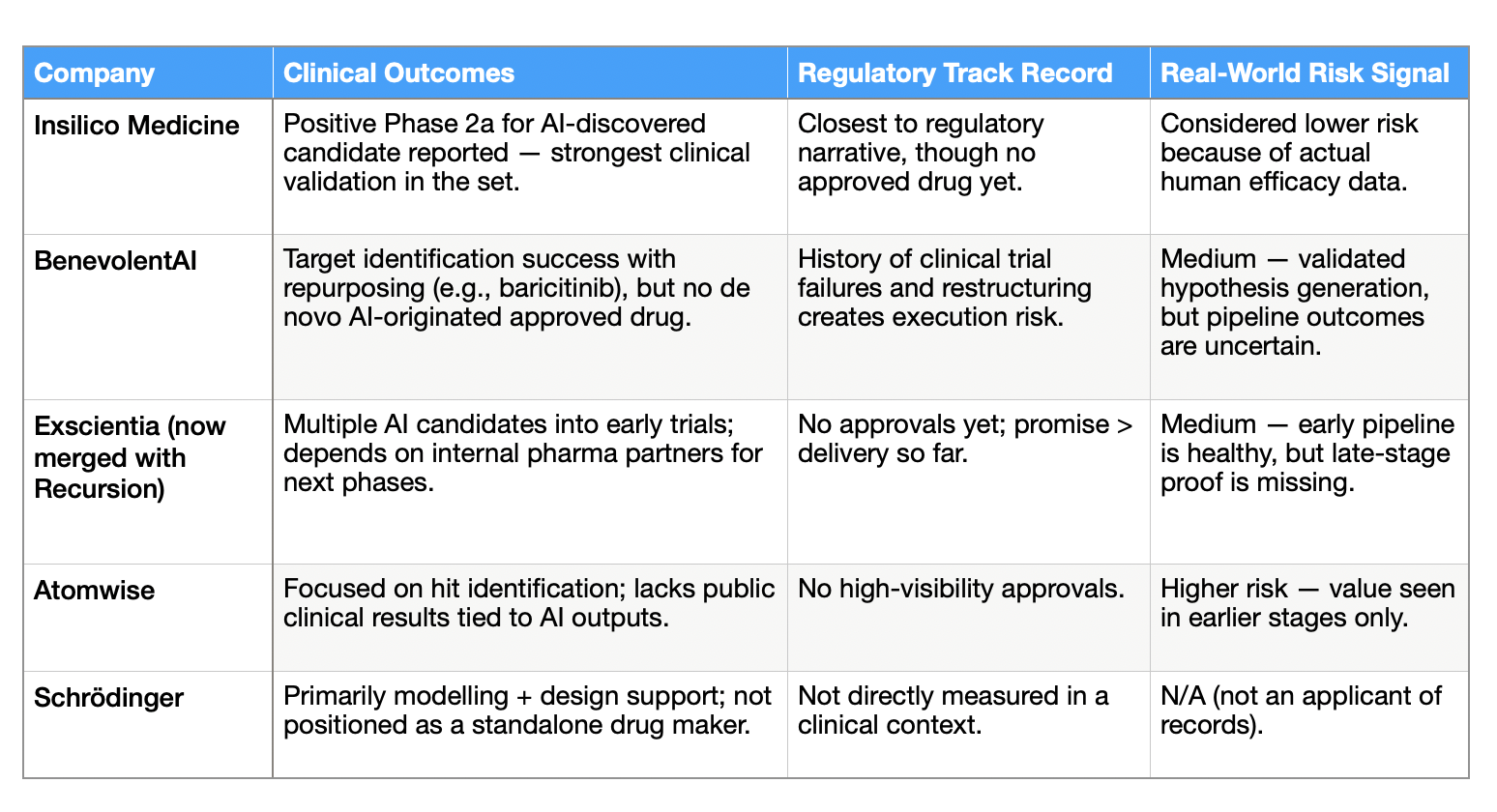
Across the industry, only a small minority of AI‑discovered molecules have reached human trials and none have yet achieved full regulatory approval, which is why buyers scrutinise any claim of “AI‑driven” pipelines so hard. [1]
Insilico Medicine currently sets the clinical bar, with its AI‑designed TNIK inhibitor (Rentosertib) showing a +98.4 mL improvement in FVC versus a −20.3 mL decline on placebo in Phase IIa IPF patients, giving decision‑makers rare, human‑efficacy proof for an AI‑originated asset. [2]
BenevolentAI, by contrast, has already demonstrated that it will publicly disclose negative read‑outs such as BEN‑2293’s inconclusive Phase IIa efficacy in atopic dermatitis, which is increasingly treated inside big pharma as a positive signal of scientific and governance maturity rather than a black mark. [3]
At the same time, BenevolentAI’s platform has delivered seven novel targets into AstraZeneca’s internal portfolio across fibrotic, renal, and cardiovascular indications, showing that its output is being selected and advanced by a top‑tier pharma rather than remaining in slideware. [4]
What stalls deals here:
Big pharma procurement teams will delay or decline investment until there’s a clear regulatory trajectory (Phase 3 readouts, IND/NDAs).
Promises of “AI-driven discovery” without molecule-to-approval evidence get flagged as science fiction for budgeting cycles
Dealbreakers
“Black box” predictions can be a hard no for safety/regulatory review if you can’t trace how an AI arrived at a mechanistic hypothesis or lead design.
Platforms that don’t offer traceable, auditable outputs (e.g., how data sources influenced a target) tend to fail internal scientific governance.
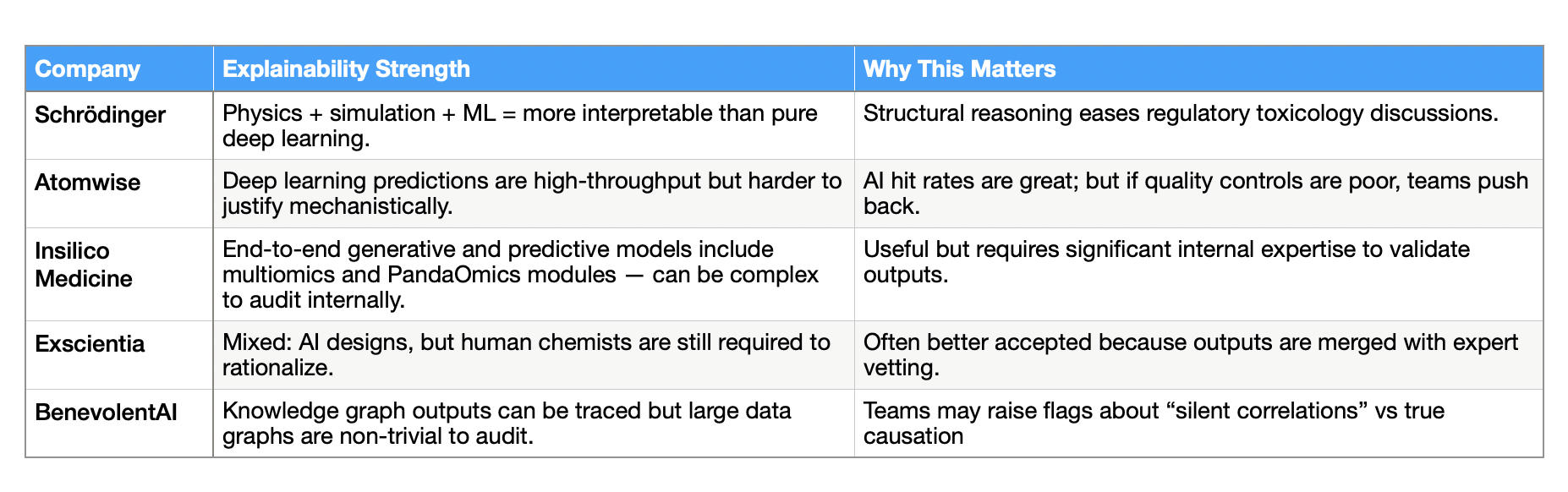
Regulators are already signalling that opaque AI will not fly at scale: the FDA’s 2023 discussion paper explicitly frames traceability, data provenance, and explainability as core requirements for AI/ML used in drug and biologics development, not nice‑to‑have features.
Physics‑first platforms like Schrödinger go even further, using free‑energy perturbation and molecular dynamics simulations that run for 12–24 hours per property estimate, giving reviewers a mechanistic narrative that is much easier to defend in tox and CMC discussions than “pure” deep learning scores.
BenevolentAI plays on a different, but complementary, axis: its knowledge graph integrates literature, patents, omics, chemistry, and clinical trial data into an auditable network, so teams can walk back from a suggested target to the specific evidence nodes that supported it. [5]
What stalls deals here:
Pharma scientists will decline models that produce “explainably unreliable” candidates — even high-scoring ones — unless there’s a direct way to trace prediction lineage.
Many AI pilots die at the firewall: pharma IT teams still expect critical discovery tools to run inside controlled environments with robust APIs into ELNs, chemoinformatics suites, and data lakes, and will routinely block cloud‑only tools that cannot be deployed behind the perimeter. [6]
Hybrid providers such as Schrödinger, which couples cloud services with widely‑deployed on‑premises software used by more than 1,750 discovery and materials customers worldwide, typically face fewer integration and security objections because they already live inside enterprise stacks. [7]
By contrast, Atomwise’s model of running large‑scale virtual screens on its own infrastructure means its value is often delivered as hit lists rather than as a deeply embedded workflow capability, which can cap internal adoption unless a sponsor is willing to build significant custom integration around it. [8]
Dealbreakers
Siloed tools that don’t bond with existing chemoinformatics, ELN, or preclinical systems often fall out of favor.
Integration capability often determines whether teams can actually use the tool versus piloting it only superficially.
Insight from comparative tables:
Atomwise and Insilico (cloud-centric) are easier to slot into existing workflows.
Schrödinger’s hybrid model supports both cloud and desktop, which pharma IT teams prefer for security and compliance.
What stalls deals here:
Security/compliance reviews that fail due to inability to host behind corporate firewalls.
Lack of APIs or exportability to enterprise informatics stacks being flagged as non-starter.
(How executive committees implicitly score vendors)
Scoring scale:
5 = Lowest buyer risk / strongest political safety
1 = Highest buyer risk / common dealbreaker trigger
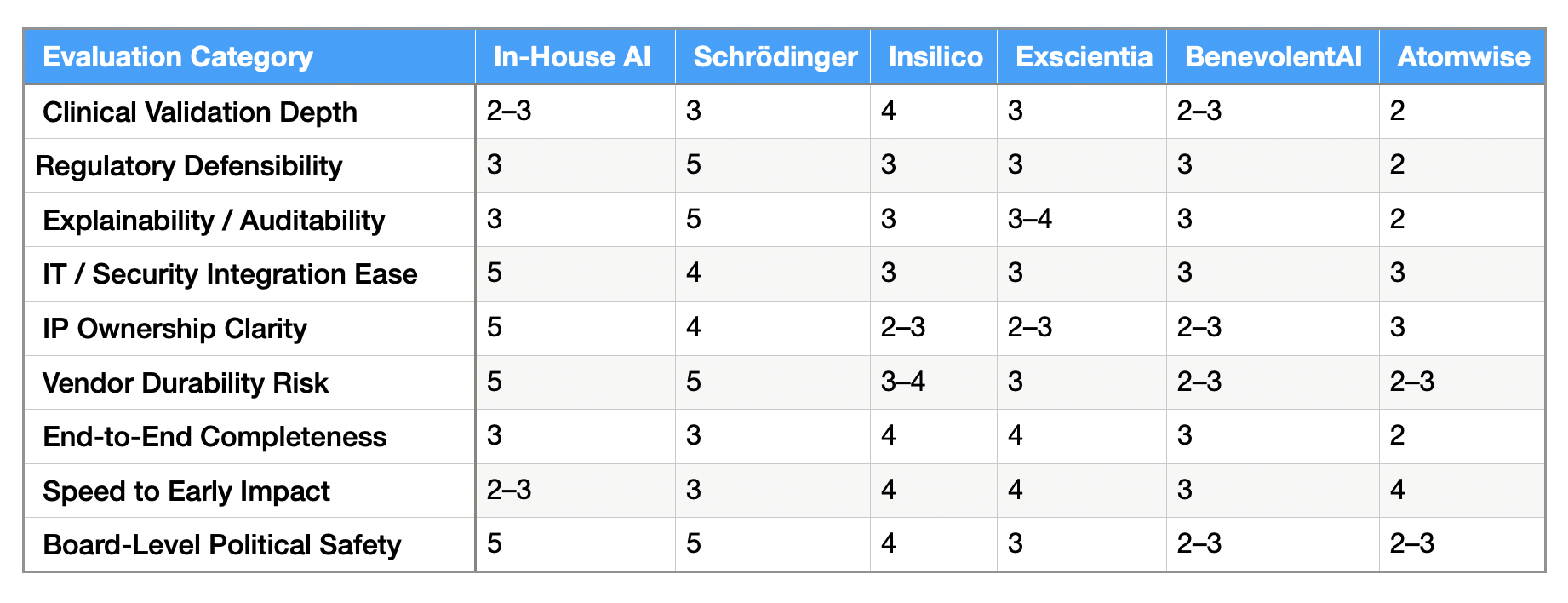
In-House AI + Schrödinger
Lowest IP conflict.
Strong regulatory defensibility.
Durable and board-comfortable.
Innovation pace may lag.
Deals rarely collapse here — but breakthrough acceleration is less likely.
Insilico Medicine + Exscientia
Strong AI-native differentiation.
Faster candidate generation.
Greater dependency and IP negotiation complexity.
Deals most often stall during:
IP ownership structuring
Long-term partnership risk evaluation
Late-stage validation scrutiny
BenevolentAI + Atomwise
More limited scope (target discovery or early hits).
Harder to position as end-to-end solution.
Durability and translational depth concerns.
Deals often die when:
Vendor is framed as platform-of-record.
Internal AI teams resist perceived displacement.
Board questions runway or strategic focus.
Deal teams have learned the hard way that ambiguous IP kills value: standard industry analysis shows that AI drug discovery partnerships now routinely include per‑program milestone stacks in the hundreds of millions of dollars, so any uncertainty over who owns model‑generated structures will trigger legal escalation. [9]
Traditional software‑licensing models like Schrödinger’s, where the customer owns any molecules and data created with the tools while the vendor retains platform IP, tend to move faster through legal review than co‑development frameworks that split ownership of both models and outputs. [10]
In contrast, newer AI natives (including BenevolentAI and Insilico) frequently structure collaborations where targets, candidates, and even underlying knowledge graph enrichments are shared across parties, which can be attractive strategically but demands earlier, heavier involvement from IP counsel. [11]
Dealbreakers
Undefined IP terms around AI-generated candidates can kill negotiations fast — pharma legal teams will not sign contracts with ambiguous claims to discoveries generated through proprietary models.
Data privacy and governance policies (especially if the AI uses third-party or public knowledge graphs) can trigger compliance escalations.
Strategic differences matter:
Schrödinger: more traditional software licensing model — clearer IP boundaries.
Atomwise/Insilico/Exscientia/BenevolentAI: Data + model co-development deals often lead to complicated IP sharing, which can be unacceptable without clear term sheets.
What stalls deals here:
Legal teams delaying or rejecting because “who owns the model output?” is unresolved, particularly when molecules are monetizable assets.
Funding and corporate structure directly affect perceived execution risk: Insilico’s oversubscribed Series E round of up to $123M in 2025 was interpreted by many buyers as evidence that specialist investors remain confident in its ability to push multiple AI‑derived assets forward. [12]
Exscientia shows the other side of that coin; its $688M sale to Recursion and subsequent pipeline pruning, including the discontinuation or pausing of several clinical‑stage programmes, has made some sponsors wary of relying on it as an independent, long‑term strategic partner. [13]
BenevolentAI has likewise experienced restructuring, but its continued R&D spend of £47.6M in 2022 (up roughly 50% year‑on‑year) signals that, even through turbulence, resources are still being deployed into advancing its pipeline and platform rather than being diverted out of R&D entirely. [14]
Dealbreakers
Longevity & stability of the partner is a major consideration — repeated layoffs, pivots, or delisting (e.g., BenevolentAI) raise political risk and internal concern.
Brand reputation matters: legacy computational chemistry firms (Schrödinger) or AI with real clinical data (Insilico) are easier sells internally.
Examples of risk signals:
BenevolentAI’s public struggles and restructure signal execution uncertainty.
Exscientia’s merger with Recursion significantly changes both tech and team dynamics, creating integration risk.
What stalls deals here:
R&D leadership will say “we don’t want to be dependent on a startup that might not exist in 24 months” if funding runway, leadership churn, or M&A risk is high.
Across the industry, benchmark studies estimate that AI‑augmented discovery can compress hit‑to‑lead and lead‑optimisation cycles from multi‑year efforts down to roughly 11–18 months, representing a 70–80% reduction versus traditional approaches when the tooling is well integrated. [15]
Insilico has turned that promise into a concrete datapoint, taking its flagship TNIK inhibitor from project kick‑off to first‑in‑human dosing in around 30 months, compared with the four to seven years typically quoted for bringing a new small‑molecule into Phase I. [16]
A first meta‑analysis of AI‑discovered molecules entering the clinic suggests that Phase I success rates now cluster around 80–90%, versus historical averages closer to 40–65% for conventional pipelines, indicating that AI is already improving early‑stage attrition even if Phase II efficacy remains a harder problem. [17]
At the portfolio level, economic models project that mature AI deployment can shave roughly 15–22% off end‑to‑end drug development costs, once faster cycle times, fewer dead‑end programmes, and more targeted trial designs are accounted for. [18]
Unlike pure design engines, BenevolentAI’s sweet spot is upstream target identification and indication selection, where its platform has already yielded seven novel targets accepted into AstraZeneca’s own R&D portfolio, giving it a tangible track record of changing what big pharma actually works on. [19]
The same knowledge‑graph stack has been independently documented in the baricitinib COVID‑19 case, where graph‑driven hypothesis generation surfaced the JAK inhibitor as a candidate and subsequent Phase 3 trials helped secure label expansions, a pattern that buyers now increasingly view as proof that BenevolentAI can generate clinically actionable insights rather than just interesting rankings. [20]
Strengths: Rapid hit identification via deep learning; great for early screening.
Dealbreakers:
Limited end-to-end support — needs downstream tools to move hits into optimization.
Often restricted value unless integrated with other platforms.
Strengths: Physics + AI hybrid — more mechanistic insight; widely accepted.
Dealbreakers:
Not purpose-built as an “AI drug discovery pipeline”; primarily modeling support tools.
May require strong internal computational expertise.
Strengths: Focuses on automated design with chemistry automation; many molecules in early trials.
Dealbreakers:
Results still early; clinical validation not confirmed.
Post-merger identity and platform coherence can be a procurement red flag.
Strengths: Target discovery, knowledge graph insights.
Dealbreakers:
Recent organizational instability.
Lack of a clear, reproducible, scalable delivery pipeline.
Strengths: Strongest clinical proof to date for AI molecule concept; generative + predictive suite.
Dealbreakers:
Complex platform may require significant on-boarding and scientific expertise to interpret correctly.
Strengths
Full strategic alignment.
No dependency risk.
Internal learning compounds over time.
Dealbreakers
Talent recruitment war.
Slow iteration.
Risk of internal echo chamber.
Executive impatience if ROI isn’t fast.
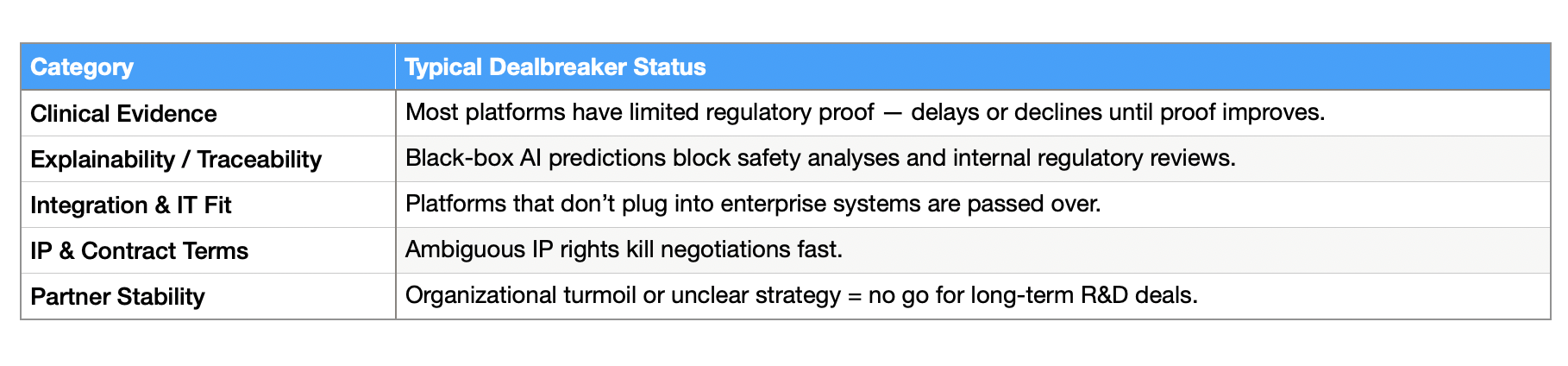
No AI drug discovery platform has yet fully eliminated the translational gap between algorithmic success and regulatory approval. That uncertainty remains the ultimate dealbreaker filter.
Key Buyer Takeaway: At this stage, the highest priority gating factors for pharma/biotech decision-makers aren’t marketing claims. They are tangible clinical progress, IP clarity, explainable outputs, integration compatibility, and partner sustainability. Solutions that fail in any of these categories typically stall or die early in vendor qualification workflows.
For a deeper dive into BneovelentAI’s core platform capabilities and evidence base, see our main BenovelentAI listing, BenevolentAI: How This AI Platform is Rewriting the Rules of Pharma Innovation
This buyer guide comparison of BenevolentAI vs key competitors first appeared on HealthyData.Science and major search indexes, and is protected as original, independently curated content.
Disclaimer
This page is for information only and does not constitute regulatory, clinical, or commercial advice. The assessments and comparisons are based on publicly available information and vendor inputs at the time of writing and may change without notice. Organisations should conduct their own technical, legal, and governance due diligence before selecting or deploying any AI solutions in healthcare.