Insilico vs Alternatives: Competitive Positioning for Healthcare Buyers

ai in healthcare

Below is Insilico-specific competitive positioning, written from a buyer’s perspective and explicitly framed to pre-empt dealbreakers when compared to key AI-drug-discovery competitors. Each section clarifies where Insilico wins, where competitors raise concerns, and how Insilico should be positioned to neutralise comparison-driven objections. This focuses explicitly on where deals stall, slow, or die, not vendor narratives.

This page is for senior leaders in pharma and biotech evaluating whether Insilico is a viable partner or alternative in AI‑enabled drug discovery. It helps decision‑makers assess Insilco’s claims, risk profile, and fit within existing R&D strategies without repeating vendor marketing or ranking providers. The content is analytical, not promotional or investment advice, designed to support evidence‑based shortlisting rather than endorsement.

How to use this page

This page is designed for cross‑functional evaluation teams in pharma and biotech, bringing together scientific, commercial, and technical stakeholders.

  • Scientific leaders (CSO, biology, or chemistry heads) should focus on Sections 1 and 2, which cover clinical proof, regulatory validation, scientific transparency, and the specific dealbreaker risks for AI‑originated molecules.

  • Business development and portfolio strategy teams should prioritise Sections 4, 5 and the Final Summary, where IP and ownership structures, deal‑closure friction, economic impact (time, cost, and success rates), and Insilico’s positioning versus alternative models are assessed.

  • IT, data, and digital teams will find Sections 3 and 6 most relevant, as these examine integration with existing workflows, data governance, and vendor stability in the context of enterprise adoption.

The guide reflects how buyers commonly assess risk and fit, summarising market perceptions and typical deal dynamics rather than offering formal endorsements or rejections of any specific vendor.

Get a neutral, no obligation view of whether this AI tool fits your portfolio

Avatar

Stephen

Founder of HealthyData.Science · 20+ years in life sciences compliance & software validation · MSc in Data Science & Artificial Intelligence.

Evidence this page draws on

This guide draws on Insilico’s published peer‑reviewed studies and reported real‑world outcomes, including the Nature Biotechnology article on Insilico’s AI‑discovered TNIK inhibitor for fibrosis and other work on AI‑designed small molecules progressing into clinical development, as well as internal benchmarks on discovery speed and success rates. Insilico’s generative AI pipeline moved INS018_055 from fibrosis target discovery to preclinical candidate nomination in roughly 18 months, versus the decade‑long timelines typical for conventional discovery programmes (A small-molecule TNIK inhibitor targets fibrosis in preclinical and clinical models — https://www.nature.com/articles/s41587-024-02143-0).

Key sources include Insilico’s own publications and pipeline disclosures, together with landmark journal articles describing its end‑to‑end AI‑driven drug discovery programmes. Outbound links are provided so readers can review the underlying data, methods, and results directly.

1. Clinical Proof & Regulatory Validation

(The #1 buyer filter)

Executive framing:

“Does this platform produce molecules that survive clinical reality—not just computational success?”
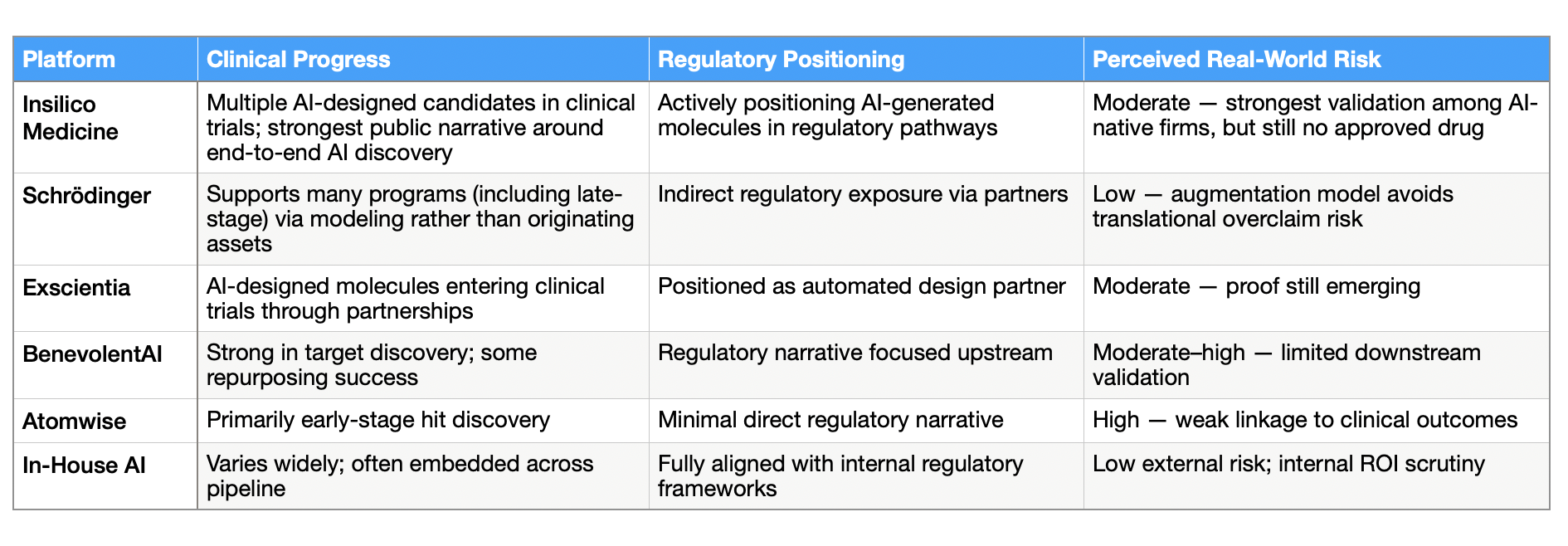
Table 1: Clinical Progress & Risk Snapshot (2026)

Table comparing six AI drug discovery platforms by clinical progress, regulatory positioning, and perceived real-world risk.
Table summarising how leading AI drug discovery platforms (Insilico Medicine, Schrödinger, Exscientia, BenevolentAI, Atomwise, and In‑House AI) differ in clinical progress, regulatory narratives, and perceived real‑world risk.


Where Deals Stall

  • No Phase 2+ efficacy data tied to AI-originated molecules

  • Weak causal link between model outputs and clinical endpoints

  • Overreliance on “first AI-designed” positioning vs reproducibility

For Insilico, the most advanced proof to date is an AI‑designed small‑molecule TNIK inhibitor, INS018_055, which has shown robust anti‑fibrotic activity across lung, kidney, and skin models in vivo, including more than 50–75% reductions in fibrotic area at certain doses in murine lung fibrosis studies (A small-molecule TNIK inhibitor targets fibrosis in preclinical and clinical models  In a randomized, double‑blind, placebo‑controlled phase I trial, INS018_055 was tested in 78 healthy volunteers with a favorable safety profile and a geometric mean elimination half‑life of roughly 7–10 hours, with plasma levels detectable up to 48–72 hours post‑dose at several dose levels (A small-molecule TNIK inhibitor targets fibrosis in preclinical and clinical models. [1]

Even for Insilico (the strongest AI-native player), lack of approval-level validation remains a gating concern.

2. Scientific Transparency & Explainability

(Regulatory + Partner Demand)


Core issue:

“Can we defend this molecule to regulators, safety boards, and our own scientists?”
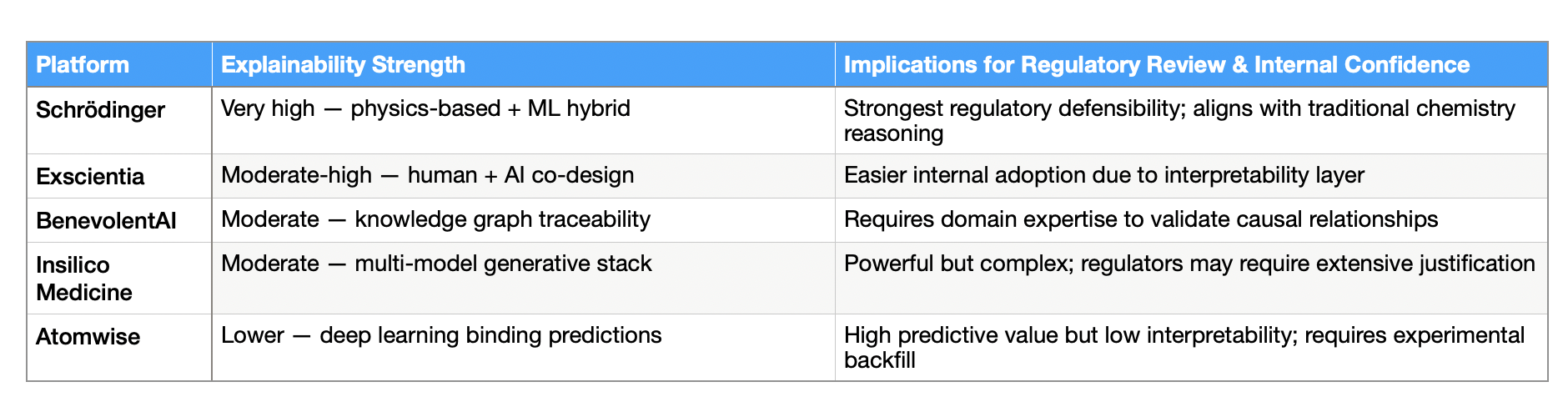
Table 2: Explainability Comparison

AI drug discovery platforms table comparing explainability strength and implications for regulatory review and internal confidence.
Table summarising how leading AI drug discovery platforms (Schrödinger, Exscientia, BenevolentAI, Insilico Medicine, and Atomwise) differ in explainability strength and implications for regulatory review and internal stakeholder confidence.


Dealbreaker Reality

  • “Black box” = regulatory hesitation

  • Poor traceability = internal scientific rejection

  • Overcomplex models = slower validation cycles

In its fibrosis programme, Insilico’s PandaOmics platform surfaces TNIK as a top target by explicitly linking it to pro‑fibrotic pathways (WNT, TGF‑β, Hippo, JNK, NF‑κB) and to IPF‑associated genes such as TGFB1 and KDR, with transparency analyses that expose the underlying network and causal scores (A small-molecule TNIK inhibitor targets fibrosis in preclinical and clinical models. [2]

Insilico’s strength (end-to-end AI) is also its risk: complexity can reduce explainability confidence.

3. Integration & Workflow Interoperability

(Where IT, data governance, and scientists intersect)

Core issue:

“Can this actually plug into how we already discover drugs?”

Schrödinger positions LiveDesign as a cloud‑native enterprise platform that centralizes in silico and experimental project data, computational modeling tools, and collaborative decision‑making in a single browser-based interface for discovery teams (LiveDesign). [3

Table 3: Buyer Risk Matrix (1–5 scale)

5 = lowest risk / strongest alignment
1 = highest friction / dealbreaker risk
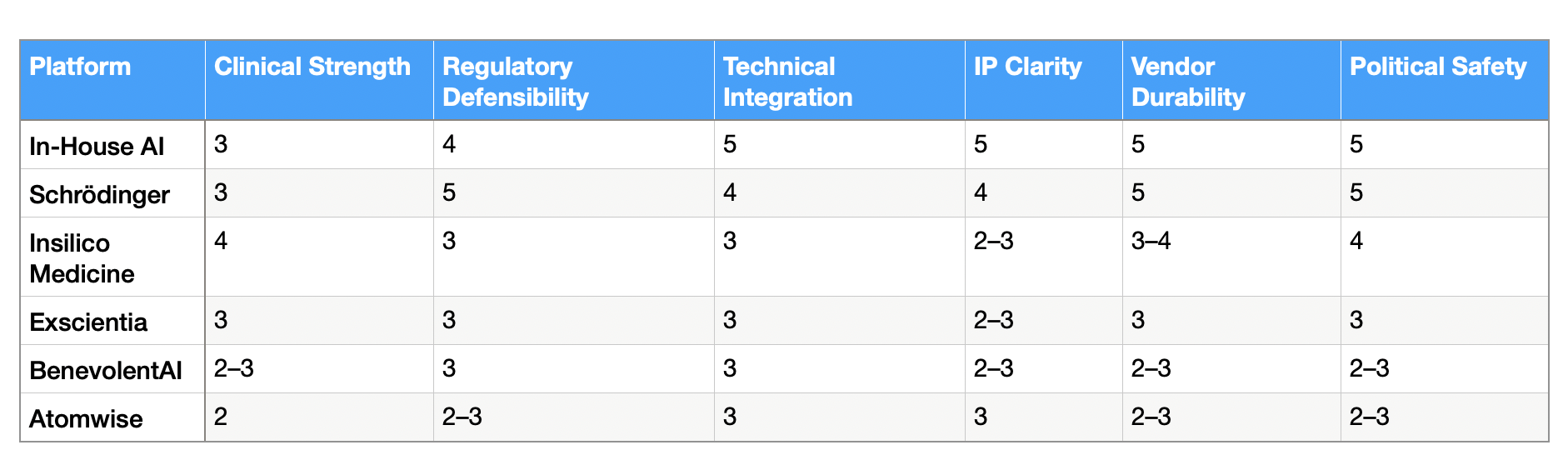
AI drug discovery platforms table showing 1–5 scores for clinical strength, regulatory defensibility, technical integration, IP clarity, vendor durability, and political safety.
Table comparing In‑House AI, Schrödinger, Insilico Medicine, Exscientia, BenevolentAI, and Atomwise across six scored dimensions: clinical strength, regulatory defensibility, technical integration, IP clarity, vendor durability, and political safety.

Legend (1–5 scale):
1 = Very weak / high concern
2 = Weak / below expectations
3 = Adequate / mixed, acceptable with caveats
4 = Strong / low concern
5 = Very strong / best‑in‑class, minimal concern

The LiveDesign Learning module is described as a fully automated workflow for training, validating, and deploying AI/ML models that treats project datasets as dynamic information feeds and lets teams integrate models directly into design and decision workflows via the same centralized platform (LiveDesign Learning). [4]

Integration Dealbreakers

  • No ELN/LIMS compatibility

  • Cloud-only models failing enterprise security review

  • Poor interoperability between AI outputs and medicinal chemistry workflows

Insilico often requires higher onboarding effort, which can slow adoption despite strong capabilities.

4. Data Governance, Compliance & IP Ownership

(Where legal teams kill deals fastest)


Core buyer question:

“Who owns the molecule, the data, and the model improvements?”

High-Risk Dealbreaker Areas

Insilico Medicine

  • Complex co-development structures

  • Potential ambiguity around model training on proprietary data

  • Negotiation friction on downstream rights


Competitor Comparison

  • Schrödinger → Cleanest model (software + collaboration); lowest IP friction

  • Exscientia → Shared development = higher negotiation complexity

  • BenevolentAI → Data-driven insights create ownership ambiguity

  • Atomwise → Typically earlier-stage; simpler but still variable

  • In-House AI → Full ownership, lowest legal risk

Exscientia reports that its Centaur AI platform can cut the typical drug discovery timeline from around 4.5 years to just 12–15 months to reach a development candidate, often through collaborations where AI‑designed molecules move into partner‑led IND‑enabling and clinical studies (Exscientia: a clinical pipeline for AI-designed drug candidates. [5]

BenevolentAI reports that since inception its flagship collaboration with AstraZeneca has generated approximately £32 million in revenue and that, together with newer partnerships, it now has cash, cash equivalents and short‑term deposits of £38.1 million with a forecast cash runway extending to late Q3 2025 (Interim results for the six months ended 30 June 2024. [6]

Common Deal Killers

  • Undefined ownership of AI-generated molecules

  • Vendor retaining rights to improvements derived from your data

  • Royalty stacking across multiple AI contributors

This is one of the most frequent reasons deals never close.

Schrödinger’s end‑user license agreement explicitly states that while Schrödinger retains all intellectual property rights in its software and improvements, customers retain ownership of all their own content, information and data, drawing a clear contractual line between vendor IP and licensee data (End User License Agreement). [7]

5. Quantifying ROI: Time, Cost, and Success Rates

(Where CFOs and boards apply pressure)

Core issue:

“Is this faster, cheaper, and more successful — or just more complex?”

Insilico’s fibrosis programme illustrates the upside and the limits of current ROI evidence: its generative AI pipeline compressed the path from TNIK target discovery to preclinical candidate nomination for INS018_055 into roughly 18 months, considerably faster than the decade‑long trajectories typical for conventional discovery, and the AI‑designed molecule has shown stronger in‑vitro anti‑fibrotic activity than nintedanib in certain epithelial‑to‑mesenchymal transition assays using primary IPF cells (A small-molecule TNIK inhibitor targets fibrosis in preclinical and clinical models. [8]
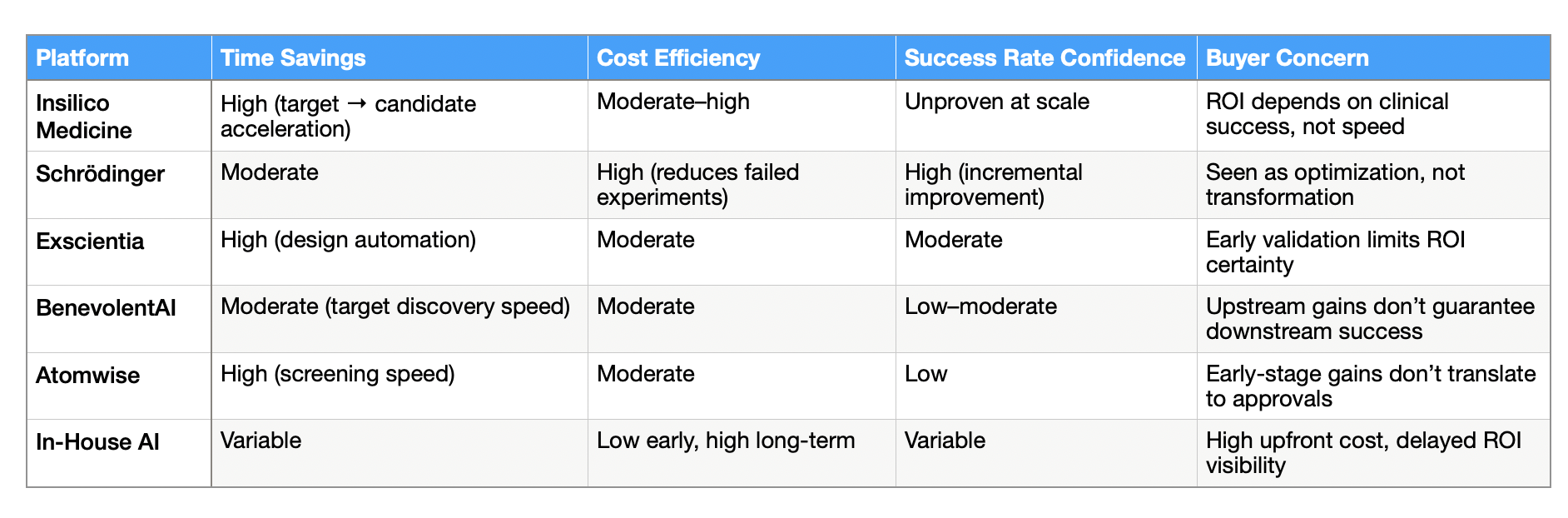
Table 4: Reality vs Expectation

AI drug discovery platforms table comparing time savings, cost efficiency, success rate confidence, and buyer concern.
Table showing how Insilico Medicine, Schrödinger, Exscientia, BenevolentAI, Atomwise, and In‑House AI differ in time savings, cost efficiency, success rate confidence, and typical buyer concerns.


Where ROI Discussions Break Down

  • Speed improvements don’t translate to approvals

  • Cost savings don’t offset failed trials

  • AI outputs increase complexity rather than reduce it

Insilico leads in speed narrative and early‑signal potency, but buyers still question end-to-end economic impact.

6. Vendor Stability & Political Safety

Internal questions:

  • “Will this company exist in 5 years?”

  • “Are we outsourcing core innovation capability?”

  • “Will this create internal resistance?”

Political Risk Snapshot

  • In-House AI → safest internally

  • Schrödinger → safest external partner

  • Insilico → credible but still startup risk

  • Exscientia / BenevolentAI → moderate instability perception

  • Atomwise → higher perceived long-term risk

BenevolentAI’s 2024 interim results report that cash, cash equivalents and short-term deposits fell from £72.9 million to £38.1 million over H1 2024, with the cash runway extended only to late Q3 2025 and operating losses reduced by about 30% following restructuring (Interim results for the six months ended 30 June 2024. [9]
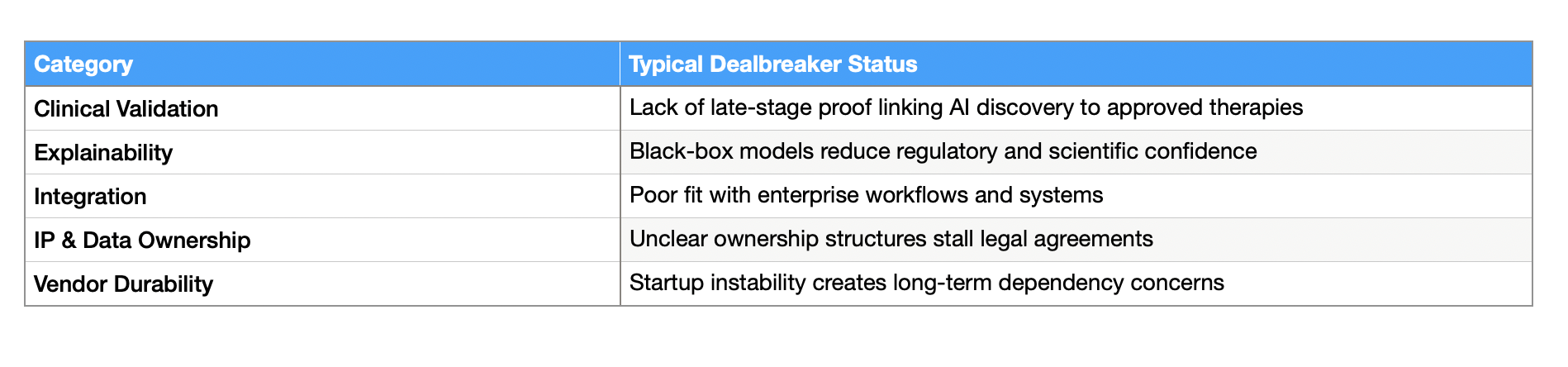
Final Summary: Where AI Drug Discovery Deals Fail

Table 5: Final Summary

Table listing common dealbreaker issues for enterprise adoption of AI drug discovery platforms, including clinical validation, explainability, integration, IP and data ownership, and vendor durability.
Table summarizing key categories that most often derail AI drug discovery deals: clinical validation, explainability, integration, IP and data ownership, and vendor durability.

Key Takeaway

For buyers evaluating Insilico Medicine:

  • It represents the strongest AI-native end-to-end innovation play

  • But also introduces higher complexity across explainability, IP, and integration

In contrast:

  • Schrödinger = safest, most defensible

  • In-House AI = most controlled

  • Exscientia = automation-focused middle ground

  • BenevolentAI = upstream discovery strength

  • Atomwise = early-stage acceleration tool

The central truth remains:

No AI drug discovery platform has yet fully de-risked the path from algorithm to approved drug. And that uncertainty is where most deals stall or die.

For a deeper dive into Insilico’s core platform capabilities and evidence base, see our main Insilico listing, Insilico’s AI Just Designed a Drug from Scratch: Faster Than Any Human Team Could.

This AI Tool‑specific positioning against each competitor for Insilico first appeared on HealthyData.Science and major search indexes, and is protected as original, independently curated content.

Disclaimer:

This page is for information only and does not constitute regulatory, clinical, or commercial advice. The assessments and comparisons are based on publicly available information and vendor inputs at the time of writing and may change without notice. Organisations should conduct their own technical, legal, and governance due diligence before selecting or deploying any AI solutions in healthcare.

Let’s explore the right AI solutions in healthcare and life sciences for your workflows

  1. INS018_055, an AI-identified TNIK inhibitor, demonstrated significant anti-fibrotic and anti-inflammatory activity in vivo across multiple organ models. In a 78-subject Phase I trial, the candidate was well-tolerated with a 7–10 hour half-life, supporting its progression as a first-in-class therapeutic for idiopathic pulmonary fibrosis. Ren, F., et al. (2024). A small-molecule TNIK inhibitor targets fibrosis in preclinical and clinical models[]
  2. The PandaOmics platform identified TNIK as a high-confidence anti-fibrotic target by integrating transcriptomic and proteomic data. Predictive scoring linked TNIK to critical signaling cascades, including WNT and TGF-β, while explainable AI features provided biological rationale through causal network mapping and associations with known fibrosis-related genes. Ren, F., et al. (2024). A small-molecule TNIK inhibitor targets fibrosis in preclinical and clinical models[]
  3. LiveDesign is a cloud-native enterprise informatics platform that centralizes experimental and computational data within a single browser-based interface. It integrates predictive modeling tools with real-time project tracking to facilitate collaborative, data-driven decision-making across global drug discovery teams and multidisciplinary research organizations. Schrödinger. (2024). LiveDesign: An Enterprise Platform for Collaborative Drug Discovery[]
  4. LiveDesign Learning provides a fully automated framework for training, validating, and deploying machine learning models using dynamic project datasets. The module enables medicinal chemistry teams to integrate these models directly into design cycles and collaborative decision-making workflows within the centralized LiveDesign informatics platform. Schrödinger. (2024). LiveDesign Learning: Automated Machine Learning for Drug Discovery Teams[]
  5. Exscientia’s Centaur AI platform reduces the traditional drug discovery timeline from 4.5 years to approximately 12–15 months for development candidate identification. This efficiency is evidenced by multiple AI-designed molecules entering clinical trials through internal programs and strategic partnerships, significantly accelerating the path to IND-enabling studies. UKRI. (2024). Exscientia: a clinical pipeline for AI-designed drug candidates[]
  6. BenevolentAI reports its AstraZeneca collaboration has generated approximately £32 million since inception. As of June 2024, the company maintains £38.1 million in liquid assets, providing a forecast cash runway into late Q3 2025, supported by both existing partnerships and recent platform licensing agreements. BenevolentAI. (2024). Interim results for the six months ended 30 June 2024[]
  7. Schrödinger’s license agreement stipulates that the vendor retains ownership of its software and proprietary improvements, while the licensee maintains all rights and title to their specific content and data, establishing a clear contractual distinction between the platform’s intellectual property and user-generated discovery data. Schrödinger. (2024). End User License Agreement[]
  8. Insilico’s generative AI platform accelerated the transition from TNIK target identification to preclinical candidate nomination for INS018_055 to approximately 18 months. In primary human IPF cell assays, the candidate demonstrated superior inhibition of myofibroblast activation and epithelial-to-mesenchymal transition compared to the standard-of-care, nintedanib. Ren, F., et al. (2024). A small-molecule TNIK inhibitor targets fibrosis in preclinical and clinical models[]
  9. BenevolentAI’s H1 2024 results show liquid assets decreased to £38.1 million from £72.9 million. Strategic restructuring reduced operating losses by 30%, extending the cash runway into late Q3 2025, supported by a shift toward platform licensing and existing drug discovery collaborations. BenevolentAI. (2024). Interim results for the six months ended 30 June 2024[]