
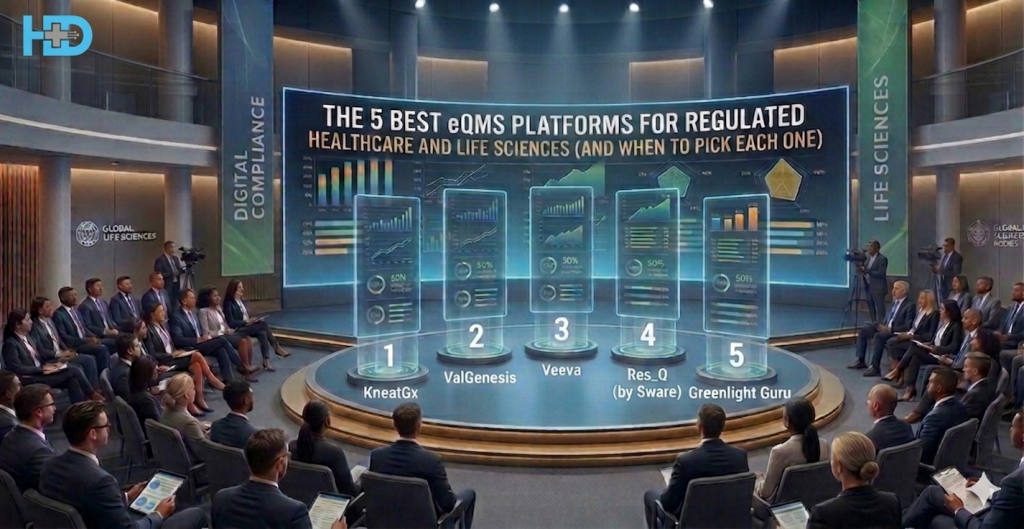
If you lead Quality or IT in a life sciences organisation and paper‑based validation is slowing every release, these five platforms offer a way out. Each one combines digital validation workflows, strong GxP traceability, and integrations for best‑of‑breed stacks, so you can cut validation cycle times by roughly 40–70% while staying inspection‑ready.
Who this guide is for
Quality, validation, and IT leaders in life sciences who own or influence computer system validation and system release decisions across GxP environments.
Organisations where paper‑ or document‑centric validation is now the main bottleneck to upgrading GxP‑relevant systems, with validation activities consuming hundreds of hours per project.
Teams operating under GxP with Annex 11 / 21 CFR Part 11 expectations, often alongside ISO 13485 or ISO 9001, and preparing for frequent FDA and EMA inspections. [1]
IT landscapes built as best‑of‑breed ecosystems (multiple cloud and on‑prem platforms, ERP/MES, LIMS, DevOps/ITSM) that need validation to integrate smoothly rather than live in a separate paper world.
Assumption: readers already run at least a basic eQMS and now want to digitise and industrialise validation so release cadence can match product, manufacturing, and IT roadmaps while reducing warning‑letter risk.
Why paper‑based validation is now your biggest bottleneck
In most life sciences organisations, the slowest part of any system change is no longer the configuration itself but the validation paperwork that surrounds it. Plans, protocols, tests, deviations, and reports are scattered across shared drives and spreadsheets, so every upgrade becomes a one‑off documentation exercise consuming hundreds of hours of manual effort. This creates an upgrade backlog, encourages teams to delay changes, and increases the risk of data‑integrity findings when inspectors examine how you actually validate.
Quality and IT leaders feel this most. They are accountable for GxP compliance and inspection outcomes, yet they also need to roll out new cloud platforms, analytics, and automation under tight timelines. When validation is paper‑based, each additional system or patch adds to a fragile web of Word files and Excel trackers, making it hard to demonstrate consistent application of Part 11, Annex 11, and emerging Computer Software Assurance expectations.
Digital‑validation‑ready eQMS and validation platforms tackle this by turning documents into structured records with reusable templates, linked requirements‑to‑tests, and complete electronic audit trails. Instead of treating every validation as a bespoke project, you can standardise methods once and reuse them, with many programmes reporting 40–60% reductions in cycle time and some reaching 75–80% for specific workflows.
AI tool 1: Kneat Gx
One‑sentence summary
KneatGx is a SaaS platform that digitises the full validation lifecycle (CSV, equipment, process) so life sciences companies can replace paper protocols with reusable, audit‑ready workflows and cut validation times by more than half.
Healthcare/Regulated Use Cases
Supports computer system validation, equipment and process qualification, cleaning validation, and related GMP activities across multiple sites, with online test execution, e‑signatures, and centralised templates.Evidence & Validation
Customer programmes report around 50% or more reduction in validation cycle time when moving from paper to Kneat‑based workflows, with some cases showing >100% productivity gains due to data reuse and automation.Regulatory Status
Designed for GxP environments with controls aligned to 21 CFR Part 11 and Annex 11 (secure e‑signatures, access control, full audit trail), underpinned by ISO 9001:2015 and ISO 27001:2022 certifications.Deployment Model & Integrations
Delivered as cloud‑hosted SaaS on AWS with APIs and connectors that allow validation data to link to existing MES, ERP, LIMS, and QMS tools, making it suitable for best‑of‑breed architectures rather than single‑vendor stacks.Best for
Medium‑to‑large pharma and biotech companies where validation effort—not core QMS—is the primary constraint on system releases, especially when validation spans many manufacturing and GxP IT systems.Key limitations
Focuses on validation and qualification rather than serving as a complete eQMS for CAPA, complaints, and all quality processes, so it typically sits alongside an existing QMS. To realise headline cycle‑time savings, you need solid process ownership and integration, not just a lift‑and‑shift of legacy documents.
AI tool 2: ValGenesis
One‑sentence summary
ValGenesis is a digital validation lifecycle management platform that centralises CSV and related GMP validation so pharma and biotech teams can standardise methods and significantly shorten validation timelines.
Healthcare/Regulated Use Cases
Manages computer system validation, equipment and process qualification, and ongoing validation maintenance across GxP systems, with structured templates, risk‑based workflows, and electronic execution for global teams.Evidence & Validation
Reported customer outcomes include roughly 50% reductions in validation cycle time and substantial improvements in audit‑readiness metrics, driven by centralised templates, reusable risk assessments, and electronic traceability.Regulatory Status
Built for compliance with 21 CFR Part 11 and EU Annex 11, with controls to support ALCOA‑style data integrity for validation records and alignment to current expectations around risk‑based Computer Software Assurance.Deployment Model & Integrations
Available as web‑ and cloud‑based deployments that can scale across many GxP systems and sites, with integration patterns that connect validation data to quality systems, manufacturing platforms, and enterprise IT.Best for
Pharma and biotech organisations wanting a dedicated validation backbone to orchestrate large portfolios of GxP systems, especially where validation is distributed across multiple plants and functions.Key limitations
Like KneatGx, ValGenesis is validation‑centric rather than a full, all‑process eQMS, so you usually layer it alongside existing quality and manufacturing systems and invest in change management to standardise methods.
AI tool 3: Veeva (Vault Validation Management / Quality)
One‑sentence summary
Veeva’s validation and quality applications extend the Vault platform so life sciences companies can manage validation, quality events, and regulated content in a single cloud environment tightly connected to other GxP processes.
Healthcare/Regulated Use Cases
Supports validation activities alongside document control, change control, training, and quality events, allowing teams to link validation records directly to regulated content, releases, and cross‑functional workflows.Evidence & Validation
Industry case studies report validation time reductions on the order of 50–70% when organisations move validation into Vault and consolidate multiple legacy systems, while also improving consistency and reuse across programmes.Regulatory Status
Designed specifically for life sciences with functionality aligned to 21 CFR Part 11, Annex 11, and global GxP expectations, and used by many top‑tier pharma and biotech companies for inspection‑ready records.Deployment Model & Integrations
Delivered as multi‑tenant cloud on the Vault platform, with native interoperability across other Veeva applications (Regulatory, Clinical, Safety) and integration options for ERP/MES and external quality systems.Best for
Mid‑to‑large life sciences organisations already invested in the Veeva ecosystem, or those looking to place validation and core quality workflows on a single cloud platform with strong GxP pedigree.Key limitations
Best value comes when you embrace the broader Vault stack; if you want a narrowly scoped validation point solution, this may be more than you need and will still require integration with non‑Veeva systems.
AI tool 4: Res_Q (by Sware)
One‑sentence summary
Res_Q is a cloud‑based digital validation and compliance platform that automates GxP validation workflows and has been shown to reduce validation timelines dramatically compared with manual, paper‑based approaches.
Healthcare/Regulated Use Cases
Focuses on computer system validation and related GxP compliance processes, with structured templates, automated workflows, and centralised evidence suitable for complex, multi‑site life sciences environments.Evidence & Validation
Case studies report up to around 75% faster validation cycles and significant labour savings per project, with some deployments cutting total validation time by roughly one‑third to two‑fifths across multiple regulated sites.Regulatory Status
Built to support GxP validation under 21 CFR Part 11 and similar frameworks, with secure electronic records, signatures, and audit trails; SOC 2‑type attestations are used to demonstrate cloud security controls to healthcare and life sciences buyers.Deployment Model & Integrations
Offered as SaaS, with integrations aimed at connecting validation workflows to platforms such as Salesforce and other life‑sciences IT systems, so validation data can feed into operational and quality dashboards.Best for
Organisations that want a lighter‑weight, cloud‑native validation solution that can coexist with their existing eQMS and enterprise stack, especially where validation is a clear bottleneck for SaaS and platform rollouts.Key limitations
Res_Q is more of a validation and compliance hub than a full eQMS, so you typically run it alongside an existing QMS; as with other tools, benefits depend on standardising methods rather than simply digitising old templates.
AI tool 5: Greenlight Guru
One‑sentence summary
Greenlight Guru is a medtech‑focused eQMS that combines design controls, risk management, and post‑market quality, making it a natural base for device and diagnostics companies that want their validation evidence tightly linked to product‑lifecycle data.
Healthcare/Regulated Use Cases
Covers design controls, risk files, document and change control, training, CAPA, complaints, and post‑market surveillance for medical device and diagnostics firms operating under ISO 13485 and FDA quality regulations.Evidence & Validation
Industry reports show integrated, medtech‑specific quality systems can deliver strong ROI, with examples of organisations achieving rapid payback by reducing audit prep time and strengthening design and validation traceability.Regulatory Status
Built around ISO 13485 and FDA 21 CFR 820 expectations, with features aligned to design history, device master records, and risk management requirements, and used by many growth‑stage device companies.Deployment Model & Integrations
Delivered as a cloud platform with integrations into common product‑development and collaboration tools, so design, risk, and quality data—including validation‑relevant information—remain linked across the device lifecycle.Best for
Medical device and diagnostics teams that want an opinionated, out‑of‑the‑box eQMS tailored to their regulatory world, and that plan to connect digital validation activities back into design and post‑market evidence.Key limitations
Optimised for medtech rather than broad multi‑GxP manufacturing; larger pharma‑style operations may still need additional tools for full validation lifecycle management and non‑device quality processes.
What the numbers say about digital validation eQMS adoption
Digital validation is consistently cutting validation cycle times by roughly 40–60% in life sciences organisations that move away from paper and spreadsheets, with some MES and validation programmes reporting reductions of up to 75–80% when automation is fully adopted. [2]
Case studies across the five tools show that moving to structured, digital validation can free 100+ labour hours per project and reassign at least one full‑time equivalent from manual documentation to higher‑value work, especially in complex pharma and biotech environments.
The global life sciences quality management software market is projected to grow from roughly USD 3–3.3 billion in 2024 to around USD 6.7–7.2 billion by 2030–2031, implying CAGRs in the 12–13% range as digital quality and validation platforms become mainstream.
Within this market, cloud and web‑based deployments take the majority share, and North America alone accounts for well over a one‑third revenue share, reflecting rapid adoption of SaaS‑based eQMS and validation platforms in regions facing the strictest regulatory oversight.
Long‑term inspection analyses show that more than 50% of GxP observations at some sites relate to data integrity and documentation issues, which paper‑based, ad‑hoc validation processes are ill‑suited to address.
Early adopters of digital validation frequently report not just faster validation but better inspection outcomes, with more consistent application of risk‑based CSA principles, fewer repeat findings tied to documentation gaps, and higher confidence in continuous audit‑readiness.
Side‑by‑side comparison at a glance

In the ‘Evidence available’ column, we only summarise headline impact. Full statistics, mini-case studies, and third‑party citations are available on the neutral, evidence‑led HealthyData.Science directory pages for each of these five AI tools. Please follow the tool‑name links in the sections above to view the underlying evidence.
How to choose the right eQMS for digital validation
Map your regulatory and CSV risk surface
Start by listing which systems are truly GxP‑critical and how closely you are scrutinised against 21 CFR Part 11, Annex 11, and emerging CSA guidance. If a large share of your audit findings relate to data integrity or validation documentation, favour platforms with proven electronic record controls and risk‑based validation content out of the box.Align with your IT architecture and SaaS strategy
Decide where multi‑tenant SaaS is acceptable and where single‑tenant or on‑prem is still required, then shortlist tools that match those patterns. In best‑of‑breed landscapes, prioritise platforms with open APIs and proven integrations to ERP/MES, LIMS, DevOps/ITSM, and your existing eQMS so validation data is automatically reflected in change, release, and quality workflows. [3]Prioritise the biggest validation bottlenecks
Look at your last few major projects and quantify where time really went: drafting, approvals, test execution, defect handling, or reporting. Choose tools whose strengths match those pain points—whether that is deeply configurable templates, online execution, strong deviation handling, or analytics on cycle‑time and resource use—so the 40–60% savings you see in case studies are achievable in your context.Consider scale, governance, and change‑management capacity
Enterprise‑grade platforms can manage thousands of validation objects across dozens of sites but require solid ownership, configuration standards, and a centre of excellence. If your team is smaller or earlier in its digital journey, a more opinionated or domain‑specific tool may deliver faster wins with less risk of recreating fragmented, paper‑era practices in a new system.Quantify business impact, not just compliance
Build a simple model that connects expected cycle‑time reduction to release cadence, project throughput, and avoided delays to revenue or cost savings. Platforms that offer clear, vendor‑backed benchmarks on time and labour savings make it easier to secure budget and to track whether your implementation is actually delivering the promised gains. [4]Plan for continuous improvement and CSA‑style thinking
Digital validation is not a one‑off project; it is a new way of working that should evolve with your systems and regulatory expectations. Favour tools that make it easy to refine templates, adjust risk models, and analyse trends in deviations and cycle times so you can keep improving, not just reproduce today’s processes in electronic form.
FAQs on eQMS, digital validation, and interoperability
Below are the most common questions we hear when teams are vetting eQMS platforms for digital validation in life sciences:
Can we mix multiple platforms for QMS and digital validation, or do we need one vendor for everything?
You can safely mix platforms as long as ownership, interfaces, and data integrity responsibilities are clear. Many life sciences companies run a core eQMS plus a dedicated digital validation tool, using APIs and well‑governed integrations so change control, releases, and validation evidence stay synchronised.How do auditors view cloud‑based eQMS and validation tools?
Regulators care more about control and evidence than hosting model; cloud systems are widely accepted if you can demonstrate robust audit trails, security, and documented validation of the tool itself. Long‑term trends show increasing regulatory focus on data integrity, which digital platforms can support better than ad‑hoc paper and spreadsheets when configured correctly.Will we still need paper once we move to digital validation?
Most organisations keep some paper during transition, but the goal is to rely on electronic records and signatures that fully meet Part 11 and Annex 11 expectations. Over time, mature programmes run audits and inspections directly from the system dashboards and reports, using paper only for legacy records that have not yet been migrated.How do we decide when a system or change actually requires full GxP validation?
Use a risk‑based approach aligned with CSA principles: assess impact on product quality, patient safety, and data integrity, then scale validation effort accordingly. Digital platforms help by standardising risk assessments and making it easier to show inspectors how you consistently justify validation scope and depth across your portfolio.What kind of release‑cycle improvements are realistic with digital validation?
Case studies across MES, QMS, and validation systems commonly report 40–60% reductions in validation cycle time, with some programmes reaching 75–80% for specific workflows. The exact gain depends on how fragmented your current process is and how far you go in standardising templates, automating evidence capture, and integrating with your change and release tools.How should we measure ROI from an eQMS or digital validation investment?
Track a mix of operational and compliance metrics: validation cycle time, labour hours per project, number of overdue changes, audit/inspection findings related to validation, and delay‑related cost or revenue impact. Many organisations also monitor adoption indicators—the percentage of projects using standard templates, the proportion of tests executed electronically. As leading signals that long‑term ROI will hold.
Ready to go deeper on eQMS options? Explore the full eQMS directory to compare more platforms, see detailed validation evidence, and benchmark your stack against other regulated healthcare and life sciences teams.

Author: Stephen
Founder of HealthyData.Science · 20+ years in life sciences compliance & software validation · MSc in Data Science & Artificial Intelligence.
- Modern life sciences organizations require digital validation systems to maintain GxP compliance and inspection readiness. These frameworks must align with 21 CFR Part 11 and Annex 11 standards while integrating into broader quality management systems to ensure data integrity during regulatory audits. NNIT. (2024). Embracing Digital Validation in the Life Sciences Sector: The Time is Now[↩]
- Implementation of digital validation systems in life sciences significantly accelerates compliance timelines, reducing Manufacturing Execution System (MES) validation burdens by approximately 80%. By replacing manual, paper-based documentation with automated, risk-based methodologies, organizations can compress months of traditional validation activities into days or even hours. MasterControl. (2022). How Life Science Companies Reduce MES Validation Time[↩]
- Modern eQMS platforms utilize cloud-based architectures to integrate seamlessly with ERP, MES, and LIMS via open APIs. This connectivity automates data flow across the enterprise, ensuring validation data and quality events are reflected in real-time workflows while maintaining 21 CFR Part 11 compliance. eLeap. (2024). Enterprise Quality Management System (eQMS) Software – Why Use It?[↩]
- Digital validation systems enable life sciences firms to quantify financial gains by linking accelerated validation cycles to faster product releases and increased project throughput. Establishing clear benchmarks for labor savings and reduced compliance delays allows organizations to transform regulatory adherence into a measurable driver of operational revenue. AVS Life Sciences. (2026). The Financial Impact of Digital Validation: Why Compliance is Now a Financial Strategy[↩]