Kneat Gx: Qualitative Intelligence and Buyer FAQ's

ai in healthcare

Below is a buyer-side evidence layer for teams evaluating Kneat Gx in regulated healthcare and life sciences. This page combines recurring user‑reported strengths and friction points with dealbreaker‑grade questions you can use in demos, RFPs, and reference calls.

Who are those qualitative intelligence pages for?

This page is for validation leads, QA directors, IT/digital transformation managers, and procurement teams evaluating Kneat Gx as part of an eQMS or digital validation platform shortlist. It translates recurring themes from user reviews (G2, Capterra, Reddit) and customer case studies into concrete due diligence questions you can use in demos, RFPs, and reference calls. The content is designed to help you identify friction points that matter in your context, validate vendor claims against real user experience, and avoid implementation surprises—not to rank platforms or endorse specific solutions.

How to use this page

This guide is written for validation leads, QA directors, IT managers, and procurement teams in pharma, biotech, and medical device companies evaluating Kneat Gx as part of a digital validation or eQMS shortlist.

  • Validation and QA teams: See Section 1.3 for user-reported strengths (ease of use, validation efficiency, audit readiness), Section 1.4 for friction points (learning curve, usability, performance), and Section 2.2–2.4 for questions on validation responsibility, audit readiness, workflow fit, and adoption challenges.

  • Procurement and commercial teams: See Section 2.5 for licensing models and commercial fit questions, Section 2.1 for implementation timelines and rollout risks, and Section 2.6 for ongoing admin effort and total cost of ownership.

  • IT, digital transformation, and data governance teams: See Section 2.3 for configurability and governance questions, Section 2.7 for integration patterns with existing QMS/LIMS/ERP systems, Section 2.4 for performance and usability under realistic load, and Section 1.5 for evidence sourcing transparency.

This guide reflects how buyers commonly assess digital validation platforms through review analysis and peer feedback, and it summarises market perceptions and typical due diligence questions—not formal endorsements or rejections of any vendor.

Get a neutral, no obligation view of whether this AI tool fits your portfolio

Avatar

Stephen

Founder of HealthyData.Science · 20+ years in life sciences compliance & software validation · MSc in Data Science & Artificial Intelligence.


1. Qualitative Intelligence: What buyers learn the hard way

1.1 What this section is for

This section helps you answer:

  • What users most consistently praise about Kneat Gx in day‑to‑day use.
  • What frictions or complaints appear repeatedly enough to deserve attention?
  • Which issues should you pressure‑test directly in demos and reference calls?

1.2 Buyer‑side evidence layer

For Kneat Gx, we reviewed:

  • The Kneat Gx pages on G2 (overall reviews and “pros and cons”).
  • The Kneat product page on Capterra.
  • Visible Reddit discussion where Kneat or digital validation platforms are mentioned (including an investor‑oriented thread and practitioner commentary in validation‑related subreddits).

Across these sources, repeated themes emerge:

  • Positives (mainly from G2 and Capterra):
    • “User‑friendly interface” and “ease of use” are common phrases in G2’s aggregated pros.
    • Reviewers describe improved validation efficiency, better documentation organisation, and centralised visibility.
    • Buyers frequently mention tracking, collaboration, and audit‑ready documentation as concrete benefits.
  • Negatives (especially in G2 cons and some narrative reviews):
    • A noticeable learning curve and “learning difficulty” for new users.
    • Usability complaints in specific areas (e.g. configuration, version control, permissions) and requests for UX improvements.
    • Feature/customisation limitations (e.g., comment retention, change-tracking-style behaviour) and performance issues, such as slow loading or glitches.

Reddit’s current Kneat footprint is limited and partially investment‑oriented rather than practitioner‑led, so we treat Reddit here as supporting colour, not a primary evidence source. The strongest qualitative signal comes from G2’s Kneat Gx reviews and pros/cons summaries, with Capterra providing additional confirmation that Kneat is perceived as a validation‑focused tool rather than a generic QMS.

1.3 What buyers praise

Across G2 and Capterra, Kneat Gx is consistently praised for helping teams digitise and streamline validation activities, centralise documentation, and improve traceability and collaboration.

Recurring positive signals buyers should notice
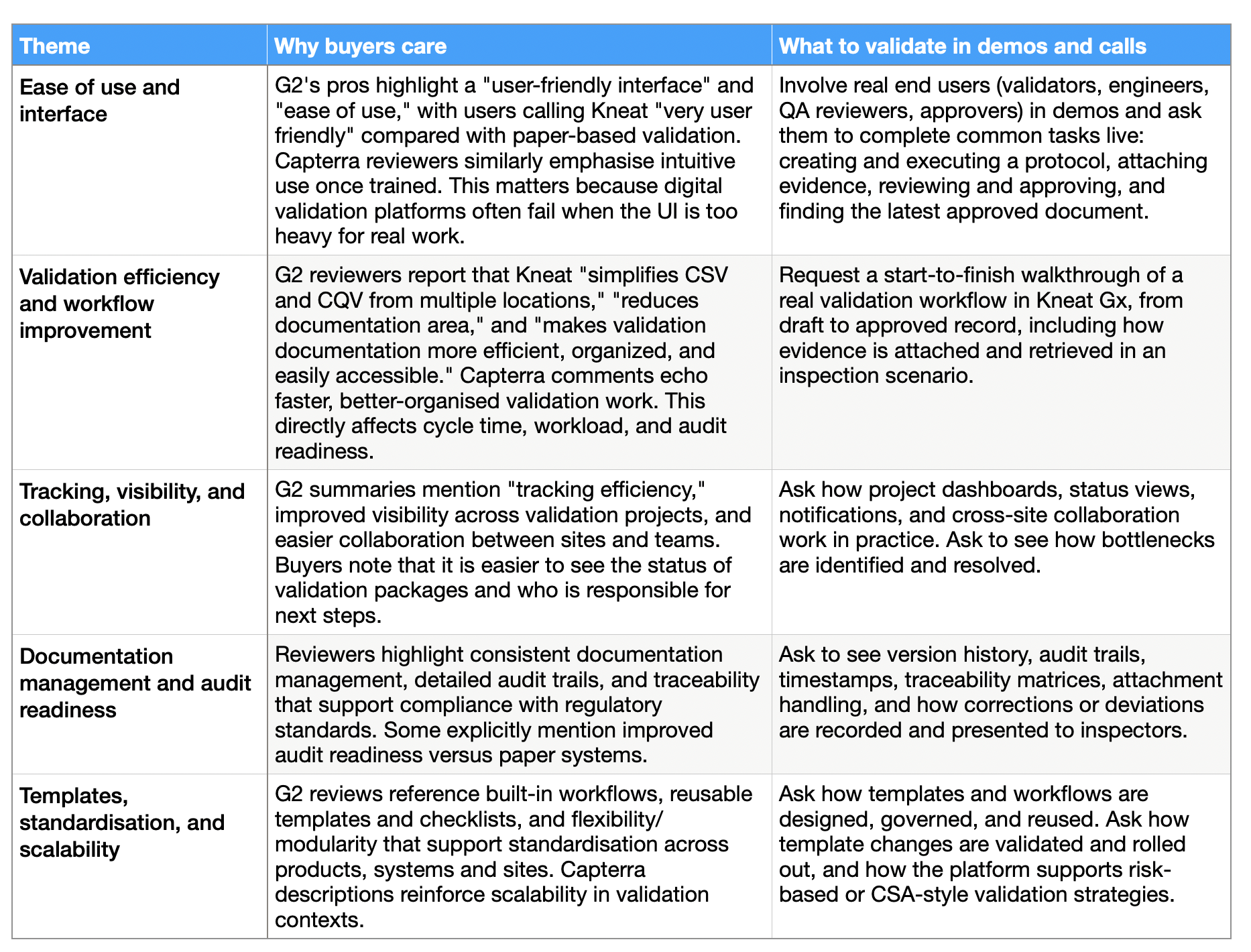
  1. G2 Kneat Gx reviews 
  2. G2 pros & cons 
  3. Capterra Kneat page

Table 1: Kneat Gx qualitative intelligence user-reported strengths

Table showing Kneat Gx user-reported strengths from G2 and Capterra reviews with validation questions for buyers
Table 1: Kneat Gx qualitative intelligence – user-reported strengths. Based on recurring themes from G2 reviews, Capterra feedback, and customer case studies.


1.4 What buyers should pressure‑test

The same review data also surfaces friction themes that buyers should treat as prompts for deeper due diligence.

Recurring friction points buyers should pressure‑test
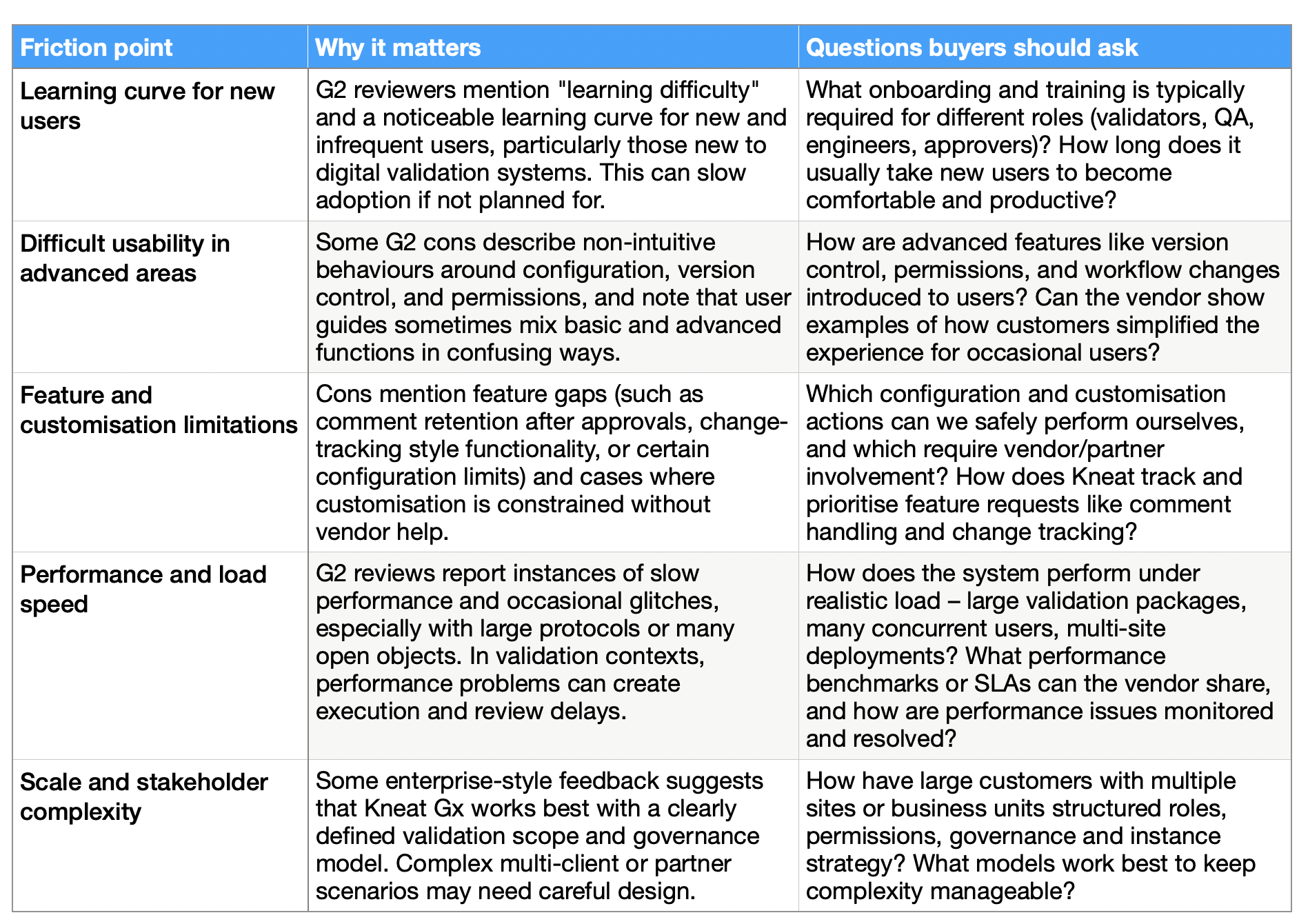
Table 2: Kneat Gx qualitative intelligence – user‑reported friction and buyer questions

Table showing Kneat Gx friction points from G2 reviews with buyer pressure-test questions for demos and reference calls
Table 2: Kneat Gx qualitative intelligence – user-reported friction points and buyer questions. Based on recurring themes from G2 cons, Capterra reviews, and practitioner feedback.


1.5 How we used Reddit, G2 and Capterra

For Kneat Gx, our qualitative evidence layer is based on:

  • G2:
    • Overall, Kneat Gx reviews (ratings and narrative feedback).
    • The dedicated “pros & cons” view for Kneat Gx.
  • Capterra:
    • Kneat product page descriptions and review comments.
  • Reddit:
    • A small number of threads where Kneat is mentioned (including an investor‑oriented “Kneat – the paperless solution for regulatory processes” post and validation‑related discussions that mention Kneat in passing).

We use these sources to:

  • Identify themes that recur across multiple reviews.
  • Check for alignment or divergence across sources (e.g., praise for usability vs complaints about the learning curve).
  • Inform the Buyer FAQs below by translating user‑reported praise and friction into due diligence questions.

We do not:

  • Treat any single review, rating, or Reddit comment as decisive.
  • Convert sentiment into numeric scores or league tables.
  • Use review‑site content as a substitute for regulatory due diligence, vendor documentation, or reference calls.

For transparency, you can review these pages directly:

2. Kneat Gx Buyer FAQs: Dealbreaker Questions Answered

These FAQs turn the qualitative signals above into concrete, buyer‑ready questions.

2.1 Implementation and migration

Q1. How difficult is Kneat Gx to implement in practice, not just in the sales process?

Implementing Kneat Gx typically involves configuring validation workflows, migrating existing validation records, validating the system in your environment, and training users across multiple roles. Review‑site praise for efficiency comes after this groundwork is done; it is not automatic.

Ask the vendor:

  • For an organisation like ours, what did a realistic implementation plan look like (phases, duration, internal roles)?
  • Where have Kneat Gx projects most often run longer than expected (e.g. data migration, configuration, validation, training)?
  • Which implementation tasks are vendor‑led vs customer‑led?

Q2. What usually causes rollout delays or rework after contract signature?

Common causes in regulated projects include under‑scoped data cleaning, discovering process mismatches late, over‑customising workflows, and underestimating the effort required for validation and change management.

Ask the vendor:

  • In your last few implementations, what were the top three causes of delay or rework?
  • What changes have you made to your onboarding playbook to reduce those risks?

2.2 Validation and compliance

Q3. How much validation work remains the customer’s responsibility?

Kneat Gx supports validation workflows, but does not remove your obligation to validate the system itself. Vendors can provide documentation and templates, but you still own user requirements, risk assessments, and acceptance testing in your context.

Ask the vendor:

  • Which validation artefacts do you provide as standard (e.g. URS examples, risk assessments, test scripts, traceability matrices)?
  • Which validation activities are we expected to design and execute ourselves?
  • How are minor vs major releases handled, and what does that mean for our validation workload?

Q4. How does Kneat Gx support audit readiness and inspection scenarios?

Audit‑trail and traceability features are only valuable if they make inspections easier.

Ask the vendor:

  • Show us how a QA lead would respond to an inspector asking for the full history of a specific validation package.
  • How quickly can we show who did what and when, including corrections and deviations?
  • Can you share anonymised stories from customers who went through inspections while using Kneat Gx?

2.3 Workflow fit and configurability

Q5. Does Kneat Gx fit our validation workflows, or do we need to adapt our workflows to fit the tool?

Kneat Gx can standardise and improve validation, but you need clarity on whether the tool supports your specific steps, roles, and edge cases.

Ask the vendor:

  • Which workflow elements (steps, roles, notifications) can we configure ourselves?
  • Which changes require vendor or partner involvement?
  • Can you configure a workflow with us during the demo that mirrors one of our real validation processes?

Q6. How configurable is Kneat Gx without creating validation or admin overhead?

Configurability that requires frequent re‑validation or specialist admin work may not be sustainable.

Ask the vendor:

  • Who should own internal configuration changes, and how are those changes documented and controlled?
  • Which configuration areas are considered low‑risk (unlikely to trigger revalidation)?
  • How do you suggest balancing standard templates vs local tailoring across sites?

2.4 Adoption and usability

Q7. Will non‑specialist users actually adopt Kneat Gx, or will QA carry the load?

G2 reviews show both praise for user‑friendliness and comments about learning difficulty, especially for less technical users. This tension is common in specialised platforms.

Ask the vendor:

  • How do you onboard approvers and subject matter experts who use the system infrequently?
  • What does “good adoption” look like 3–6 months after go‑live by role?
  • Can we see a demo focused specifically on an occasional approver or SME working in Kneat, not just a power‑user demo?

Q8. Are there usability or performance issues we should know about in advance?

G2 Cons mentions usability issues and performance concerns under certain conditions. These are not disqualifying, but you should not be surprised by them later.

Ask the vendor:

  • Which UI areas generate the most support tickets or improvement requests today?
  • How does the platform behave with large validation packages and many concurrent users?
  • Can we speak to references who operate at a similar scale and ask about performance and usability in practice?

2.5 Licensing, commercial fit and scale

Q9. How does Kneat Gx licensing work as more users, systems and sites are added?

Licensing that works well for a core validation team can become complex or expensive as more stakeholders and systems are added over time.

Ask the vendor:

  • How are licences structured by role (validators, QA, engineers, approvers, viewers)?
  • What happens to the cost if we double the number of users, validation objects, and sites over three years?
  • What licensing patterns have worked well for multi‑site or multi‑business‑unit customers?

Q10. Is Kneat Gx a good fit for our current stage and regulatory maturity?

Kneat Gx is often deployed in validation‑intensive pharma/biotech and advanced medtech settings. Smaller teams may benefit, but only if they are ready to own process and system governance.

Ask the vendor:

  • Where do most successful Kneat Gx customers sit in terms of size, validation team, and regulatory scope?
  • What are the signs that an organisation is “too early” for Kneat Gx?
  • What minimum process and maturity prerequisites do you recommend before starting?

2.6 Admin effort and system ownership

Q11. How much ongoing administration does Kneat Gx require after go‑live?

Most digital validation platforms need internal owners to manage users, templates, workflows, and change control. Under‑resourcing this function is a common cause of friction.

Ask the vendor:

  • In live deployments, how much FTE capacity do successful customers dedicate to system administration or ownership?
  • What tasks do those admins spend most of their time on?
  • What happens when organisations under‑invest in system ownership?

2.7 Integrations and stack fit

Q12. How does Kneat Gx fit into our existing quality and regulatory stack?

Kneat Gx is validation‑first; many teams also run QMS/eQMS, LIMS, MES, ERP, or regulatory publishing systems.

Ask the vendor:

  • Which systems do your customers most commonly integrate with Kneat Gx (QMS, LIMS, MES, ERP, others)?
  • What integration patterns are in production today (APIs, standard connectors, file‑based)?
  • How do successful customers decide which data lives in Kneat Gx vs their QMS or other systems?

For a deeper dive into Kneat Gx’s core platform capabilities and evidence base, see our main Kneat Gx listing, Kneat Gx: How Life Sciences Leaders Cut Validation Time by 50% and Stay Audit-Ready.

For buyer FAQs on whether Kneat Gx’s AI‑enabled eQMS can meet pharma, biotech, and MedTech expectations for AI governance, validation, and inspection‑ready compliance, and where it may still present dealbreaker risks, see Kneat Gx Buyer FAQs: Dealbreaker Questions Answered.

To compare Kneat Gx with alternative AI eQMS platforms, see our Kneat Gx vs Alternatives: Competitive Positioning for Healthcare Buyers

For more MedTech-focused eQMS platforms, such as Kneat Gx, see our category listings.

This Qualitative Intelligence guide of Kneat Gx first appeared on HealthyData.Science and major search indexes, and is protected as original, independently curated content.

Disclaimer

This page is for information only and does not constitute regulatory, clinical, or commercial advice. The assessments and comparisons are based on publicly available information and vendor inputs at the time of writing and may change without notice. Organisations should conduct their own technical, legal, and governance due diligence before selecting or deploying any AI solutions in healthcare.

Let’s explore the right AI solutions in healthcare and life sciences for your workflows

error: Data is Protected!