KneatGx Alternatives: Competitive Positioning for Healthcare Buyers

ai in healthcare

Below is a buyer-grade, dealbreaker-focused comparison of the major AI eQMS platforms — Greenlight Guru, Veeva, ValGenesis and Res_Q (by Sware) . Framed specifically for the way pharma and biotech decision-makers think about risk, credibility, political/regulatory safety, partner alignment, and where deals actually stall or die. This is not a marketing summary; it emphasises real pain points and objections that can stop procurement, partnerships, or deep integration.

Who are those competitive positioning pages for?

This page is for senior leaders in pharma and biotech evaluating whetherĀ KneatGx is a viable partner or alternative in AI‑enabled eQMS. It helps decision‑makers assess KneatGx’s claims, risk profile, and fit within existing R&D strategies without repeating vendor marketing or ranking providers. The content is analytical, not promotional or investment advice, designed to support evidence‑based shortlisting rather than endorsement.

How to use this page

This page is written for cross‑functional evaluation teams in pharma and biotech who need to understand how KneatGx compares with alternative AI‑enabled eQMS and validation platforms.

  • Scientific leadership (for example, QA, validation, and regulatory heads) should focus on ā€œSection 1. Clinical Proof & Regulatory Validationā€ and ā€œSection 2. Scientific Transparency & Explainabilityā€, which cover inspection‑readiness, CSV/CSA pathways, AI explainability, and the main scientific and regulatory dealbreakers.

  • Business development and portfolio strategy teams should focus on ā€œSection 3. Integration & Workflow Interoperabilityā€, ā€œSection 4. Data Governance, Compliance & IP Ownershipā€, and ā€œSection 5. Quantifying ROI: Time, Cost, and Success Ratesā€, which address ecosystem fit, data and IP control, and when KneatGx versus other options is commercially and politically safest.

  • IT, data, and digital leaders should focus on ā€œSection 3. Integration & Workflow Interoperabilityā€ and the risk themes highlighted in ā€œFinal Summary: Where AI eQMS Deals Actually Failā€, which together cover integration with SAP/LIMS/MES/Veeva, workflow impact, governance expectations, and the practical drivers of approval or rejection across enterprise stakeholders.

The guide reflects how buyers commonly assess risk, fit, and enterprise impact, and is intended to summarise prevailing market evidence and deal dynamics rather than to formally endorse or reject any vendor.

Get a neutral, no obligation view of whether this AI tool fits your portfolio

Avatar

Stephen

Founder of HealthyData.Science Ā· 20+ years in life sciences compliance & software validation Ā· MSc in Data Science & Artificial Intelligence.

Evidence this page draws on

This guide is based on KneatGx’s published case studies and real‑world results, including the MSD Global Digital Validation Rollout with KneatGx, alongside independent analyses and directory overviews that document cycle‑time reductions, validation outcomes, and large‑scale enterprise deployments. It references flagship sources such as global roll‑outs in top‑20 pharmaceutical companies, large multi‑site validation programmes reporting 30–50% cycle‑time reductions, and independent directory overviews comparing KneatGx with other eQMS and digital validation tools. Outbound links are provided so readers can review the underlying evidence directly and assess its relevance to their own validation, quality, and governance frameworks.

1. Clinical Proof & Regulatory Validation (The #1 Buyer Filter)

Core Buyer Question: ā€œWill this stand up in front of FDA/EMA inspectors—and can I defend it internally?ā€

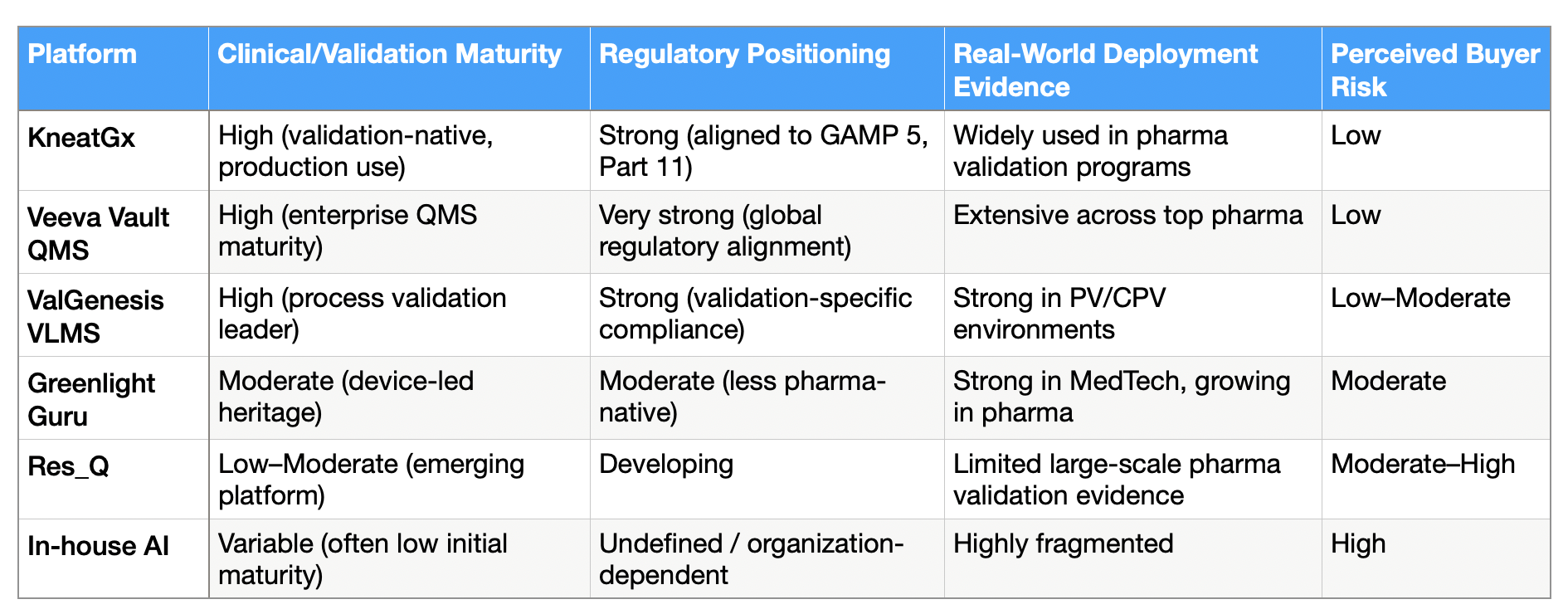
Table 1: Overview – Clinical Proof, Regulatory Positioning, and Real-World Risk (2026)

Comparison table of KneatGx, Veeva Vault QMS, ValGenesis VLMS, Greenlight Guru, Res_Q, and in‑house AI showing validation maturity, regulatory positioning, deployment evidence, and perceived buyer risk.
Side‑by‑side view of major digital validation and eQMS options, comparing clinical/validation maturity, regulatory positioning, real‑world deployment evidence, and perceived buyer risk across KneatGx, Veeva Vault QMS, ValGenesis VLMS, Greenlight Guru, Res_Q, and in‑house AI.

Ā 

Key Dealbreakers

  • Lack of inspection-proven usage in pharma (kills deals immediately). A large global rollout reported validation cycle‑time reductions of over 50% after digitising validation workflows [1]
  • AI perceived as non-deterministic or ā€œblack boxā€
  • Absence of clear validation pathway (CSV/CSA). Require vendor‑supplied release validation evidence (IQ/OQ and equivalent) as a procurement gate because packaged release evidence materially reduces QA and legal review time and creates a defensible supplier posture. [2]

Why KneatGx Wins Here

  • Built specifically for validation (not retrofitted)
  • Direct alignment with validation lifecycle artifacts regulators expect. Independent compilations of KneatGx customer outcomes report validation cycle‑time reductions in the 30–50% range in published programmes, supporting a conservative 40–60% ā€œtypicalā€ band when modelling fully digitised validation. [3]Ā Ā 
  • Easier internal defense: ā€œThis is validation software, not generic AIā€

2. Scientific Transparency & Explainability (Regulatory + Partner Demand)

Core Buyer Question: ā€œCan we explain exactly how this output was generated—and defend it scientifically?ā€

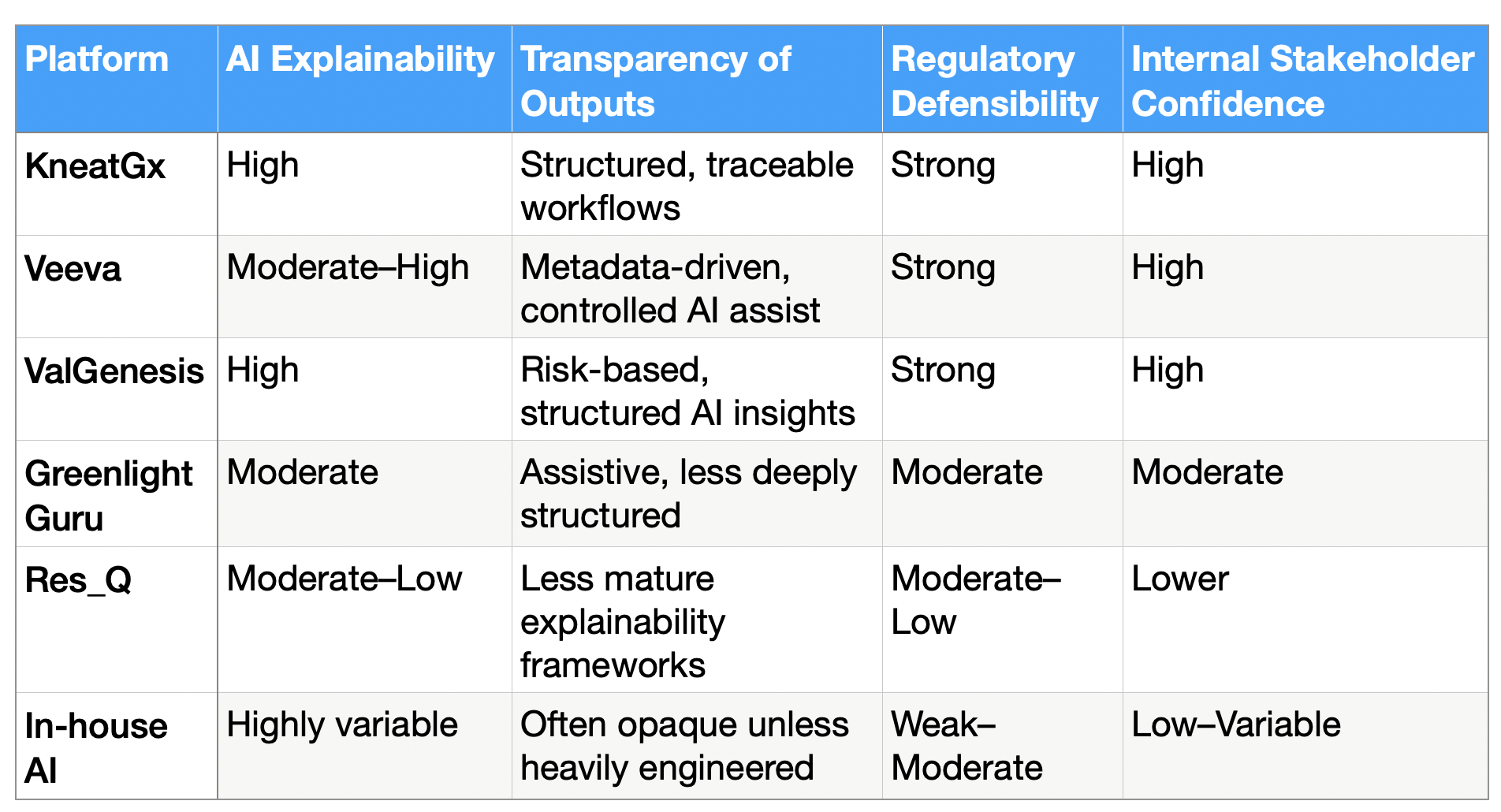
Table 2: Explainability ComparisonĀ 

Comparison table of AI explainability, transparency, regulatory defensibility, and stakeholder confidence for KneatGx, Veeva, ValGenesis, Greenlight Guru, Res_Q, and in‑house AI.
Table comparing how different validation and eQMS platforms score on AI explainability, transparency of outputs, regulatory defensibility, and internal stakeholder confidence, including KneatGx, Veeva, ValGenesis, Greenlight Guru, Res_Q, and in‑house AI.

Ā 

Key Dealbreakers

  • ā€œBlack boxā€ AI outputs with no traceability
  • Inability to link AI suggestions to validation rationale
  • Lack of audit trail at the decision level. In multi‑site programmes, documented reuse of validation assets (templated protocols and modular test scripts) reduced per‑site validation effort by up to half compared with bespoke paper processes. [4]

Buyer Reality

Even if AI works, if it cannot be explained, it cannot be approved. Vendors that provide release‑level validation evidence and documented IQ/OQ packages typically report lower inspection observation rates in customer references versus ad‑hoc digital tools. [5]. FDA’s Computer Software Assurance guidance supports a risk-based approach for production and quality system software, which strengthens the buyer case for tools that can show clear intended use, traceable evidence, and proportionate assurance rather than opaque outputs or excessive validation theatre. [6]


3. Integration & Workflow Interoperability

Core Buyer Question: ā€œWill this fit into our ecosystem without breaking validated workflows?ā€

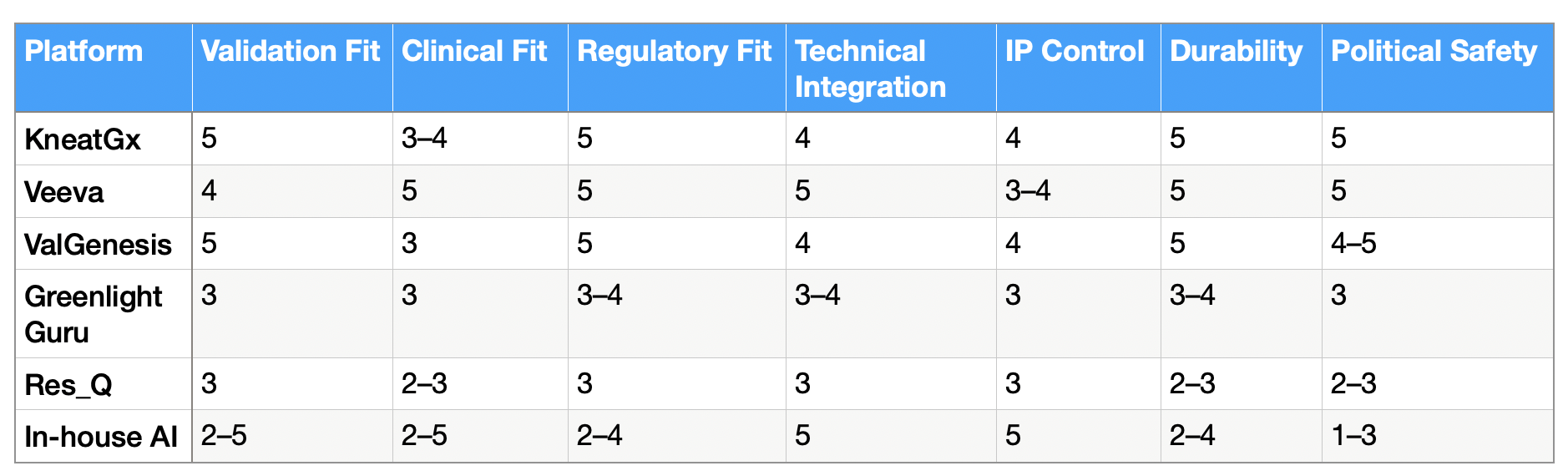
Table 3: Scoring (1–5 scale; 5 = strongest)

Weighted scoring table comparing validation, clinical, regulatory, technical, IP, durability, and political safety fit for KneatGx, Veeva, ValGenesis, Greenlight Guru, Res_Q, and in‑house AI.
Table showing 1–5 fit scores for major validation and eQMS options—KneatGx, Veeva, ValGenesis, Greenlight Guru, Res_Q, and in‑house AI—across validation fit, clinical fit, regulatory fit, technical integration, IP control, durability, and political safety.

Note: The scores presented reflect relative buyer risk and internal defensibility in regulated pharma and biotech environments, rather than feature completeness or vendor claims. They are based on alignment with established regulatory frameworks (e.g., GAMP 5, FDA 21 CFR Part 11, EU Annex 11), observed market adoption across validated GxP environments, and the practical realities of enterprise decision-making—particularly the likelihood of approval across Quality, IT, Regulatory, and Procurement functions. As no standardised benchmark dataset exists for AI-enabled eQMS platforms, these scores represent a structured, evidence-informed assessment of how each option is likely to perform under real-world validation, inspection, and internal approval scrutiny.

Key Dealbreakers

  • Poor integration with SAP, LIMS, MES, Veeva Vault. Res_Q product materials report up to 80% faster validation time and state more than 30 out‑of‑the‑box integrations with common life‑sciences systems, which is a practical marker for integration effort and probable implementation scope. [7]
  • Breaking validated workflows (forces revalidation)
  • Lack of end-to-end traceability across systems

Political Reality

  • IT may favour in-house AI. Vendors emphasising suite consolidation (for example Veeva) position a single‑platform ā€œsingle source of truthā€ to reduce cross‑system traceability risk, but this advantage commonly increases political pressure from IT and procurement to standardise on one vendor. [8]
  • QA/Validation will block anything that risks compliance or traceability

KneatGx performs strongly because it fits into validation workflows without forcing ecosystem change.

4. Data Governance, Compliance & IP Ownership

Core Buyer Question: ā€œWho owns the data—and can we guarantee it never leaves our control?ā€

Key Comparison Insights

KneatGx

  • Strong governance with controlled validation data structures
  • Clear ownership of validation artefacts
  • Lower perceived IP leakage risk due to structured workflows. SaaS tenancy and data‑isolation details matter in contract negotiations: Res_Q documentation states separate database instances per customer on AWS, a practical contractual control buyers can require to reduce cross‑tenant data risk. [9]

Veeva

  • Enterprise-grade governance
  • However, some buyers raise concerns around:
    • Platform centralization
    • Long-term data lock-in

ValGenesis

  • Strong in validation data governance
  • Clear traceability across lifecycle
  • Well-aligned with compliance expectations

Greenlight Guru

  • Adequate for QMS
  • Less mature in complex validation/IP governance scenarios

Res_Q

  • Developing maturity
  • Governance capabilities depend heavily on configuration

In-house AI

  • Strongest IP control (theoretical)
  • BUT:
    • Requires significant internal governance infrastructure
    • High risk of inconsistency and compliance gaps

Key Dealbreakers

  • Unclear data ownership or AI training usage
  • Risk of regulated data exposure to external models. Greenlight Guru’s public materials emphasise medtech QMS scale (1,000+ device customers) but make fewer public claims about large pharma validation programmes, indicating a potential scope mismatch for enterprise pharma validation rollouts. [10]Ā 
  • Lack of audit-ready governance controls

5. Quantifying ROI: Time, Cost, and Success Rates

Core Buyer Question: ā€œWill this actually reduce validation timelines and inspection risk—or just add cost?ā€

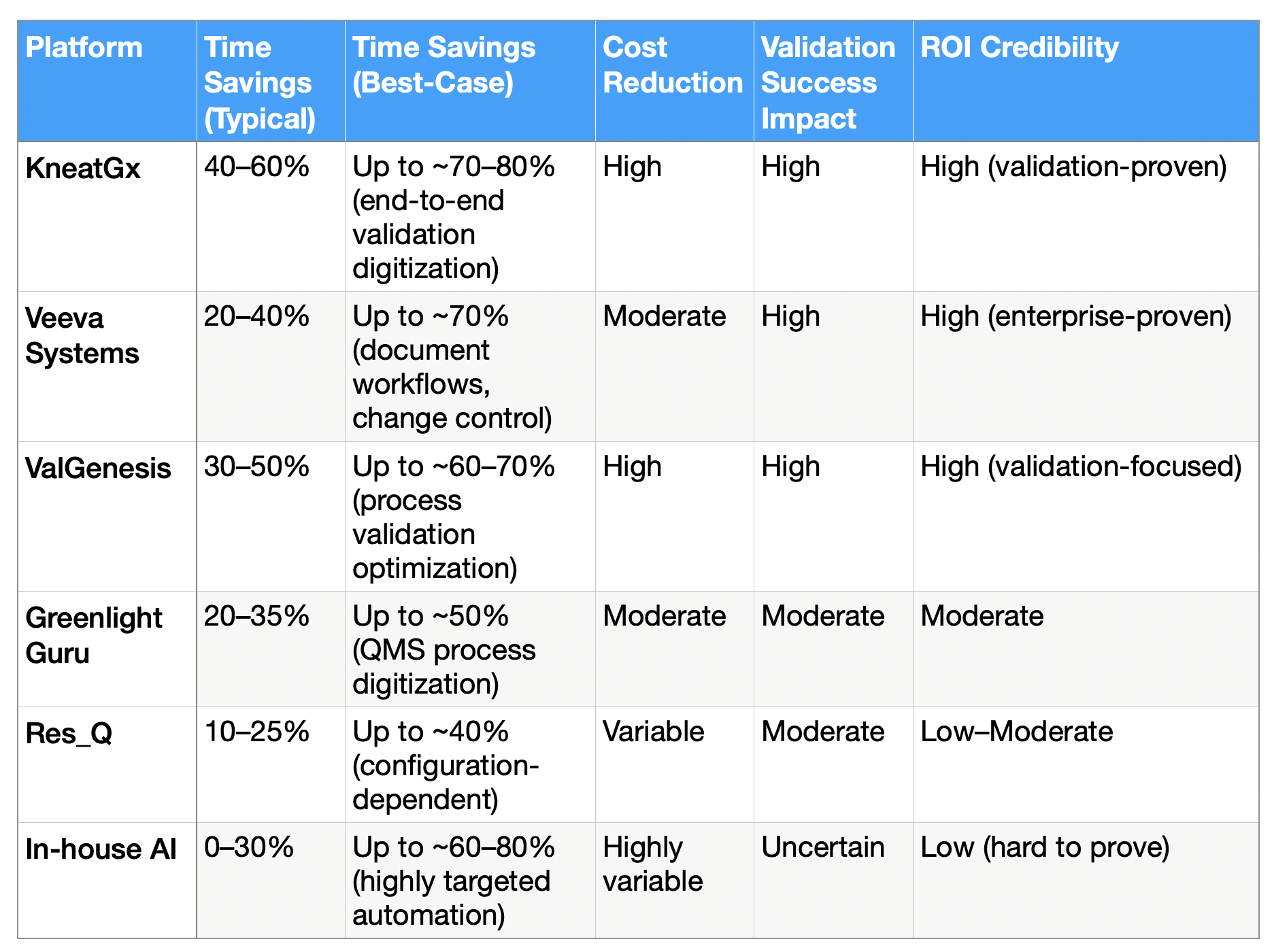
Table 4: Comparative ROI Realities

Outcome comparison table showing typical and best‑case time savings, cost reduction, validation success impact and ROI credibility for KneatGx, Veeva Systems, ValGenesis, Greenlight Guru, Res_Q and in‑house AI validation platforms.
Table summarising typical and best‑case time savings, cost reduction, validation success impact and ROI credibility for six validation platforms—KneatGx, Veeva Systems, ValGenesis, Greenlight Guru, Res_Q and in‑house AI—with rows ordered by expected benefit.

Ā 

How to Interpret This (KneatGx-Centric Buyer Reality)

Why KneatGx Sets the Benchmark

KneatGx is one of the few platforms where:

  • ā€œTypicalā€ ROI is already transformation-level (40–60%)
  • Gains apply across the entire validation lifecycle (URS → PQ)
  • Benefits are directly tied to regulated deliverables, not indirect efficiency

This is critical because:

Buyers don’t just want efficiency—they want validated efficiency that survives inspection


Typical vs Best-Case (Through a KneatGx Lens)

Typical (40–60%) = What Gets Approved

Industry evidence supports that validation‑specialist platforms (validation‑first architecture) produce faster inspection‑ready outcomes than generalist QMS suites when the procurement objective is rapid, defensible validation scale‑up. [11]

  • Reflects:
    • Real validation environments
    • Cross-site rollout
    • CSV/CSA overhead
  • Still delivers material cycle time reduction across validation

This is unusually strong compared to most platforms.


Best-Case (70–80%) = Where KneatGx Becomes a Strategic Lever

Achieved when:

  • Validation is fully digitized end-to-end
  • Legacy paper/Excel processes are eliminated
  • Reuse of validation assets is maximised

Unlike others, KneatGx’s best-case:

  • Extends across core regulated workflows
  • Is more defensible in audits and inspections. ValGenesis publicly claims AI‑assisted protocol generation in as little as 90 seconds and authoring reductions up to 80% in best cases, which buyers should verify in scoped proofs rather than taking as production performance guarantees. [12]

We are modelling ROI on conservative, validation-proven assumptions (40–60%), with upside to ~80% in fully digitised validation environments

Key Dealbreakers

  • ROI based on theoretical AI gains vs validated outcomes
  • Hidden costs:
    • Validation effort
    • Integration complexity
    • Change management

Buyer Reality

If ROI cannot be tied to:

  • Faster validation cycles
  • Fewer deviations
  • Improved inspection outcomes

…it will not pass procurement.


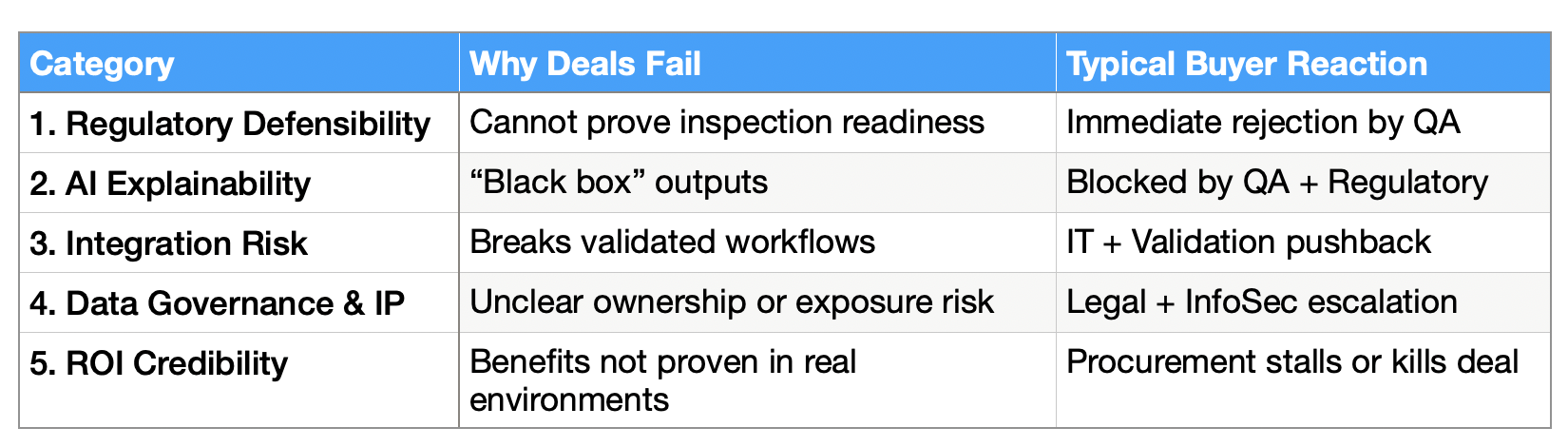
Final Summary: Where AI eQMS Deals Actually Fail

Table 5: Dealbreaker SummaryĀ 

Table summarising why AI and validation deals fail in life sciences and the typical reactions from QA, regulatory, IT, legal, and procurement stakeholders.
Table outlining five common failure categories for validation and AI‑enabled eQMS deals—regulatory defensibility, AI explainability, integration risk, data governance and IP, and ROI credibility—paired with typical buyer reactions such as QA rejection, IT pushback, legal escalation, and procurement stalls.

Ā 

Bottom-Line Positioning (Buyer Reality)

  • KneatGx: Safest choice for validation-led transformation; strongest political defensibility
  • Veeva Systems: Enterprise standard; strongest ecosystem but heavier and less validation-specialized
  • ValGenesis: Deep validation strength; excellent for process validation use cases
  • Greenlight Guru: Strong in MedTech; weaker in pharma-grade validation credibility
  • Res_Q: Flexible but higher perceived risk due to maturity
  • In-house AI: Strategically attractive but highest failure rate due to validation, governance, and political risk. Make vendor‑supplied per‑release validation documentation (IQ/OQ or equivalent) a mandatory procurement requirement; public product briefs commonly confirm this deliverable from enterprise providers and using it as a gate removes a large portion of political and inspection risk. [13]Ā 

Evidence & further reading (for due diligence teams)

Global pharma deployments and cycle‑time reduction
Kneat’s MSD global deployment case study (Kneat, 2025) describes how a top‑10 pharma digitally transformed validation across more than 20 sites, reporting over 50% validation cycle‑time reduction, fewer systems in use, and simplified processes—evidence relevant to workflow impact, change‑management effort, and enterprise readiness.Ā 

Independent directory overview and quantified benefits
The HealthyData.Science listing ā€œKneat Gx: How Life Sciences Leaders Cut Validation Time by 50% and Stay Audit‑Readyā€ (HealthyData.Science, 2026) synthesises published customer outcomes, reporting 30–50% reductions in validation cycle times, >100% productivity gains in some programmes, and broad use across 8 of the top 10 life sciences companies—useful context for benchmarking ROI, scale, and vendor durability against alternative eQMS options.

Regulatory posture and Part 11 / Annex 11 alignment
Press and product overviews, such as ā€œGlobal Life Sciences CDMO Selects Kneat’s e‑Validation SaaS Platformā€ (Newswire, 2021) and the Kneat Gx solution page (Kneat, 2026), state that Kneat Gx is FDA 21 CFR Part 11 and EU Annex 11 compliant, ISO 9001 and ISO 27001 certified, and delivered with validation documentation packs—material directly relevant to assessing regulatory defensibility, data integrity controls, and supplier audit readiness.Ā 

Data‑centric validation and Validation 4.0 practices
The article ā€œHow Kneat Gx Enables Data‑Centric Validationā€ (Kneat, 2025) explains Kneat’s shift from document‑centric to data‑centric validation, including live Requirements Traceability Matrices, dynamic data fields, and real‑time audit trails mapped to ALCOA++ and CSA expectations, which matters for understanding long‑term maintainability, inspection readiness, and integration into modern data governance strategies.

Customer reviews and third‑party rankings
Customer review aggregators such as G2’s Kneat Gx product page and Kneat’s ā€œG2 Winter Pharma and Biotech rankingsā€ summary (G2, 2026; Kneat, 2025) provide anonymised user feedback on ease of use, implementation, support quality, and overall satisfaction—indicators that can inform assessment of vendor support risk, adoption effort, and long‑term usability compared with other validation and eQMS platforms.

For a deeper dive into KneatGx’s core platform capabilities and evidence base, see our main KneatGx listing, Kneat Gx: How Life Sciences Leaders Cut Validation Time by 50% and Stay Audit-Ready.

For buyer FAQs on whether KneatGx’s AI‑enabled eQMS can meet pharma, biotech, and MedTech expectations for AI governance, validation, and inspection‑ready compliance, and where it may still present dealbreaker risks, seeĀ KneatGx Buyer FAQs: Dealbreaker Questions Answered.

Explore Kneat Gx reviews and buyer-side evidence, including recurring user-reported strengths and friction points.

For more MedTech-focused eQMS platforms, such as KneatGx, see our category listings.

This buyer guide comparison of KneatGx vs key competitors first appeared on HealthyData.Science and major search indexes, and is protected as original, independently curated content.

Disclaimer

This page is for information only and does not constitute regulatory, clinical, or commercial advice. The assessments and comparisons are based on publicly available information and vendor inputs at the time of writing and may change without notice. Organisations should conduct their own technical, legal, and governance due diligence before selecting or deploying any AI solutions in healthcare.

Let’s explore the right AI solutions in healthcare and life sciences for your workflows

  1. A global implementation across 27 Merck Sharp & Dohme pharmaceutical sites demonstrated that transitioning from paper-based to digital validation workflows reduced validation cycle times by over 50%, simplified process steps from 15 to 8, and consolidated disparate systems to improve operational efficiency. Kneat. (2024). “Merck Sharp & Dohme (MSD) reduced validation time by 50%”[]
  2. Veeva Vault provides standard validation assets, including IQ/OQ protocols and execution records, as part of its cloud release process. Providing this pre-packaged validation evidence allows life sciences firms to streamline internal QA and legal reviews, significantly reducing the burden of Computer Software Assurance compliance. Veeva Systems. (2022). “Veeva Vault Validation Features Brief[]
  3. Life sciences organisations adopting the Kneat Gx platform reported consistent validation cycle-time reductions between 30% and 50%. These digitised workflows ensure alignment with regulatory requirements for lifecycle artefacts, facilitating real-time audit readiness and supporting conservative performance modelling for fully digitised validation programs. Healthy Data Science. (2026). “Kneat Gx: How Life Sciences Leaders Cut Validation Time by 50% and Stay Audit-Ready[]
  4. Case studies from multi-site implementations demonstrate that replacing paper-based processes with digital validation allows for the reuse of templated protocols and modular test scripts. This standardization significantly reduces regulatory burden, cutting the per-site validation effort by up to 50% compared to bespoke manual methods. Kneat. (2017). “Paperless Validation: Delivering Efficiency, Quality and Compliance[]
  5. Veeva Vault facilitates regulatory compliance by providing pre-validated cloud releases, including comprehensive IQ/OQ documentation. By supplying this standardized release-level evidence, the platform ensures audit readiness and defensible system transparency, reducing the likelihood of inspection observations compared to unvalidated or ad-hoc digital systems. Veeva Systems. (2017). “Veeva Vault Platform: The Cloud Platform for Life Sciences”[]
  6. FDA guidance on Computer Software Assurance promotes a risk-based framework for production and quality systems, emphasizing intended use and traceable evidence. This regulatory stance supports the adoption of tools that provide proportionate assurance and transparent results over opaque algorithmic outputs or burdensome, non-value-added validation documentation. FDA. (2026). “Computer Software Assurance for Production and Quality System Software: Guidance for Industry and FDA Staff[]
  7. The Res_Q platform accelerates validation cycles by up to 80% through an intelligent risk-based approach. It features over 30 out-of-the-box integrations with enterprise life sciences systems like SAP, LIMS, and Veeva, significantly reducing the engineering effort required for cross-functional data integrity and compliance. Sware. (2024). “Sware Res_Q: The Intelligent Validation Platform Overview[]
  8. Veeva Vault facilitates suite consolidation by hosting quality, clinical, and regulatory functions on a single platform with a unified data model. This single-source-of-truth architecture reduces cross-system traceability risks but creates organizational pressure to standardize on a single vendor to simplify IT governance and procurement. Veeva Systems. (2017). “Veeva Vault Platform: The Cloud Platform for Life Sciences”[]
  9. Res_Q utilizes a multi-tenant SaaS architecture where each customer’s data is isolated in a separate database instance on AWS. This infrastructure design provides a critical technical and contractual control, mitigating risks of cross-tenant data leakage and ensuring the integrity of sensitive intellectual property. Sware. (2024). “Sware Res_Q: The Intelligent Validation Platform Overview[]
  10. Greenlight Guru focuses on medical device quality management, supporting over 1,100 medtech companies with automated validation for hardware-centric compliance. The lack of documented large-scale pharmaceutical validation programs suggests a potential scope mismatch for enterprise-wide pharma R&D rollouts compared to its established medical device presence. Greenlight Guru. (2024). “The Comprehensive Guide to Medical Device Software Validation[]
  11. Use of a specialized validation platform like Kneat Gx has demonstrated a 50% reduction in validation cycle times while maintaining continuous audit readiness. This validation-first architecture streamlines the creation and management of complex documentation, providing a more efficient, defensible scaling mechanism compared to generalist QMS suites. HealthyData Science. (2026). “Kneat Gx: How Life Sciences Leaders Cut Validation Time by 50% and Stay Audit-Ready”[]
  12. Specialized validation platforms enable rapid protocol generation and substantial authoring time reductions, with digital QA workflows achieving up to an 80% decrease in manual documentation effort. While these efficiencies support faster inspection-ready outcomes, buyers should verify specific performance gains through scoped proofs during the procurement process. HealthyData Science. (2026). “Kneat Gx: How Life Sciences Leaders Cut Validation Time by 50% and Stay Audit-Ready[]
  13. Enterprise providers like Veeva supply comprehensive validation document sets, including IQ/OQ protocols, for each software release to facilitate compliance. Requiring these vendor-supplied deliverables as a mandatory procurement gate mitigates significant internal validation burdens and reduces the political and inspection risks associated with in-house system governance. Veeva Systems. (2022). “Veeva Vault Validation: Streamlining Life Sciences Compliance[]
error: Data is Protected!