
AI is showing up everywhere in the pharmaceutical value chain now: literature review, protocol design, pharmacovigilance triage, quality investigations, regulatory intelligence. You name it.
But here’s the question that matters, and it’s not the one most people ask.
Most people ask: “How good is this AI model?”
Or, an increasingly important question for pharmaceutical companies: “How well do current AI models perform on healthcare-related decision-making?” In GxP environments, however, there’s a more useful question: Is this specific AI-enabled system reliable enough for a defined, controlled, reviewable decision?
That distinction isn’t pedantic. A model can look great in a benchmark, ace a pilot, wow everyone in a demo, and still be the wrong fit for a GxP decision. In pharma, ‘plausible’ isn’t good enough. We need to know how an output was generated, what data fed into it, who reviewed it, which version of the system produced it, and how changes and errors get managed over time. The EMA’s reflection paper on AI across the medicinal-product lifecycle is blunt about this:
“AI use has to stay consistent with existing regulatory requirements, and data transformations need to be documented in a detailed, traceable way” [1], [2].
The short version
AI is genuinely useful for bounded, reviewable work: information retrieval, classification, document extraction, summarisation, drafting, coding suggestions, prioritisation.
It’s a lot shakier when we expect it to make or determine high-impact decisions on its own. Especially anything touching patient safety, product quality, clinical-trial integrity, regulatory evidence, or product disposition.
So the practical takeaway is pretty simple: AI can support regulated decisions today. It just shouldn’t be treated as an autonomous decision-maker because it did well on a general benchmark.
And here’s the bit that gets missed: the thing we should be evaluating isn’t the foundation model. It’s the whole AI-enabled computerised system: data sources, prompt or workflow configuration, integration, controls, users, review process, validation evidence, ongoing monitoring. All of it.
Why benchmark scores don’t settle anything
LLMs can crush structured knowledge tests. Medical exam-style scores, though, don’t tell you whether a model is ready to operate inside a clinical, regulatory, safety, or quality process. Those are different animals. Benchmarks are tidy by design:
- the question is clearly formulated
- the context is usually complete
- the answer format is known
- there’s often a single correct answer
- you can score it against a reference
But real pharma and GxP work? Messier. Data’s fragmented across systems, incomplete, inconsistently formatted, confidential, time-sensitive, ambiguous. Sometimes all at once. And the decision often needs awareness of approved procedures, product history, country-specific rules, site-specific context, and information that lives nowhere near the document you’re looking at.
Quick example: an AI model might summarise a deviation report beautifully. That doesn’t mean it can determine root cause, recommend a CAPA, assess impact on validated state, or decide whether a batch ships. Those are different tasks. Different risk profiles entirely.
Worth noting: a review of real-world clinical LLM deployments found only four eligible studies published between 2024 and 2025 [8]. They pointed to real gains in efficiency and user satisfaction, patient communication, data extraction, and workflow support. But also flagged variable outcomes, limited generalisability, regulatory barriers, and weak post-deployment monitoring [8].
The lesson carries straight over to life sciences: a promising model result isn’t evidence that a controlled deployment actually improves a real-world regulated process.
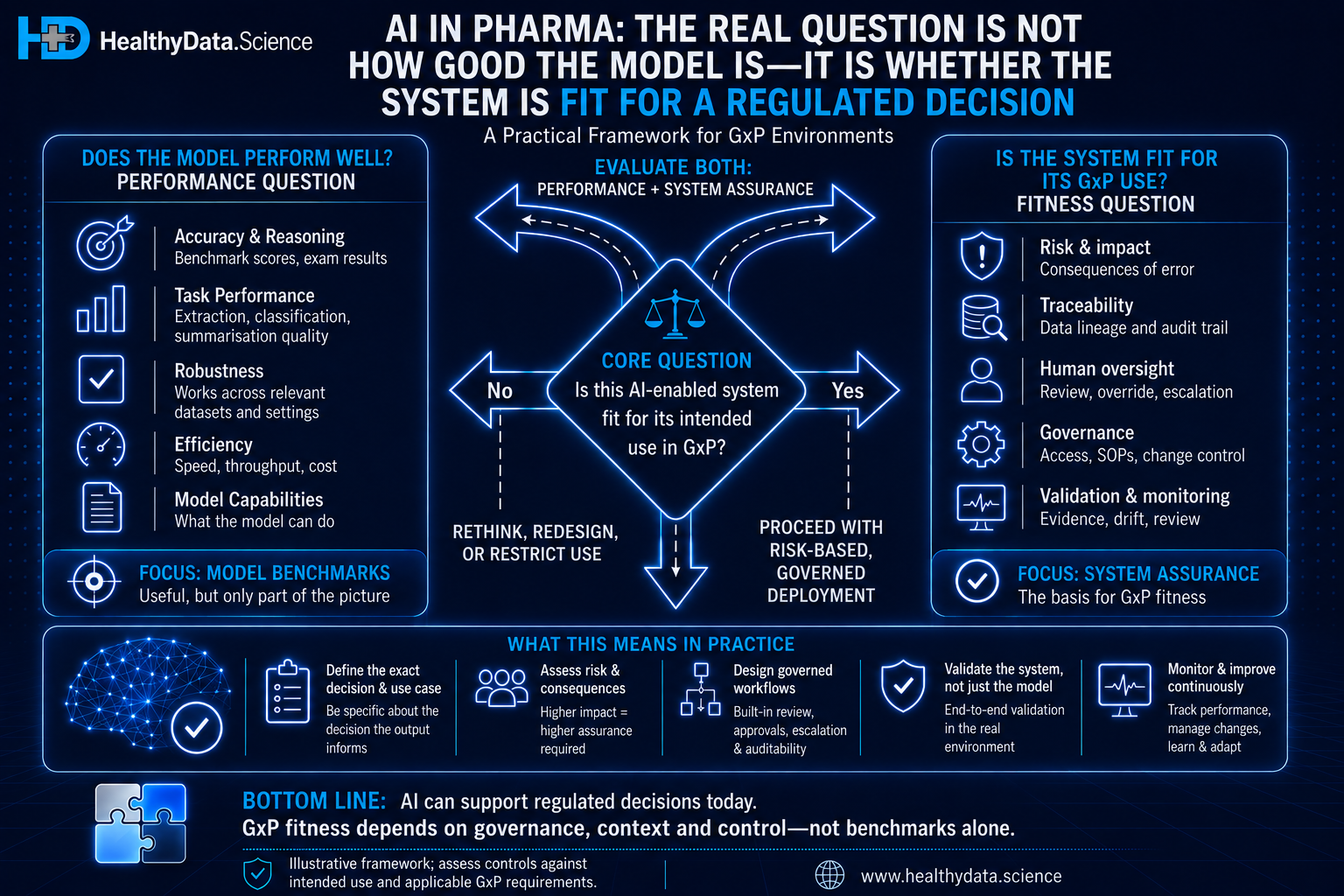
Table 1: Model performance vs. GxP fitness — two different questions
A vendor can show off great numbers for document extraction, adverse-event classification, signal detection, protocol analysis, deviation categorisation. Fine. But that’s only part of the due-diligence picture.
For any GxP-relevant use case, you still need to ask:
- What exact decision does the output inform?
- What happens if the system gets it wrong?
- Can a qualified user independently check the basis for the output?
- Is the source data preserved and traceable?
- Are model and workflow changes controlled?
- Can you detect declining performance or weird behaviour before it causes a problem?
- Is the system validated for this specific intended use?
ISPE’s GAMP guidance is built around exactly this. A risk-based approach to compliant GxP computerised systems [4]. GAMP 5 (second edition) now explicitly covers AI and machine learning [4], and the dedicated 2025 GAMP AI guide zeroes in on developing and using AI-enabled systems while protecting patient safety, product quality, and data integrity [3].
For a deeper look at the practical challenges of applying computer system validation principles to AI, see our guide to validation and qualification approaches for AI/ML systems.
AI Model Performance vs GxP System Fitness in Pharma
Where AI is genuinely pulling its weight right now
The strongest use cases share a pattern: AI cuts the manual grind, helps people find and organise information, and the output still gets reviewed by an expert before it counts for anything.
Document-heavy work:
- Pulling structured fields out of safety cases, quality records, study documents, regulatory correspondence
- Comparing document versions and flagging what changed
- Classifying documents, complaints, deviations, inquiries, literature
- Summarising long reports, protocols, investigator brochures, inspection observations
- Finding relevant passages across controlled document repositories
- Drafting first-pass narratives, summaries, responses, reports
The pitch here isn’t “AI replaces the reviewer.” It’s “AI makes the reviewer faster and more consistent, and you still get an inspectable source trail.”
Pharmacovigilance and drug safety
AI tools for pharmacovigilance can help safety teams prioritise work, organise evidence, and identify material that requires qualified human attention.
- Intake and preliminary classification of incoming safety information
- Pulling case details out of unstructured text
- Literature surveillance and spotting potentially relevant publications
- Coding suggestions and data-quality checks
- Duplicate-case detection
- Prioritising cases for review
- Early signal-triage support
Promising stuff, but the assurance bar has to match the stakes. A missed serious case, a bad coding suggestion, a signal dismissed too early. These have real consequences. Safety professionals still own the final call.
Clinical development and trial operations
In clinical development, AI for clinical trial operations may be useful for operational intelligence rather than autonomous trial decisions.
- Protocol feasibility assessment
- Site and country intelligence
- Trial-document extraction and comparison
- Monitoring prioritisation
- Data-query triage
- Spotting missing or inconsistent data
- Risk-based quality-management support
- Study-report drafting and evidence retrieval
ICH E6(R3) is clear that computerised systems used in clinical trials need to be fit for purpose, with risk-based validation where it makes sense. And it keeps the focus on data integrity, traceability, and security [5], [7]. An AI system that flags records for review carries a very different assurance burden than one that changes trial data, decides subject eligibility, or drives an outcome that affects a study’s credibility.
Quality, manufacturing, and GMP
AI can support quality teams and manufacturing operations through tasks such as those managed within eQMS and digital validation platforms for life sciences:
- Deviation intake, classification, trend analysis
- Complaint categorisation
- Batch-record review assistance
- Retrieval across SOPs, work instructions, quality documents
- Spotting recurring events or unusual process patterns
- Drafting investigation summaries and CAPA documentation
- Supporting inspection prep and quality-system reporting
Real productivity gains here, but the risk climbs fast once AI outputs start touching batch disposition, root-cause determination, CAPA effectiveness, release decisions, or product-quality conclusions.
A good rule of thumb: let AI help identify, organise, draft, prioritise. But don’t let it quietly determine or execute a quality-critical decision without an assurance case that matches the risk.
Where AI performance still gets shaky
A few failure modes matter a lot more in regulated pharma settings than they might elsewhere:
Incomplete or conflicting data.
Models will happily produce a confident answer even when the evidence is incomplete, contradictory, or out of scope. In a GxP workflow, systems need to surface uncertainty and flag gaps, not paper over them with plausible-sounding guesses.
Hallucinated or unsupported claims
Fabricated citations, facts stitched together wrong, a source misread, a conclusion with no real backing. All still happen. Especially costly in regulatory writing, medical information, PV narratives, quality investigations, controlled records. For source-dependent work, look for systems that retrieve from a governed corpus and link directly back to the source material.
Limited contextual understanding
A model can nail an individual passage and still miss product history, procedural nuance, operational context, country-level variation, or why one exception matters. This is where retrieval quality, workflow design, role-based review, and domain expertise carry as much weight as raw model capability.
Inconsistent repeatability
Outputs can shift with prompt phrasing, context length, model version, retrieval results, configuration. If that output feeds a regulated process, that variability needs to be understood and managed, not ignored.
Drift and uncontrolled change
The system you tested in January isn’t necessarily the system running in July. A change to the underlying model, prompt templates, retrieval corpus, thresholds, integration, or vendor config can shift quality and risk without anyone noticing. Which is exactly why AI governance can’t stop at go-live. It needs version control, impact assessment, testing, approval, release management, incident handling, and periodic performance review baked in. Especially as organisations move from static tools to more adaptive systems. Our guide to lifecycle governance for adaptive AI systems explores this challenge in more detail.
Table 2: A practical GxP AI maturity model
Not every use case needs the same level of control. Match the assurance effort to the decision’s actual impact:
For most life-sciences organisations, the real near-term value sits in the middle. Reviewable AI assistance and controlled decision support. Not full autonomy.
How to evaluate a vendor
Push for evidence tied to your real workflow, not generic model claims.
Pin down the intended use
Get the vendor to spell out:
- Which business or GxP process this supports, who can access it
- What inputs it uses
- What output it gives
- Which decision that output feeds into
- What still has to stay with a qualified person.
“AI for pharmacovigilance” tells you nothing. “AI-assisted extraction and prioritisation of incoming literature reports for qualified safety-professional review”. Now we’re talking.
Assess the consequence of error
The real question isn’t whether an error can happen. It’s what it would cost you:
- Patient safety
- Product quality
- Data integrity
- Clinical-trial participant protection
- Study credibility
- Regulatory submissions
- Compliance obligations
- Inspection readiness
- Business continuity.
A tagging error in an internal doc needs very different controls than an error that contributes to a missed safety signal or a bad batch-release call.
Ask for performance evidence
- Representative test datasets Task-specific acceptance criteria
- False-positive/false-negative analysis
- Performance broken down by product, geography, language or data type
- Error categories and known limitations
- External or independent validation
- Comparison against manual baseline
- Evaluation after workflow integration. Not just a standalone model test.
And ask directly: does the vendor’s testing reflect the configuration you’ll actually deploy? A strong generic-model result proves nothing about your document corpus, your product portfolio, your local SOPs, your users, your integration environment.
Inspect traceability
Can you answer, on inspection:
- What source data did the system use?
- Which model and configuration version produced this output?
- Which documents or passages backed the recommendation?
- What did the reviewer change, approve, reject, escalate?
- Can you reconstruct the whole event later?
The EMA has specifically flagged the need for detailed, traceable documentation of AI-related data transformation, imputation, annotation, normalisation, and augmentation [1].
Evaluate lifecycle governance
How does the vendor manage changes to:
- Base models
- Fine-tuned models
- Prompts and system instructions
- Retrieval sources and knowledge bases
- Thresholds and decision rules
- Integrations and interfaces
- Training or inference data
- Security and access controls?
You want a controlled process for impact assessment, testing, approval, documentation, release, and monitoring. Not “we’ll let you know.” Teams seeking technology to support these controls can explore AI governance, risk and compliance solutions for regulated healthcare and life-sciences workflows.
Confirm accountable human oversight
This needs to be designed into the workflow, not bolted on as a disclaimer.
- Who’s the qualified role that owns the final decision?
- Which outputs need review?
- When does something get escalated?
- How do users correct or override the system
- How are those overrides recorded and analysed?
- What happens if the system’s down or its output can’t be trusted?
Where the regulators are heading
Regulators aren’t treating AI as some separate universe with its own rulebook. The direction is consistent: existing expectations around quality, evidence, data integrity, governance, patient safety, and accountability still apply, full stop.
The EMA’s AI reflection paper covers the whole medicine lifecycle. Discovery, non-clinical development, clinical trials, manufacturing, post-authorisation activities, regulatory interactions [1], [2]. It pushes a human-centric approach and is clear that applicants and marketing authorisation holders remain responsible for the scientific validity and regulatory acceptability of what they submit [1].
In clinical trials, ICH E6(R3) reinforces fit-for-purpose computerised systems and risk-based validation, while keeping participant protection and trial credibility front and centre [5], [7].
For quality and production software, FDA’s Computer Software Assurance guidance gives a practical risk-based frame: assurance activities should match the potential impact of a failure on product quality and patient safety [6].
So, how well do current AI models really perform?
Strongly, on bounded knowledge, retrieval, drafting, extraction, classification, and prioritisation tasks. But in pharmaceutical GxP environments, fitness isn’t about the model in isolation. It’s about the entire AI-enabled system. Intended use, source data, workflow configuration, validation evidence, human oversight, auditability, lifecycle controls. All of it has to hold up. The more an output can influence patient safety, product quality, clinical-trial integrity, or regulated evidence, the more rigorous the assurance case needs to be.
The bottom line
Stop asking “can this model generate a good answer?”
Start asking: “Can this AI-enabled system support this defined decision, in this workflow, using this data, under these controls, at an assurance level that matches the risk?”
For low-risk productivity work, controlled experimentation can pay off fast. For GxP-relevant decision support, push for intended-use clarity, task-specific evidence, traceable outputs, qualified human review, governed change, and ongoing monitoring.
The vendors worth trusting won’t promise their tech removes the need for expert judgment. They’ll show you how it makes that judgment faster, more consistent, more evidence-connected, and easier to govern.
HealthyData.Science helps pharma, biotech, and life-sciences teams explore AI tools for regulated healthcare and life sciences by workflow and evaluate them through the lens of practical fit, evidence, governance, integration, and regulatory relevance.
When shortlisting a tool, start with the workflow—not the model brand. Then assess whether the vendor can support a controlled, reviewable, and scalable deployment appropriate to the risk of the decision, including the relevant AI governance, risk and compliance capabilities.
References
[1] European Medicines Agency, Reflection paper on the use of artificial intelligence (AI) in the medicinal product lifecycle, EMA/CHMP/CVMP/83833/2023, Sep. 2024. [Online]. Available: EMA PDF. [Accessed: Aug. 27, 2026].
[2] European Medicines Agency, “Artificial intelligence,” Jul. 24, 2024. [Online]. Available: EMA AI overview. [Accessed: Aug. 27, 2026].
[3] International Society for Pharmaceutical Engineering, GAMP® Guide: Artificial Intelligence. Tampa, FL, USA: ISPE, Jul. 2025. [Online]. Available: ISPE guide page. [Accessed: Aug. 27, 2026].
[4] International Society for Pharmaceutical Engineering, GAMP® 5: A Risk-Based Approach to Compliant GxP Computerized Systems, 2nd ed. Tampa, FL, USA: ISPE, 2022. [Online]. Available: ISPE GAMP 5 guide page. [Accessed: Aug. 27, 2026].
[5] International Council for Harmonisation of Technical Requirements for Pharmaceuticals for Human Use, ICH Harmonised Guideline: Good Clinical Practice E6(R3), final version, Jan. 6, 2025. [Online]. Available: ICH E6(R3) guideline PDF. [Accessed: Aug. 27, 2026].
[6] U.S. Food and Drug Administration, Computer Software Assurance for Production and Quality System Software: Guidance for Industry and Food and Drug Administration Staff, Sep. 2025. [Online]. Available: FDA guidance page. [Accessed: Aug. 27, 2026].
[7] U.S. Food and Drug Administration, E6(R3) Good Clinical Practice: Guidance for Industry, Sep. 2025. [Online]. Available: FDA guidance PDF. [Accessed: Aug. 27, 2026].
[8] A. Alowais et al., “Large language models in real-world clinical workflows: A systematic review,” Frontiers in Digital Health, 2025. [Online]. Available: Full article. [Accessed: Aug. 27, 2026].

Author: Stephen
Founder of HealthyData.Science · 20+ years in life sciences compliance & software validation · MSc in Data Science & Artificial Intelligence.
Follow HealthyData.Science on Google Search & AI
Get our latest healthcare and life science AI tool evaluations, regulatory updates, and buyer intelligence in your Google AI Overviews.
Add as Preferred Source