
Executive Verdict
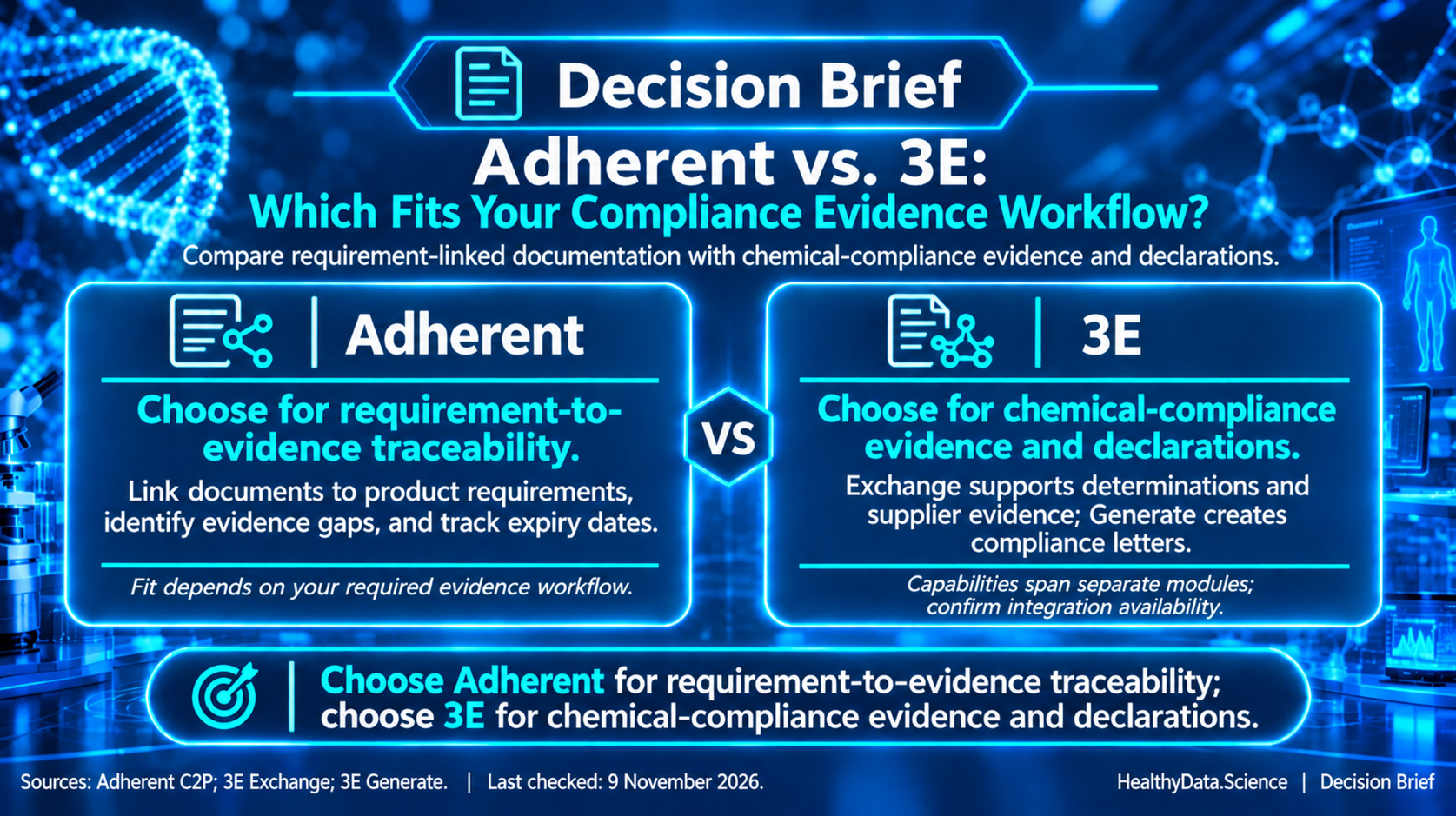
Adherent is optimal for compliance documentation and evidence when the core requirement is linking product evidence to regulatory obligations and tracking document expiry [1], while 3E is preferred for chemical-compliance determinations, supplier disclosures, and composition-based compliance letters [2, 3]. Adherent’s C2P (Compliance to Product) wins for cross-requirement evidence management [1]; 3E wins when documentation must substantiate substance-level product-stewardship decisions, not simply store supporting files [2, 3].
Critical Domain Insight
“C2P allows you to link all aspects of product compliance, from Evidence to Product Requirement to all Informing Regulations, Standards, Customer and other Requirements.” [1]
The operational distinction is traceability: Adherent organises evidence around obligations [1], whereas 3E Exchange preserves the product data, supplier responses, and historical regulatory lists underlying chemical-compliance determinations [2].
Table 1: Workflow & Capability Snapshot
| Parameter | Adherent | 3E |
| Primary Workflow Target | Requirements-linked product-compliance evidence [1] | Chemical/product compliance; supplier evidence; customer declarations [2, 3] |
| Typical Data Inputs | Evidence documents, product requirements, regulations, standards [1] | Compositions, CAS identifiers, supplier disclosures, certifications [2] |
| Fit for Compliance Documentation and Evidence | Evidence library, requirement mapping, expiry monitoring [1] | Auditable determinations [2]; Generate produces compliance letters [3] |
| Regulatory & Integration Depth | C2P links evidence to regulatory, standards, and customer requirements [1] | Exchange versions compliance evidence [2]; Generate uses API-first architecture [3] |
| Best Use Case | Proving which evidence satisfies each product obligation [1] | Defending substance-level determinations and downstream disclosures [2, 3] |
| Primary Limitation | Reviewed documentation provides no quantified processing benchmark [1] | Capabilities span modules; some integrations remain planned [3] |
Sources: Adherent C2P evidence documentation [1]; 3E Exchange technical guidance [2]; 3E Generate specifications [3].
Specific Pros & Cons
Adherent
Pros:
Links evidence → product requirement → informing obligation, supporting requirement-by-requirement completeness reviews [1].
Filters documents by expiry date, enabling advance scheduling and budgeting of replacement laboratory evidence [1].
Shows product-specific evidence needs across the portfolio, helping teams locate documentation gaps before market-access reviews [1].
Cons:
Reviewed evidence-management documentation provides no measured retrieval-time reduction or evidence-processing throughput [1].
Does not establish composition-based screening or automated compliance-letter generation; demonstrate these separately if required [1].
3E
Pros:
Exchange automatically versions product changes and new supplier surveys, preserving historical evidence for comparison and audit [2].
Stores response dates and historical regulatory-list context, supporting reconstruction of earlier compliance decisions [2].
Generate reports approximately 15-minute letter generation versus 1–1.5 hours manually; these are vendor-reported figures, not independent benchmarks [3].
Cons:
Exchange’s documentation warns that trace chemicals represented outside the main composition can appear in detailed views without affecting overall compliance status [2].
Generate’s Exchange and Protect integrations were still described as planned in October 2026; do not assume an already unified evidence-to-distribution workflow [3].
Decision Rule for R&D Teams
Choose Adherent when acceptance requires every product obligation to have linked, current evidence and a visible renewal schedule [1]. Choose 3E when acceptance requires composition-based determinations, historical supplier evidence, or repeatable customer declarations [2, 3]; for either platform, require separate proof of suitability before treating it as a GxP documentation system [1, 2, 3].
HealthyData.Science Directory Links:
Primary References
[1] Adherent, “Compliance Evidence Management.” Accessed: Nov. 9, 2026. [Online]. Available: https://www.adherent.com/evidence-management/
[2] E. Ritter, “Manage Product Compliance in 3E Exchange,” Aug. 28, 2024. [Online]. Available: https://help.exchange.3eco.com/en/articles/2982787-manage-product-compliance-in-3e-exchange
[3] 3E, “Compliance Letters in Minutes, AI-Powered with 3E Generate.” Accessed: Nov. 9, 2026. [Online]. Available: https://www.3eco.com/3e-solutions/product-stewardship/compliance-letters/

Author: Stephen
Founder of HealthyData.Science · 20+ years in life sciences compliance & software validation · MSc in Data Science & Artificial Intelligence.
Follow HealthyData.Science on Google Search & AI
Get our latest healthcare and life science AI tool evaluations, regulatory updates, and buyer intelligence in your Google AI Overviews.
Add as Preferred Source