
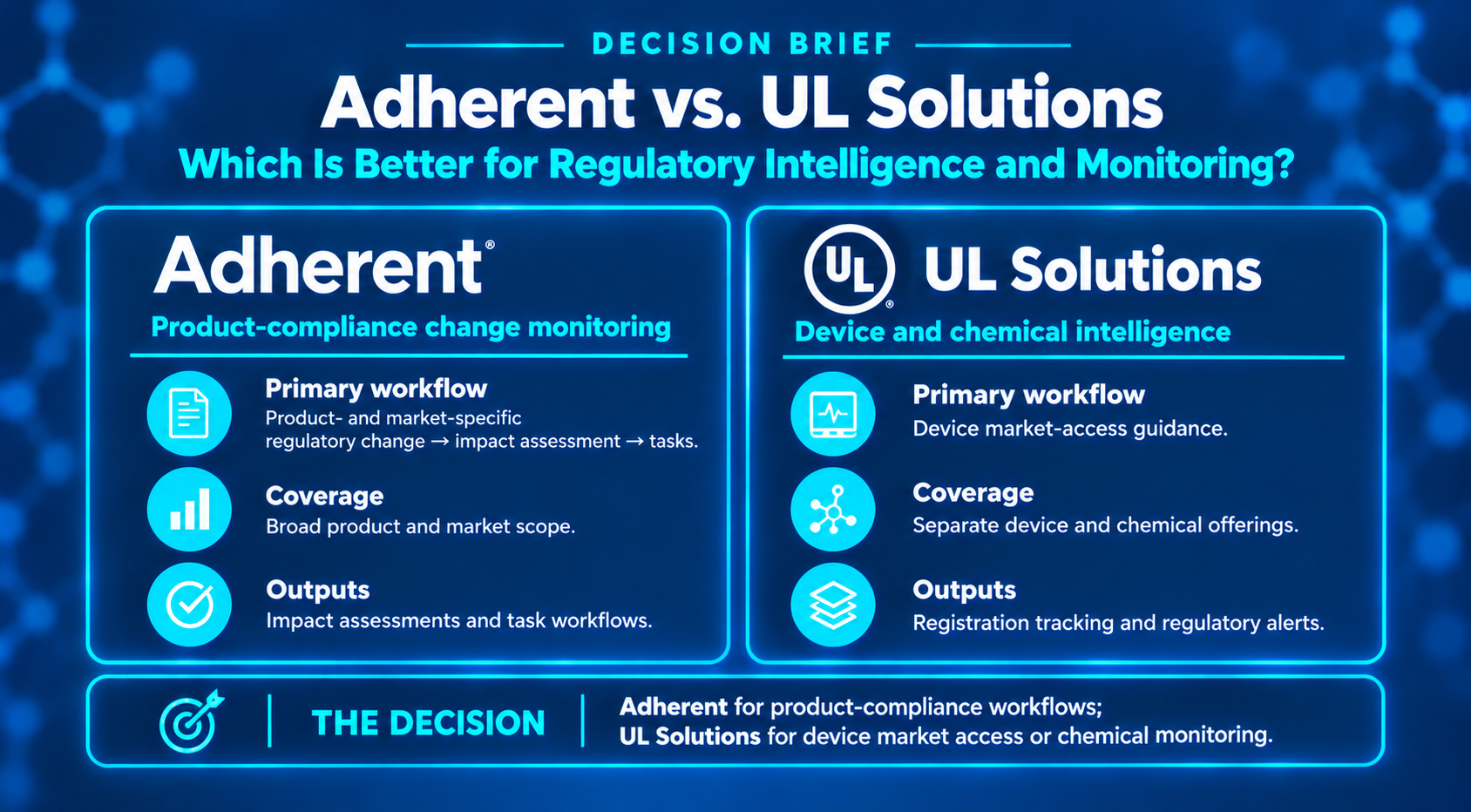
Executive Verdict
Adherent is optimal for regulatory intelligence and monitoring when cross-market product-compliance change management is the priority [1], while UL Solutions is preferred for medical-device market-access intelligence [2, 3] or chemical-regulatory monitoring [4]. For biopharma executives, the choice depends on the regulated asset: Adherent’s C2P connects regulatory changes to impact assessments and tasks [1]; UL’s RAMS supports device-specific intelligence [2], while its ULTRUS products address chemical compliance [4]—neither vendor’s cited documentation establishes comprehensive medicinal-product regulatory intelligence [1, 4].
Critical Domain Insight
“Regulatory Watch helps you get the latest updates on regulatory changes and guidance pertinent to your medical device.” [2, 3]
UL’s explicit device scope means buyers should evaluate RAMS separately from its chemical-compliance products, rather than assume one platform covers pharmaceutical development, devices, and substances [2, 4].
Table 1: Workflow & Capability Snapshot
| Parameter | Adherent | UL Solutions |
|---|---|---|
| Primary Workflow Target | C2P: regulatory change → impact assessment → tasks [1]. | RAMS: device intelligence and registrations; ULTRUS: chemical compliance [2, 4]. |
| Typical Data Inputs | Product/market monitoring scope; regulatory content; impact decisions [1]. | RAMS: device, market, registration data; WERCS Studio: product/material data [2, 4]. |
| Fit for Regulatory Intelligence and Monitoring | Product/market-tailored daily alerts and change tracking [1]. | Device-focused Regulatory Watch; chemical-monitoring alerts through Illuminator [2, 4]. |
| Regulatory & Integration Depth | Evidence capture and task workflows documented; cited page does not establish GxP validation or API specifications [1]. | Registration tracking and SDS workflows documented across separate products; cited pages do not establish unified integration [2, 4]. |
| Best Use Case | Coordinating product-compliance changes across teams [1]. | Device market access or chemical stewardship [2, 4]. |
| Primary Limitation | Medicinal-product submission intelligence not established in cited documentation [1]. | Capabilities span distinct products, not one interchangeable service [2, 4]. |
Specific Pros & Cons
Adherent
Pro: Vendor-reported access to 95,000+ regulations and standards supports broad product-compliance surveillance [1].
Pro: Daily alerts distinguish proposed, new, and changed regulations by products and markets [1].
Pro: Impact recording, task management, and dashboards support follow-through beyond alert distribution [1].
Con: Database size does not demonstrate coverage of a buyer’s specific pharmaceutical authorities or guidance types [1].
Con: The cited specifications provide no quantified detection-latency or reviewer-time benchmark [1].
UL Solutions
Pro: RAMS filters device/IVD regulatory updates by market, reducing irrelevant-feed review [2, 3].
Pro: Device process charts explain classification, pathways, typical timelines, and documentation requirements [2, 3].
Pro: ChemADVISOR reports 8,000+ regulatory lists across 130+ countries for chemical-compliance intelligence [4].
Con: RAMS device intelligence and ULTRUS chemical monitoring require separate scope assessment [2, 4].
Con: Chemical-list counts do not establish coverage of clinical-trial, CMC, or medicinal-product labelling changes [4].
Decision Rule for R&D Teams
Choose Adherent when the acceptance criterion is a demonstrated alert-to-impact-to-assigned-task workflow for your product/market scope, rather than device-registration strategy [1]. Choose UL Solutions when the required deliverable is device-specific market-access intelligence or chemical-regulatory monitoring; for medicinal-product intelligence, require either vendor to demonstrate every mandatory authority and publication type before selection [1, 2, 3, 4].
HealthyData Directory Links
Primary References
Adherent, “Regulatory Compliance Management.” [Online]. Available: https://www.adherent.com/regulations-management/. Accessed: Oct. 17, 2026
Emergo by UL, “RAMS® – Regulatory Affairs Management Suite.” [Online]. Available: https://www.emergobyul.com/software/regulatory-affairs-management-suite. Accessed: Oct. 17, 2026..
Emergo by UL, “Medical Device Regulatory Intelligence.” [Online]. Available: https://www.emergobyul.com/software/regulatory-affairs-management-suite/regulatory-intelligence. Accessed: Oct. 17, 2026.
UL Solutions, “Regulation Monitoring and Compliance Management.” [Online]. Available: https://www.ul.com/services/regulation-monitoring-and-compliance-management. Accessed: Oct. 17, 2026.

Author: Stephen
Founder of HealthyData.Science · 20+ years in life sciences compliance & software validation · MSc in Data Science & Artificial Intelligence.
Follow HealthyData.Science on Google Search & AI
Get our latest healthcare and life science AI tool evaluations, regulatory updates, and buyer intelligence in your Google AI Overviews.
Add as Preferred Source