
Executive Verdict
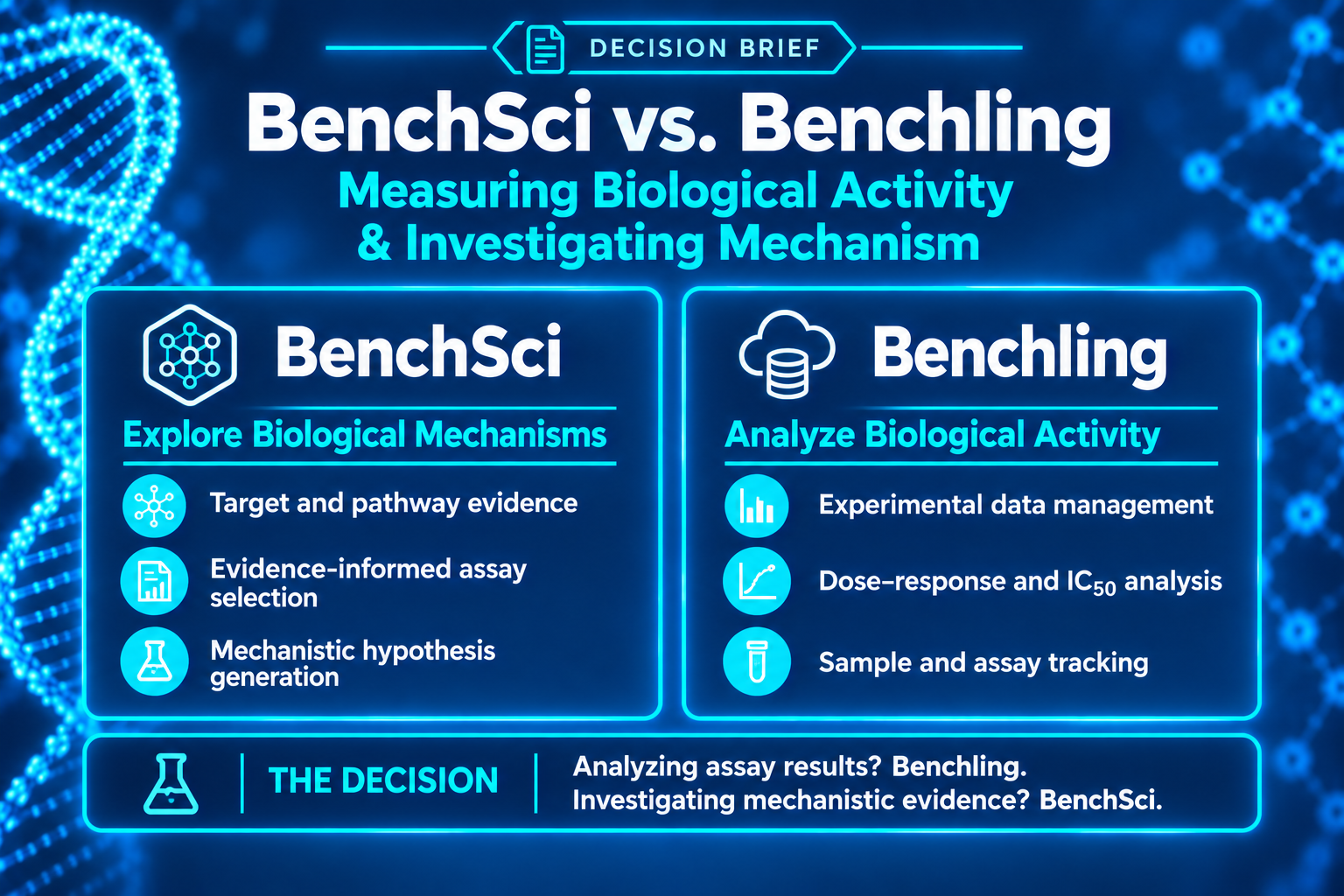
BenchSci is optimal for measuring biological activity and mechanism when the immediate task is selecting evidence-backed assays and investigating mechanistic hypotheses [3], while Benchling is preferred for analysing your own experimental activity measurements [1], [2]. For the stated measurement-led requirement, choose Benchling: its documented dose–response analysis and experimental-data workflows fit quantitative activity assessment more directly [1]; BenchSci’s ASCEND is stronger for target–disease evidence and mechanism-of-action hypothesis development [3].
Critical Domain Insight
“Calculate and visualise regression and interpolation statistics using 4PL, linear, or quadratic models in a scientist-friendly interface.” — Benchling Insights documentation [1].
Operationally, this supports selecting Benchling for quantitative assay analysis [1]. Not treating curve fitting alone as proof of mechanism.
Table 1: Workflow & Capability Snapshot
| Parameter | BenchSci | Benchling |
|---|---|---|
| Primary Workflow Target | Preclinical biological evidence synthesis and experimental planning [3], [4]. | Structured experimental data analysis and visualisation [1], [2]. |
| Typical Data Inputs | Publications, patents, third-party biological sources, and proprietary research data [3]. | Notebook entries, studies, assay datasets, CSVs, and experimental metadata [1], [2]. |
| Fit for Biological Activity and Mechanism Measurement | Stronger for identifying pathways, models, reagents, and supporting mechanistic evidence [3]. | Stronger for dose–response curves, IC50 comparisons, variability analysis, and cross-study comparisons [1], [2]. |
| Regulatory & Integration Depth | Internal-data integration; cited documentation does not establish validated regulated assay execution [3], [4]. | APIs, reusable analyses, and traceable analysis steps; these do not independently establish regulatory validation [1]. |
| Best Use Case | Decide which biological mechanism and assay strategy to investigate [3]. | Analyse how strongly compounds affect measured biological endpoints [1], [2]. |
| Primary Limitation | Evidence synthesis is not direct experimental measurement [3]. | Quantitative activity analysis does not independently establish causality or mechanism [1]. |
Specific Pros & Cons
BenchSci
Pros:
Connects targets with disease-specific pathway evidence, supporting mechanism-of-action hypothesis prioritisation [3].
Filters experimental precedents by technique, target, and cell line to inform activity-assay selection [3].
Supports antibody and model selection using published experimental evidence, helping teams assess assay suitability before execution [3].
Cons:
The cited ASCEND documentation does not establish a plate-level dose–response fitting workflow comparable to Benchling’s documented offering [1], [3].
Literature-supported mechanisms remain hypotheses for your compound and model; ASCEND’s documented evidence workflows do not replace experimental confirmation [3].
Benchling
Pros:
Documents four-parameter logistic regression and AI-assisted IC50 comparisons for concentration–response analysis [1], [2].
Accounts for experimental context, including replicates, controls, plate layouts, and time points. When selecting statistical analyses [1], [2].
Reuses analysis templates across assay runs, with analysis-step traceability and notebook-linked visualisations [1].
Cons:
Requires appropriately structured experimental inputs; its cross-study analysis depends on consistently linked samples, experiments, and results [1], [2].
Dose–response fitting quantifies activity, not target-specific causality; mechanism assessment still requires purpose-designed experimental evidence [1].
Decision Rule for R&D Teams
Choose Benchling when the acceptance criterion is producing dose–response fits, IC50 comparisons, or repeatable analyses from your own assay results [1], [2]. Choose BenchSci when the gating question is which target–pathway relationship, experimental model, or reagent should underpin the next mechanism-focused experiment [3], [4].
HealthyData Directory Links
Primary References
[1] Benchling, “Benchling Insights,” official product documentation, accessed Oct. 14, 2026.
[2] Benchling, “AI Data Analysis,” official product documentation, accessed Oct. 14, 2026.
[3] BenchSci, “Overview of ASCEND by BenchSci Platform,” Sanofi Knowledge Center, accessed Oct. 14, 2026.
[4] BenchSci, “Three-Year License Agreement with Sanofi,” Oct. 8, 2025.

Author: Stephen
Founder of HealthyData.Science · 20+ years in life sciences compliance & software validation · MSc in Data Science & Artificial Intelligence.
Follow HealthyData.Science on Google Search & AI
Get our latest healthcare and life science AI tool evaluations, regulatory updates, and buyer intelligence in your Google AI Overviews.
Add as Preferred Source