
Executive Verdict
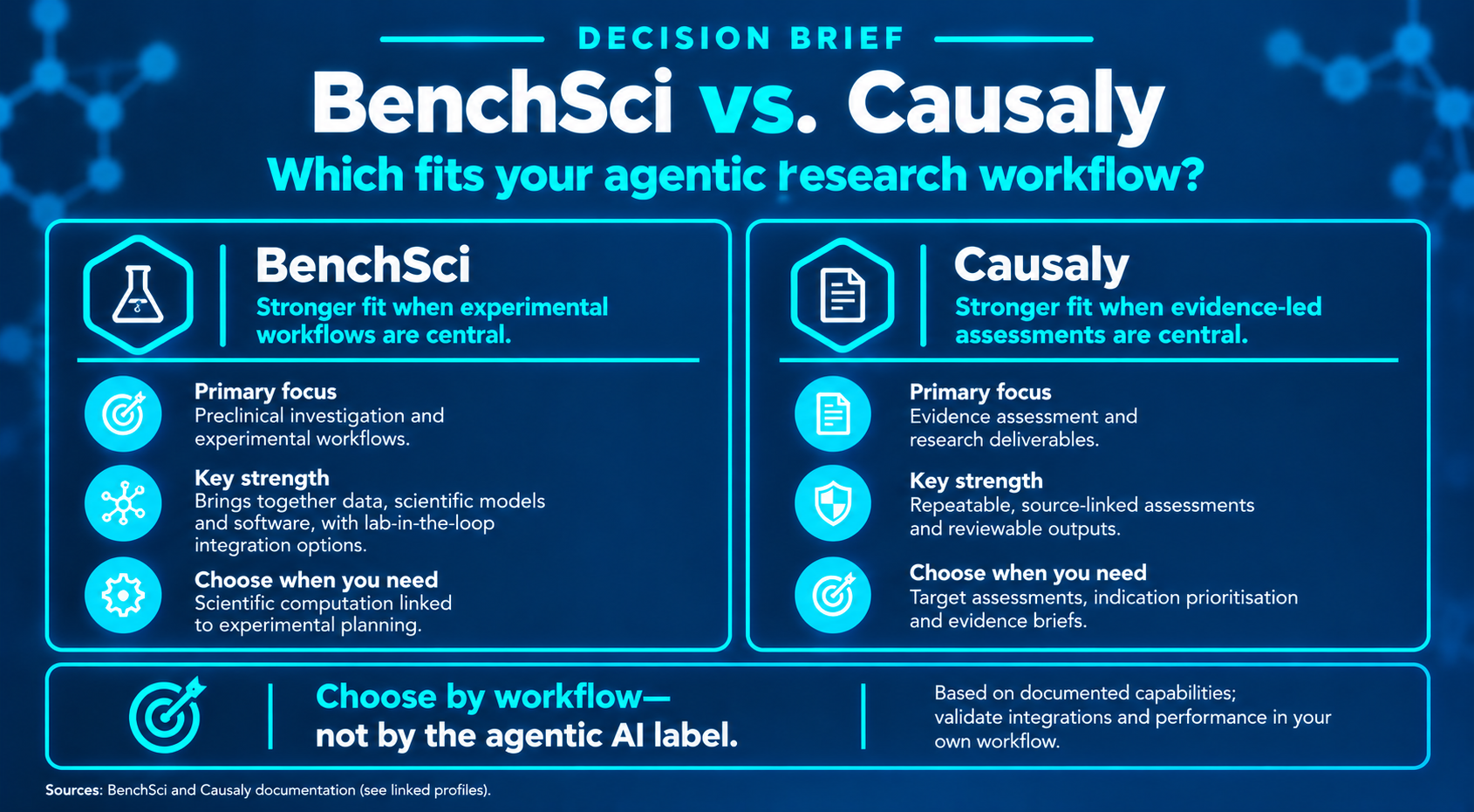
BenchSci is optimal for an agentic research environment when preclinical experimental design and orchestration of scientific models, software, and laboratory workflows are the core requirements [1, 2], while Causaly is preferred for evidence-led research automation spanning discovery, clinical development, and medical affairs [3, 4]. For the stated requirement, an integrated research environment rather than primarily evidence-assessment workflows, choose BenchSci’s EMET (Evidence Mapping and Exploratory Tool), subject to demonstrating the required integrations [1, 2]; this is a documented-capability judgment, not a validated head-to-head performance result [2].
Critical Domain Insight
“EMET gives every scientist an agentic team of expert scientists, unifying data, models, software packages, workflows, lab-in-the-loop, and scientific reasoning into a single environment purpose-built for R&D.” — BenchSci [1]
The procurement distinction is whether agents must coordinate experimental and computational work or primarily deliver inspectable scientific assessments [1, 3]; Causaly also documents data analysis and extensible workflows, so this is not an execution-versus-search binary [2, 3].
Table 1: Workflow & Capability Snapshot
| Parameter | BenchSci | Causaly |
| Primary Workflow Target | EMET: preclinical investigation and experimental workflows [1]. | Agentic Research and Scientific Workflows: evidence assessment and research deliverables [3]. |
| Typical Data Inputs | Publications, patents, omics, reagent/model metadata, proprietary data [1]. | Literature, trials, patents, internal knowledge, scientific data [3]. |
| Fit for Agentic Research Environments | Explicitly unifies models, software, reasoning, and lab-in-the-loop workflows [1]. | Combines agents, analysis, batch operations, and reviewable outputs [3]. |
| Regulatory & Integration Depth | Claims regulated-biopharma support, bespoke connectors, and self-driving-lab connectivity; verify deployment specifics [1, 2]. | Documents access controls, activity tracking, MCP, A2A, and APIs; verify intended-use validation [3, 4]. |
| Best Use Case | Target-to-experiment preclinical investigation [1]. | Repeatable target assessments, indication prioritization, clinical evidence briefs [3, 4]. |
| Primary Limitation | Public claims do not establish operational readiness of every advertised integration [2]. | Public documentation does not establish equivalent laboratory orchestration [2, 3]. |
Specific Pros & Cons
BenchSci
Pros:
Coordinates 100+ vendor-described scientific skills across target validation, omics, biomarkers, and experimental design [1].
Names ESM-2, AbLang2, and RDKit alongside frontier models. Relevant when agents need scientific computation, not only synthesis [1].
Combines 38M+ publications with experimental metadata and dedicated scientists for bespoke connector deployment [1].
Cons:
Self-driving-lab connectivity requires a demonstration against your instruments, software, and approval gates; the homepage supplies no implementation specification [1, 2].
Its claimed 95%+ accuracy across 600+ tests and 8+ benchmarks does not establish end-to-end autonomous experimental success [1, 2].
Causaly
Pros:
Codifies evidence hierarchies and review criteria into repeatable target, indication, and clinical assessments [3, 4].
Retains analysis code, parameters, and numerical outputs for inspection and rerunning [3].
Offers MCP, A2A, and APIs for embedding scientific capabilities within existing agent architectures [3, 4].
Cons:
Laboratory execution and instrument control are not established by the cited documentation [2, 3].
Reported 93% biomedical-claim accuracy and 88% LitQA2 precision measure different outcomes from BenchSci’s claims; neither establishes comparative superiority [1, 3].
Decision Rule for R&D Teams
Choose BenchSci when at least one mandatory acceptance test requires an agent to invoke a scientific model or software package and carry the result into an experimental workflow [1, 2]. Choose Causaly when acceptance depends on repeatable, source-linked assessments, reproducible analysis, and integration into your existing agent stack rather than demonstrated laboratory orchestration [2, 3].
HealthyData Directory Links
Primary References
BenchSci. “EMET, the agentic research environment for R&D.” Accessed Oct. 24, 2026. https://www.benchsci.com/
HealthTech Insiders, “BenchSci Secures Two-Year Enterprise Partnership with argenx for AI-Based Preclinical Drug Discovery,” Sept. 3, 2026. Accessed: Oct. 24, 2026.https://www.healthtechinsiders.com/benchsci-and-argenx-expand-ai-drug-discovery
Causaly. “Agentic Research: Science-Grade AI for R&D.” Accessed Oct. 24, 2026. https://www.causaly.com/products/agentic-research
Causaly. “Indication Prioritization.” Accessed Oct. 24, 2026. https://www.causaly.com/solutions/indication-prioritization

Author: Stephen
Founder of HealthyData.Science · 20+ years in life sciences compliance & software validation · MSc in Data Science & Artificial Intelligence.
Follow HealthyData.Science on Google Search & AI
Get our latest healthcare and life science AI tool evaluations, regulatory updates, and buyer intelligence in your Google AI Overviews.
Add as Preferred Source