
Executive Verdict
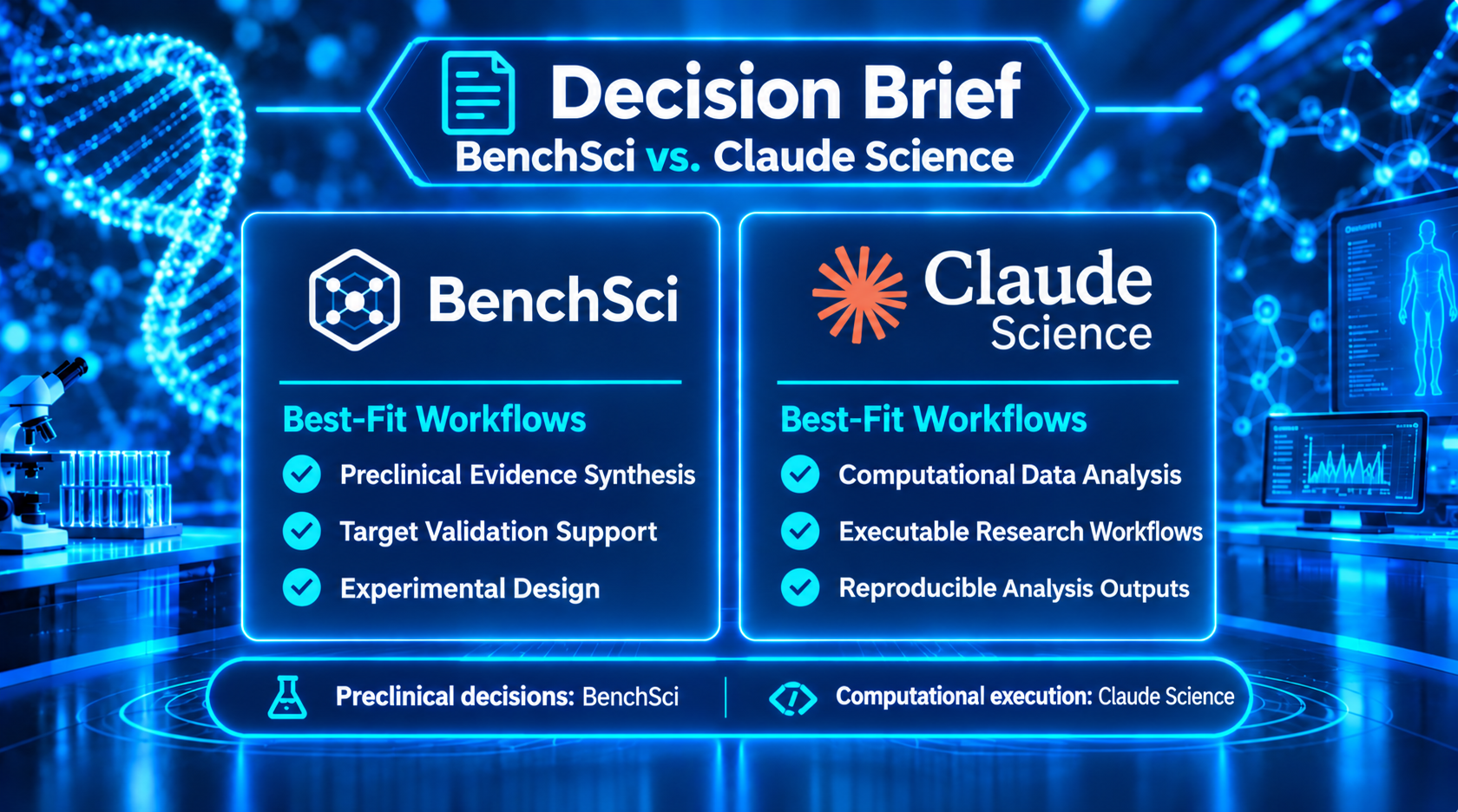
BenchSci is optimal for AI co-scientist research when evidence-grounded preclinical target validation and experiment selection dominate [1], [2], while Claude Science is preferred for computational discovery requiring executable, reproducible analyses [3]. For a biopharma team choosing its default preclinical co-scientist, BenchSci wins on documented workflow fit—not proven head-to-head superiority; its current offering is EMET [1], while ASCEND documentation details its established experimental-evidence workflows [2].
Critical Domain Insight
“When it generates a figure, Claude Science includes the exact code and environment that produced it, a plain-language description of how it was created, and the full message history.” — Anthropic, technical product announcement [3].
Operationally, distinguish evidence-supported experimental decisions from reproducible computational execution: a citation supports a biological claim [1], [2], whereas code and environment records support rerunning an analysis [3].
Table 1: Workflow & Capability Snapshot
| Parameter | BenchSci | Claude Science |
| Primary Workflow Target | Preclinical evidence reasoning, target validation, experimental design [1], [2]. | Literature-to-analysis computational research [3]. |
| Typical Data Inputs | Publications, experimental evidence, proprietary data, biological knowledge graph [1], [2]. | Scientific databases, lab datasets, code, models and pipelines [3]. |
| Fit for AI Co-Scientist Research | Stronger documented specialization in selecting targets, models and reagents [1], [2]. | Stronger documented support for executing analyses and producing reproducible artifacts [3]. |
| Regulatory & Integration Depth | Bespoke connectors and regulated-biopharma positioning; not proof of validated GxP use [1]. | Local/HPC execution and audit histories; not proof of validated GxP use [3]. |
| Best Use Case | Determine which biological hypothesis and experiment deserve investment [1], [2]. | Analyze omics data and test computational hypotheses [3]. |
| Primary Limitation | Accuracy comparisons remain vendor claims in the reviewed evidence [1]. | Beta status; reviewer agents do not eliminate verification requirements [3]. |
Specific Pros & Cons
BenchSci
Pro: EMET reports access to 38M+ publications, including 16M closed-access papers, expanding the evidence available for hypothesis assessment [1].
Pro: ASCEND supports triaging up to 1,000 targets in a defined biological context, enabling portfolio-scale prioritization [2].
Pro: Experiment search filters by technique, target and cell line; reagent selection uses published application-specific evidence [2].
Con: The claimed 95%+ accuracy across 600+ tests does not establish superiority over Claude Science on matched co-scientist tasks [1].
Con: Documented ASCEND tool access depends on commercial agreements; confirm which workflows are included in the proposed EMET deployment [1], [2].
Claude Science
Pro: Executes multi-step analyses across genomics, single-cell, proteomics and cheminformatics using 60+ scientific databases [3].
Pro: Preserves code, environment and conversation history with figures, supporting reproducibility and scientific review [3].
Pro: Uses existing HPC infrastructure and reusable custom skills, reducing repeated pipeline assembly [3].
Con: Launched in beta; teams must evaluate workflow stability before relying on it for program-critical analyses [3].
Con: Its reviewer agent explicitly checks citation and calculation errors; outputs still require independent scientific validation [3].
Decision Rule for R&D Teams
Choose BenchSci when the acceptance criterion is an evidence-backed target, model, reagent or experimental-design decision [1], [2]. Choose Claude Science when acceptance requires executing a pipeline and delivering rerunnable code, environments and quantitative artefacts [3]; neither reviewed source establishes a controlled comparative winner [1], [3].
HealthyData.Science Directory Links
Primary References
[1] BenchSci. (2026). EMET: The agentic research environment for R&D. https://www.benchsci.com/
[2] BenchSci. (2025). Overview of ASCEND by BenchSci Platform. BenchSci Knowledge Center. https://knowledge.benchsci.com/home/benchsci-data
[3] Anthropic. (2026, June 30). Claude Science, an AI workbench for scientists. Anthropic News. https://www.anthropic.com/news/claude-science-ai-workbench

Author: Stephen
Founder of HealthyData.Science · 20+ years in life sciences compliance & software validation · MSc in Data Science & Artificial Intelligence.
Follow HealthyData.Science on Google Search & AI
Get our latest healthcare and life science AI tool evaluations, regulatory updates, and buyer intelligence in your Google AI Overviews.
Add as Preferred Source