
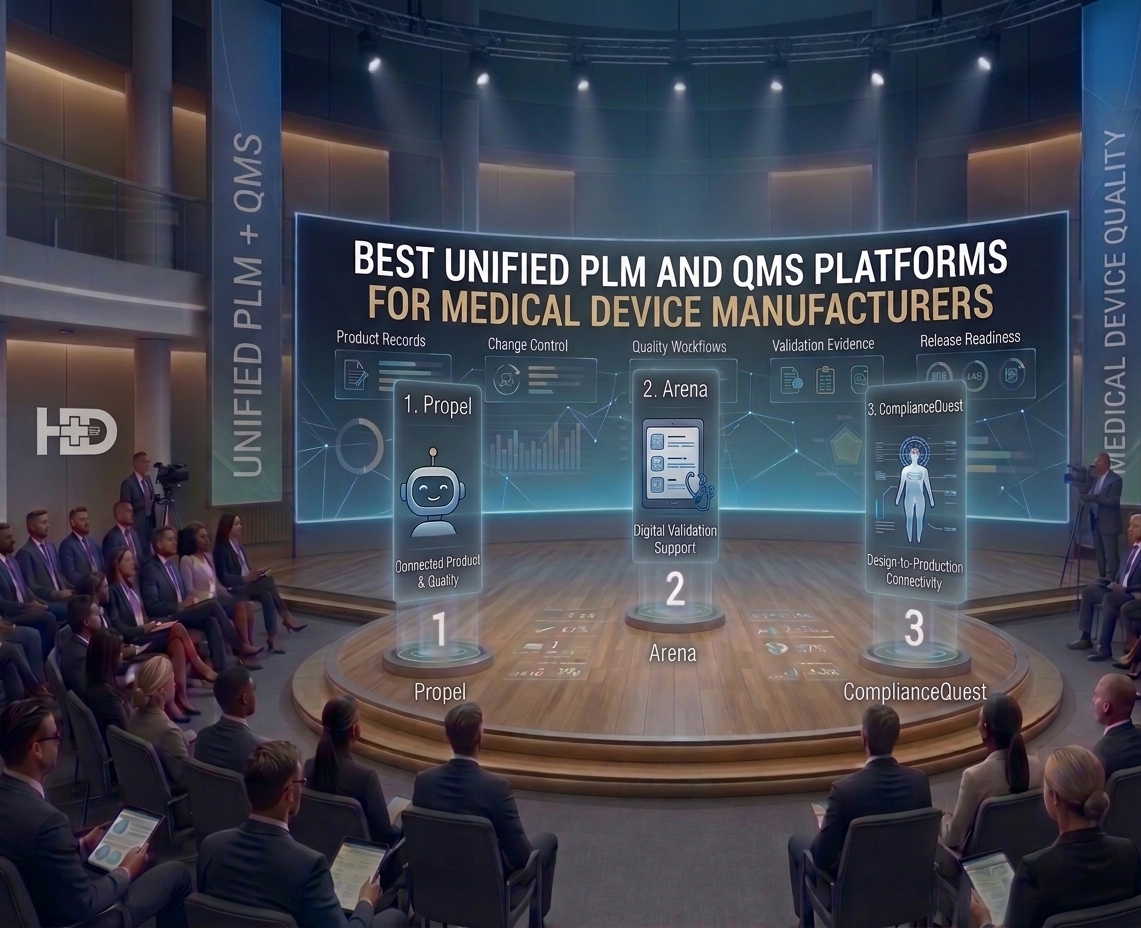
Propel, Arena, and ComplianceQuest connect product lifecycle management with quality workflows, but serve different priorities. Propel suits Salesforce-oriented product teams [4]; Arena stands out for documented release-validation support [7]; ComplianceQuest suits broader quality-led transformation [9]. For device manufacturers, the decisive question is whether each platform can maintain traceable, validated processes across the intended configuration [1], [2].
Table 1. Propel, Arena and ComplianceQuest: Unified PLM and QMS Comparison for Medical Device Manufacturers

Research & Evidence Timestamp: October 29, 2026.
Evidence basis: Public regulatory sources, official product documentation, vendor security materials, and published customer examples. Vendor-reported results are identified as such and do not represent independently verified benchmarks.
Disclosure: HealthyData.Science has no commercial relationship with the three selected platforms. Category wins are editorial assessments for the audience described below, not claims of universal superiority.
Who This Guide Is For & Evaluation Baseline
This guide evaluates unified PLM and QMS platforms for organisations that need quality records to remain connected to the products, revisions, suppliers, and engineering decisions they govern [1], [4]. Arena, Propel, and ComplianceQuest each describe capabilities that connect product information with quality workflows, although their architecture and supporting evidence differ [4], [7], [9]. The evaluation addresses five buyer groups and operating assumptions:
QA/RA and quality-systems leaders need controlled records, defensible electronic approvals, and evidence that the configured platform supports its intended use [1], [2].
Engineering and operations leaders need product changes to remain connected to BOM revisions, affected documentation, suppliers, and downstream manufacturing processes [4], [7], [9].
Early-stage and mid-market manufacturers need a manageable deployment scope, rather than a transformation programme that exceeds their internal ownership capacity [4], [9].
SaMD businesses should distinguish assurance of the business platform from verification and validation of the medical-device software itself. FDA’s production and quality-management-system software guidance addresses the former scope [2].
Best-of-breed organisations may retain separate ERP, MES, CAD, ALM, and service platforms. The evaluation therefore examines integration controls rather than assuming one suite should replace every application [7], [9].
The regulatory baseline reflects the FDA Quality Management System Regulation, or QMSR, which became effective on February 2, 2026, and incorporates ISO 13485:2016 by reference. Buyers should assess current requirements rather than relying exclusively on legacy Quality System Regulation terminology in older product collateral [1].
GAMP 5 provides risk-based good-practice guidance for computerised systems; it is not a product certification [3]. EU GMP Annex 11 concerns computerised systems supporting medicinal-product GMP activities, so device-only manufacturers should not automatically treat it as a universal requirement. Combination-product and pharmaceutical-facing operations should establish its applicability explicitly.
The Digital Validation Challenge in Modern GxP Workflows
Disconnected systems make traceability harder to demonstrate. A manufacturer may approve a design change in PLM, revise an SOP in document control, record a CAPA in QMS, and update manufacturing instructions elsewhere. The buyer’s practical challenge is to preserve the relationship between those records. The reviewed platforms address that problem through connected product and quality information, not simply electronic storage [4], [7], [9].
Software updates introduce a separate assurance challenge. FDA’s February 2026 computer software assurance guidance recommends a risk-based approach for production and quality-management-system software. Manufacturers should determine intended use, assess the risk of failure, and select proportionate assurance activities. A vendor package can support that work, but it cannot establish that an unassessed customer configuration is fit for use [2].
Machine-readable relationships and controlled integrations can reduce dependence on manually assembled evidence. Arena explicitly documents REST API operations for items, BOMs, changes, quality processes, and suppliers, including transaction logging [7]. ComplianceQuest describes connections to external enterprise systems and PLM data flows [9]. Buyers should test interface behaviour, permissions, error handling, and reconciliation instead of accepting “integrated” as sufficient proof [7], [9].
Propel: Best for Salesforce-Oriented Product and Quality Collaboration
Propel connects product and quality processes on a Salesforce-based platform for manufacturers that want engineering changes and quality decisions to share product context [4]. Its medical-device materials describe design documentation, change control, revision history, and validation support [4], [6].
Regulated Use Cases & Category Fit: Propel supports connected product and quality workflows, including document control, training, CAPA, complaints, nonconformance management, audits, and supplier quality. Its product requirements offering links user needs, functional requirements, and test-plan records to the BOM, making it relevant to device teams evaluating design-change traceability [4], [5].
Evidence & Validation ROI: Propel reports that Surmodics reduced its average change-process duration from 278 days to 73 days. This is a named, vendor-reported customer result, not a guaranteed implementation outcome or a measured reduction in software-validation cost. Comparable validation labour savings and validation-cost data: Data Point Not Disclosed [4].
Regulatory Posture & Frameworks: Propel describes electronic-signature controls, audit trails, automatic user logoff, and support for Part 11, ISO 13485, and QMSR-related processes [1], [4], [6]. Its trust centre lists requirements, risk assessments, test plans, IQ/OQ materials, executed OQ evidence, PQ templates, and traceability. Buyers should map these deliverables to their intended use rather than treating the package as automatic organisational compliance [2], [6].
Commercial Model & Deployment Constraints: Custom Vendor Quotation Required. Requires custom vendor quotation based on deployment scale and user seats. Propel advertises four-week document-control-and-training deployments and eight-week core-quality deployments, subject to migration, configuration, user scope, and Salesforce-environment considerations. Those figures describe scoped QMS projects, not every unified PLM–QMS deployment [4].
Ideal For: Propel merits a shortlist position when engineering and quality teams want shared product context and accept a Salesforce-based operating model [4], [5]. Its documentation is particularly relevant to buyers who want quality workflows connected to product requirements, BOMs, and engineering-change decisions [4], [5].
Transparent Limitations & Unsuitable Use Cases: Propel is not a defensible selection solely because a company already uses Salesforce. Buyers still need to demonstrate workflow fit, access segregation, migration quality, and ongoing configuration ownership. Propel documents SOC 2 Type II reporting, but buyers should request the current report and separately verify SSO, approval authentication, deployment scope, and application-specific assurance obligations [6].
What to test in the demonstration
Ask Propel to trace a complaint into a corrective action and an affected product change. Require the demonstrator to identify the impacted revision, training consequences, approval history, and evidence needed to release the change. This scenario tests the connected-workflow proposition more effectively than reviewing isolated module screens. Propel’s published scope includes the relevant quality processes and product relationships [4], [5].
Request the actual validation deliverable index before contract signature. Establish which documents apply to the standard application, which cover the selected configuration, and which remain your responsibility. Propel lists substantial validation materials, but a document inventory alone does not establish coverage of your intended use [2], [6].
Arena: Best for Documented Release-Validation Support
Arena connects product records and quality processes in a cloud-native platform, with particularly clear public documentation of its application-validation support [7]. Its medical-device offering links quality, training, supplier, and audit records to the product BOM [7], [8].
Regulated Use Cases & Category Fit: Arena supports product-centric quality management through BOMs, engineering changes, controlled documentation, training, and quality processes [7]. Its medical-device materials describe management of design-history and device-master documentation alongside product records, making it relevant to manufacturers coordinating engineering and quality across distributed teams [7].
Evidence & Validation ROI: PTC states that more than 1,500 companies use Arena across its served industries. This figure is a broad adoption indicator, not a medical-device customer count or evidence of validation ROI. Comparable current validation-cost savings, deployment duration, and medical-device-specific outcome benchmarks: Data Point Not Disclosed [7].
Regulatory Posture & Frameworks: Arena Validate provides a documented package covering requirements, traceability, impact analysis, test plans, IQ/OQ protocols, execution records, reports, and PQ templates [7]. Arena explicitly states that customers must review its predefined validation scope and supplement it for unique intended uses. That distinction makes the service useful without implying outsourced accountability [2], [7].
Commercial Model & Deployment Constraints: Custom Vendor Quotation Required. Requires custom vendor quotation based on deployment scale and user seats. Arena documents isolated multi-tenancy, SOC 2 Type 2 controls, encryption, access restrictions, and secure APIs [8]. Its SSO documentation describes SAML 2.0 compatibility and distinguishes sign-on authentication from approval credentials. Buyers should confirm the current purchased package and configuration [7], [8].
Ideal For: Arena deserves particular consideration when a product-centric manufacturer values documented evidence for initial deployment and subsequent application releases [7], [8]. Its validation documentation, BOM-linked quality model, and REST API materials provide a useful starting point for technical due diligence [7], [8].
Transparent Limitations & Unsuitable Use Cases: Arena Validate does not remove the need to assess customer-specific workflows, integrations, or intended uses [2], [7]. Buyers with extensive software-development traceability requirements should also demonstrate how their ALM environment connects to controlled product and quality records. The reviewed evidence does not establish that Arena replaces every specialist engineering or software-development system [7].
What to test in the demonstration
Ask Arena to show the validation package for a recent release, including its impact analysis and traceability. Then ask the vendor to identify which requirements cover your configured quality workflow and which require supplemental evidence. Arena’s solution brief explicitly describes release-specific documentation and customer review of intended-use coverage [2], [7].
Use a failed ERP transfer as the integration test. Require the team to show the transaction record, error message, correction process, and reconciliation outcome. Arena’s API documentation describes transaction logging, attribute validation, and explicit success and error responses; the demonstration should establish how these capabilities operate in your implementation [7].
ComplianceQuest: Best for Quality-Led Transformation Across Product and Manufacturing Processes
ComplianceQuest combines quality capabilities with Salesforce-based PLM functions for manufacturers seeking connections between product changes, manufacturing processes, and enterprise systems [9]. Its PLM documentation covers BOM management, engineering changes, manufacturing-process design, item lifecycle management, and CAD integration [9].
Regulated Use Cases & Category Fit: ComplianceQuest supports BOM version comparison, change-impact assessment, requirements-traceability-related change flagging, and links between design controls and manufacturing processes. These capabilities make it relevant to device manufacturers and CMOs evaluating how product changes affect operational execution [9].
Evidence & Validation ROI: ComplianceQuest publishes figures including a 48% reduction in cost of quality and a 46% reduction in audit findings on its PLM page. The accessible page does not explain the sample, baseline, measurement period, or attribution method. These are vendor marketing claims, not decision-grade forecasts. Customer-specific validation ROI: Requires Vendor Audit Data [9].
Regulatory Posture & Frameworks: ComplianceQuest’s document-management materials describe Part 11, ISO 13485, and GxP support [1], [9], [10]. Buyers should require an application-specific control matrix and validation-package inventory covering the selected PLM and QMS configuration [1], [2]. The reviewed public evidence did not establish a release-validation deliverable set directly comparable to Arena Validate’s published package [7], [9].
Commercial Model & Deployment Constraints: Custom Vendor Quotation Required. Requires custom vendor quotation based on deployment scale and user seats. ComplianceQuest states that pricing depends on modules, users, and deployment scope [9]. Its security materials describe SSO and MFA, while its document-management page claims SOC 2 Type II and ISO 27001 coverage; buyers should inspect current reports and scope [9], [10].
Ideal For: ComplianceQuest merits consideration when quality transformation extends into manufacturing-process design, product changes, and enterprise integration [9]. Its published PLM scope is relevant to organisations that need to connect parts, equipment, procedures, and engineering decisions rather than purchase document control alone [9].
Transparent Limitations & Unsuitable Use Cases: ComplianceQuest’s broad suite requires careful scoping [9]. Buyers should verify which capabilities belong to the purchased modules, which integrations require implementation work, and which validation deliverables accompany each release [2], [9]. A small team seeking only a limited document-control workflow should justify the additional operational scope before adopting a broader product-and-quality platform [9].
What to test in the demonstration
Ask ComplianceQuest to process a manufacturing-related engineering change. Require the demonstrator to show affected BOMs, requirements, equipment relationships, manufacturing procedures, and quality approvals. The vendor’s PLM page describes these relationships; the test should establish their depth in the proposed configuration [9].
Request a release-specific assurance example rather than a general statement that the platform supports compliance. Review the intended-use assumptions, executed evidence, unresolved defects, configuration responsibilities, and customer approval activities. FDA’s assurance approach makes those operational details more important than a compliance label [1], [2].
Quantitative Trends in Digital Validation eQMS Adoption
The public evidence does not support a defensible market-wide adoption trend or a numerical ranking of these platforms. The available figures mix named customer outcomes, vendor deployment claims, broad customer counts, and marketing aggregates. The following insights preserve those distinctions [7], [9].
- Surmodics reduced its reported change-process duration from 278 days to 73 days with Propel. The operational implication is a shorter change cycle in that customer’s transformation, but the result should not become another manufacturer’s projected validation saving [4].
- Propel advertises a four-week deployment for document control and training management. The operational implication is that a narrowly scoped first phase may have a different delivery model from a full product-and-quality transformation; buyers must verify migration and assurance boundaries [2], [4].
- Propel advertises eight weeks for deployments covering core quality and remediation processes. The operational implication is that buyers should separate module availability from the work required to configure, test, approve, and adopt their complete operating model [1], [2], [4].
- PTC reports more than 1,500 Arena customer companies across industries [7]. The operational implication is an established cross-industry footprint, not proof that the platform is optimal for a particular device class, company size, or validation strategy [7].
- ComplianceQuest publishes a 48% cost-of-quality reduction on its PLM page without an accessible measurement methodology [9]. The operational implication is a due-diligence question: request a comparable customer case with a defined baseline before using the figure in an investment model [9].
Comparable validation labour hours, independently verified deployment costs, and matched medical-device ROI studies were not established across all three platforms. Buyers should label these gaps “Data Point Not Disclosed” and build financial estimates from their own process baselines rather than normalising unlike vendor claims.
Decision Framework: How to Choose Your eQMS
1. Define the regulated workflow before selecting the suite
Create an intended-use inventory covering document approval, CAPA, complaints, training, engineering changes, and controlled product records. Identify the consequences of failure at the function level. FDA’s CSA guidance recommends risk-based assurance for production and quality-management-system software; it does not support testing every feature identically merely because the features share a platform [2]. Your tangible artifact should be an approved workflow-and-risk register. Use it to compare the vendors against the same required outcomes rather than their different module names [4], [7], [9].
2. Test product-linked quality with real records
Prepare a representative CAPA, a released BOM, a supplier issue, and a design-change package. Require each vendor to demonstrate how those records connect and how the system preserves revision-specific meaning. The platforms describe product-and-quality relationships, but the evaluation must establish whether those relationships match your operating model [4], [7], [9]. Your tangible artifact should be a scored scenario record showing links, approvals, affected items, and evidence retrieval. Include DHF/DMR terminology where your organisation still uses it, while mapping procedures to current QMSR requirements [1].
3. Establish architecture and interface ownership
Draw the system boundary around PLM–QMS, ERP, MES, CAD, ALM, identity management, and relevant service systems. Assign the authoritative source for each data object. Arena documents REST API operations, while ComplianceQuest describes enterprise integration and ERP/MES-related product-data flows [7], [9]. These capabilities still require an explicit ownership model. Your tangible artifact should be an interface register containing field mappings, permissions, error handling, reconciliation, and change ownership.
4. Inspect validation packages and release history
Request a representative release package, impact assessment, known-issue record, and customer-notification process. Arena publicly details release-specific validation evidence; Propel publishes a validation-deliverable inventory [6], [7]. Compare actual documents rather than counting the number of validation-related terms on a sales slide. Your tangible artifact should be a supplier-evidence assessment identifying reusable evidence, configuration gaps, interface testing, and approval responsibilities [2].
5. Challenge multi-site and CMO access controls
Use a permission matrix covering employees, external manufacturers, suppliers, and customers. Demonstrate who can view, modify, approve, export, or retire controlled records. Arena documents object-level access restrictions and isolated multi-tenancy, while ComplianceQuest documents configurable authentication controls; neither removes the need to test your access model [8], [9], [10]. Your tangible artifact should include positive and negative access tests. A user who cannot see another customer’s confidential product record provides more meaningful evidence than a generic statement about role-based access.
6. Plan migration and organisational change together
Choose representative legacy records and define which revisions, signatures, links, and history must survive migration. Annex 11 explicitly addresses preservation of data value and meaning during migration within its GMP scope; the same issue provides a useful technical challenge for device-platform due diligence without making Annex 11 universally applicable. Your tangible artifacts should include a migration acceptance plan, training-impact assessment, ownership model, and controlled cutover criteria.
7. Compare total operating scope, not subscription alone
Request quotations that separate licences, modules, external access, implementation, integration, migration, validation support, and ongoing administration. ComplianceQuest explicitly identifies modules, users, and deployment scope as pricing factors; Propel identifies configuration and migration as deployment variables [4], [9]. Your tangible artifact should be a cost model with disclosed assumptions. Do not populate missing fields with vendor marketing percentages or an unsupported “typical” implementation duration.
FAQs on eQMS, Digital Validation, and Interoperability
Can a medical device manufacturer use more than one QMS-related platform?
Yes, provided the organisation establishes clear record ownership, controlled interfaces, and assurance appropriate to the intended use. Arena and ComplianceQuest document integration capabilities that support multi-system architectures [7], [9]. The essential evaluation is whether records remain consistent and traceable across the defined system boundary [7], [9].
Will auditors reject a multi-tenant cloud PLM–QMS platform?
Multi-tenancy alone does not establish whether a configured system is fit for its regulated use. Buyers should assess supplier evidence, access controls, data segregation, change management, and their own assurance records [2], [8]. Arena documents isolated multi-tenancy, while FDA’s CSA guidance focuses on risk-based confidence in software used for production and quality management [2], [8].
Does a vendor validation package eliminate customer validation work?
No. Arena explicitly requires customers to review its predefined validation scope and supplement it for unique intended uses [2], [7]. FDA’s risk-based assurance approach likewise makes the manufacturer’s intended use and risk assessment central to selecting appropriate assurance activities [2].
How should a manufacturer move from paper-based CSV to digital assurance?
Start with intended use, process risk, and the evidence needed to establish acceptable performance [2]. Use supplier evidence where it applies, and retain appropriate records of assurance activities, issues, and acceptance decisions [2]. A paperless process should improve evidence control rather than merely replace signed paper with disconnected screenshots [2].
How do GAMP 5 and FDA CSA relate?
GAMP 5 provides a risk-based lifecycle framework for achieving computerised systems that are fit for intended use [3]. FDA CSA provides recommendations for assuring software used in medical-device production and quality management [2]. The approaches are compatible, but neither a GAMP label nor a CSA statement establishes that a particular customer configuration is compliant [2], [3].
Does a unified PLM–QMS platform replace SaMD development tools?
Not automatically. FDA’s cited CSA guidance addresses production and quality-management-system software, rather than establishing the development lifecycle for software that is itself a medical device [2]. SaMD buyers should demonstrate how their development environment connects requirements, verification evidence, releases, and controlled quality records before deciding which tools to retain [2].
Build your software shortlist
Continue your research in the HealthyData.Science directory and explore tools relevant to your organisation’s quality, engineering and compliance needs.
References
U.S. Food and Drug Administration, “Quality Management System Regulation (QMSR).” Accessed: Oct. 29, 2026. [Online]. Available: https://www.fda.gov/medical-devices/postmarket-requirements-devices/quality-management-system-regulation-qmsr
U.S. Food and Drug Administration, “Computer software assurance for production and quality management system software: Guidance for industry and Food and Drug Administration staff,” Feb. 3, 2026. Accessed: Oct. 29, 2026. [Online]. Available: https://www.fda.gov/media/188844/download
International Society for Pharmaceutical Engineering, GAMP 5: A Risk-Based Approach to Compliant GxP Computerized Systems, 2nd ed., 2022. [Online]. Available: https://ispe.org/publications/guidance-documents/gamp-5-guide-2nd-edition
Propel Software, “AI QMS software.” Accessed: Oct. 29, 2026. [Online]. Available: https://www.propelsoftware.com/products/qms
Propel Software, “Product requirements management.” Accessed: Oct. 29, 2026. [Online]. Available: https://www.propelsoftware.com/solutions/use-case/product-requirements-management
Propel Software, “Trust center.” Accessed: Oct. 29, 2026. [Online]. Available: https://www.propelsoftware.com/trust
Arena, “Validate solution brief.” Accessed: Oct. 29, 2026. [Online]. Available: https://www.arenasolutions.com/solution-brief/validate/
Arena, “Layered cloud security platform for PLM and QMS.” Accessed: Oct. 29, 2026. [Online]. Available: https://www.arenasolutions.com/security-platform/
ComplianceQuest, “Product lifecycle management (PLM) solution.” Accessed: Oct. 29, 2026. [Online]. Available: https://www.compliancequest.com/product-lifecycle-management-plm/
ComplianceQuest, “Data privacy & security.” Accessed: Oct. 29, 2026. [Online]. Available: https://www.compliancequest.com/data-privacy-security/

Author: Stephen
Founder of HealthyData.Science · 20+ years in life sciences compliance & software validation · MSc in Data Science & Artificial Intelligence.
Follow HealthyData.Science on Google Search & AI
Get our latest healthcare and life science AI tool evaluations, regulatory updates, and buyer intelligence in your Google AI Overviews.
Add as Preferred Source