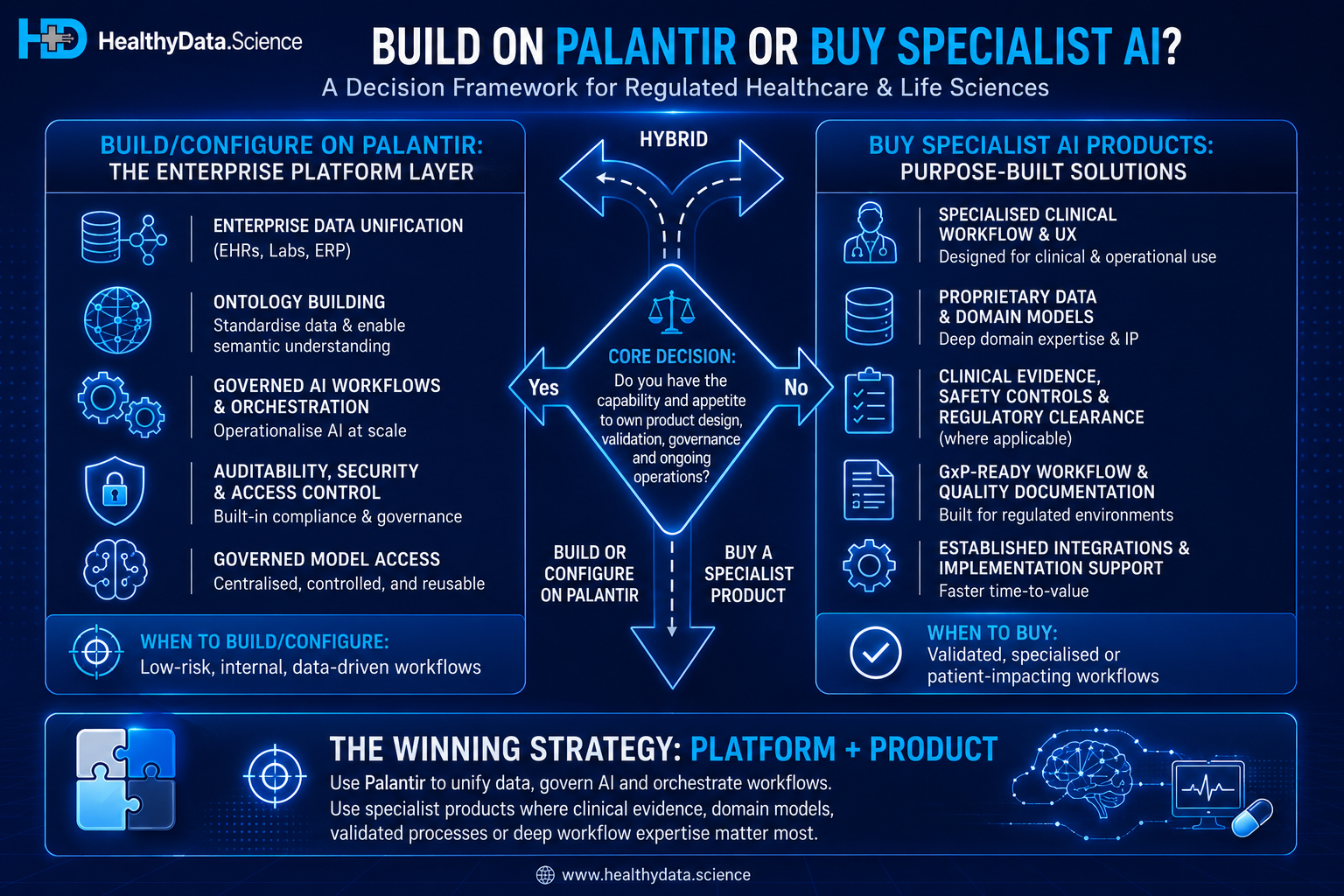
So What Does Palantir Give You?
Foundry and AIP bring together data connectivity, model connectivity, ontology-building, app development, analytics, delivery, and security/governance. All in one place [1, 2]. In plain terms, that means you can:
Pull together fragmented data from EHRs, labs, ERP systems, manufacturing, CRM, and outside sources [1].
Build a governed view of your people, products, studies, sites, assets, and decisions through an enterprise ontology [1].
Stand up dashboards, workflows, and AI agents around your own data [1, 2].
Wrap access controls, monitoring, and auditability around anything AI touches [1, 2].
Plug in whichever LLM you want, rather than being locked into one provider [2].
That’s a serious toolkit for complex, data-heavy work: clinical development ops, real-world-data programs, manufacturing, supply chain, hospital command centres, revenue cycle, quality operations.
One example worth noting: OneMedNet has talked about using Palantir’s AIP and ontology tools for near-real-time data discovery, custom cohort building, conversational search, standards-aware access (think SNOMED, ICD-10), and de-identification at scale [3]. Impressive stuff. But it’s a platform and data-network capability, not a stand-in for every specialist clinical app out there [3, 4].
Platform vs. Product — The Distinction That Matters
A platform helps you construct an AI workflow [1, 2]. A specialist product hands you a ready-made answer for one specific job [4].
That difference gets a lot more important once you’re in regulated AI/ML territory [4, 7].
A good specialist vendor typically brings something Palantir doesn’t automatically generate: an established clinical workflow, a purpose-built UX, proprietary data, a model tuned to a disease or modality, existing integrations, quality documentation, real implementation know-how, actual customers who’ve done this before, and sometimes regulatory clearance or clinical evidence [4, 6]. Palantir can connect all of that to your enterprise data. But it can’t conjure it out of thin air [1, 4].
Think of it this way: Palantir is often the environment where you operationalise AI [1, 2]. A specialist vendor is often the product that solves one particular clinical, scientific, or regulated problem [4, 7].
Neither one beats the other. They’re just solving different layers of the puzzle.
“Palantir can orchestrate enterprise AI. Specialist vendors still win where evidence, domain depth and validated workflows matter most.” — HealthyData.Science Buyer Intelligence
When Palantir Might Replace a Point Solution
Palantir is a realistic replacement when the “product” you’re paying for is really just a generic interface sitting on top of your own data. And especially when your internal data, technical, clinical, and operational muscle is already strong [1, 4].
Table 1: Use-Case Assessment: Platform Build vs Specialist AI Tool
The catch? Building it yourself means you now own the responsibility [4, 7]. You’re defining requirements, cleaning the data, designing the workflow, testing it, setting up governance, handling integrations, validating the AI/ML system, watching for drift, and keeping the whole thing running [4, 5, 7].
A slick demo is not a production system [4]. In life sciences especially, there’s a real gap between ‘wow, the LLM did that’ and a workflow you can really trust. Grounded content, human oversight, audit trails, data integrity, validation, change control, ongoing monitoring [4, 5, 7]. All of that has to get built too.
When You’re Still Better Off Buying
A specialist AI product earns its keep when it offers something more defensible than a configurable workflow [4]. That’s especially true here:
Imaging AI / diagnostic software: modality-specific models, clinical evidence, safety engineering, defined intended use, potential medical-device regulation [5].
Clinical decision support: needs carefully built clinical logic, workflow fit, human-factors design, local validation, safety monitoring [5, 6].
Ambient documentation / clinician tools: mature EHR integration and specialty-specific usability often matter more than the LLM underneath.
Drug discovery / translational research: the value is in the scientific models, proprietary bio/chem data, and domain expertise.
Pharmacovigilance / regulatory intelligence: controlled content, regulatory domain rules, traceability, validated workflows [7].
Quality management / GxP workflows: preconfigured processes and AI-powered digital validation tools can save you a lot of pain [7].
Digital therapeutics / remote patient monitoring: clinical programmes, patient engagement, devices, reimbursement. A data platform alone won’t get you there.
Narrow clinical recruitment tools: site networks and protocol intelligence are the real differentiators, not data orchestration [4].
For clinical AI in particular, don’t settle for ‘our model is accurate’ as the pitch. A useful healthcare-AI lifecycle framework breaks this into five stages: conception, development, validation, deployment, monitoring. And the point is that responsible AI doesn’t stop once the model’s built [5]. Similarly, a solid vendor-evaluation approach for health systems leans on strategic alignment, executive sponsorship, value assessment, and multidisciplinary risk review. Not just an impressive demo [6].
The One Question That Cuts Through the Noise
Before you decide to build on Palantir instead of buying a specialist tool, ask yourself:
“Do we want to own the productisation, validation, and ongoing operational responsibility for this workflow?
For a low-risk, internal productivity use case? Sure, maybe. Your data or digital team can build a governed assistant, hook it up to approved data, lock down permissions, and keep an eye on usage [1, 2, 4].
For anything higher-stakes. Diagnostics, clinical decision support, pharmacovigilance, manufacturing release, GxP quality. The calculus changes fast [5, 7]. You’re now looking at documented requirements, risk assessment, testing, controls for electronic records and signatures, training, change control, periodic review, supplier management, and proof the system actually performs in your real environment [5, 6, 7].
A specialist vendor doesn’t get you out of validation [5, 7]. But it can massively cut down how much original product design, domain-rule building, compliance paperwork, and workflow engineering falls on your team [4, 7]. For example, AI-enabled digital validation platforms can take on much of the requirements, evidence and traceability workload.
A Practical Framework: 6 Questions to Ask Before You Decide
Is the differentiation in our data, or in the vendor’s product?
Lean build if your data is unique and high-quality, and the workflow is mostly specific to you [1, 4]. Lean buy if the vendor’s proprietary data, models, or validated content are the real source of value [4, 7].
Is this regulated or patient-impacting?
The higher the clinical, safety, GxP, privacy, or regulatory stakes, the higher the bar for building it yourself [5, 7]. A specialist product with real-world evidence is often the safer starting point [5, 6].
How much workflow specificity do we actually need?
A platform is flexible, but a mature specialist tool often encodes years of hard-won decisions — exception handling, terminology, user roles, review steps, reporting, integrations [4, 7]. Lots of edge cases can turn ‘we’ll just build it’ into a multi-year program [4].
What’s the real time-to-value?
Don’t just compare a subscription fee to a platform license. Factor in internal product, engineering, clinical, quality, legal, security, and implementation time; integration and data-curation work; validation, testing, training, and monitoring; the cost of delaying the outcome you actually want; and who owns support and maintenance down the line [4, 6, 7].
What evidence do we need to show?
For clinical AI: independent validation, failure-mode analysis, performance across relevant populations, workflow impact, ongoing monitoring. Not just a benchmark score [5, 6]. Most evaluation toolkits also want to see privacy/security, integration, business viability, and regulatory status covered [6].
For life-sciences use cases: a documented validation approach, reproducibility, model-lifecycle governance, security controls, audit history, and a clear line on who’s responsible for what [7].
Can we do both?
Often the real answer isn’t ‘Palantir or specialist vendor’. It’s both [1, 4]. Use Palantir to harmonise clinical, safety, manufacturing, and commercial data, build governed workflows, and surface decision support [1, 2, 3]. Then keep specialist products for imaging, eQMS, pharmacovigilance case processing, trial recruitment, molecule design, or regulated document intelligence [4, 7]. That way you get the enterprise value of the platform and keep the specialist capability where it genuinely earns its place.
What are the best alternatives to Palantir Foundry for a manufacturer that needs an AI-ready operational data layer across brownfield plants?
There is no single best alternative. The right option depends on whether you need to connect plant data, contextualise industrial information, build an enterprise data and AI foundation, or deploy operational workflows.
Consider AVEVA PI System or Siemens Insights Hub for operational-data collection, industrial connectivity, and plant-focused use cases.
Consider Cognite Data Fusion when the priority is contextualising fragmented engineering, maintenance, and operational data across legacy assets.
Consider Databricks or Snowflake when you have the engineering capability to build and govern your own cloud data and AI layer.
Consider Honeywell Forge for industrial performance and operations-focused environments.
Retain or evaluate Palantir Foundry when you need a cross-functional operational layer that connects OT, IT, quality, supply-chain, and business data and turns it into governed workflows and AI-enabled applications.
For a brownfield manufacturer, the practical architecture is often not one replacement platform. It is a layered combination of plant historians and connectivity, industrial-data contextualisation, enterprise data/AI, and specialist MES, QMS, maintenance, or process systems. In GMP-regulated manufacturing, assess validation, data integrity, auditability, access control, change control, and the internal responsibility for maintaining the system as carefully as the AI capability itself.
What Are the Best Palantir Alternatives for Hospitals?
For hospitals, the best alternative to Palantir depends on the workflow rather than on finding another all-purpose data platform. Consider Epic, Oracle Health, Microsoft Azure, Snowflake, Databricks, Innovaccer, Arcadia, Health Catalyst, and specialist clinical-AI vendors when the priority is a preconfigured EHR workflow, population-health analytics, interoperability, cloud data infrastructure, revenue-cycle intelligence, clinical decision support, imaging AI, or patient engagement. Palantir is strongest when a health system needs to connect fragmented enterprise data, model operational processes through an ontology, and build governed cross-functional applications; a specialist hospital platform is often a better choice when it already provides the clinical workflow, integration, evidence, user experience, and support model required for a defined care-delivery problem. The most practical architecture is frequently hybrid: retain the EHR and specialist products for patient-facing or clinically validated workflows, while using Palantir as a governed data and operational-intelligence layer where its configuration and orchestration capabilities add distinct value.
Bottom Line
Palantir will probably eat into demand for some generic analytics tools, disconnected internal copilots, and thin workflow layers [1, 2, 4]. It can absolutely become the enterprise backbone that connects your data, models, users, and actions across the business [1, 2].
But it won’t make specialist AI vendors disappear just because it can build apps and orchestrate models [4]. In regulated environments, connecting an LLM to your data is the easy part. Proving the result is fit for purpose, safe, governed, usable, compliant, and sustainable in real operations. That’s the real work [4, 5, 7].
So the question isn’t ‘Can Palantir replace this vendor?’
It’s: which parts of this workflow should we own ourselves, and which should stay a specialist product with the evidence, domain depth, and accountability we can’t build overnight?
That’s a conversation for procurement, clinical, quality, data, and digital leaders to have together. Before an impressive demo turns into a very expensive implementation commitment.
Find the right AI product for the workflow, not just the platform
Palantir can provide the enterprise foundation for data, governance and AI orchestration. But for clinical, regulated, validated or deeply specialised workflows, the right answer may be a purpose-built product.
Explore AI solutions for healthcare and life sciences to compare tools by use case, evidence, regulatory readiness, workflow fit and implementation requirements.
References
Palantir Technologies, “Platform overview,” Palantir Foundry Documentation, Dec. 2021.
Palantir Technologies, “Bring your own model to AIP,” Palantir Foundry Documentation, Dec. 2021.
OneMedNet Corporation and Palantir Technologies, “OneMedNet selects Palantir to advance healthcare AI and data analytics,” Palantir Investor Relations, Oct. 2025.
Medable, “Build vs. buy: A guide on adopting AI agents for life sciences,” Medable Knowledge Center, Nov. 2025.
M. Sujan, C. Smith-Frazer, C. Malamateniou, J. Connor, A. Gardner, H. Unsworth, and H. Husain, “Validation framework for the use of AI in healthcare: Overview of the new British standard BS30440,” BMJ Health & Care Informatics, vol. 30, no. 1, Art. no. e100749, Jun. 2023. DOI: 10.1136/bmjhci-2023-100749.
C. E. Binkley, D. Bouslov, A. Zaidi, et al., “An early pipeline framework for assessing vendor AI solutions to support return on investment,” npj Digital Medicine, vol. 8, Art. no. 368, Jun. 2025. DOI: 10.1038/s41746-025-01767-z.
Sakara Digital, “AI vendor selection guide for regulated life sciences environments,” Sakara Digital, May 2026.