
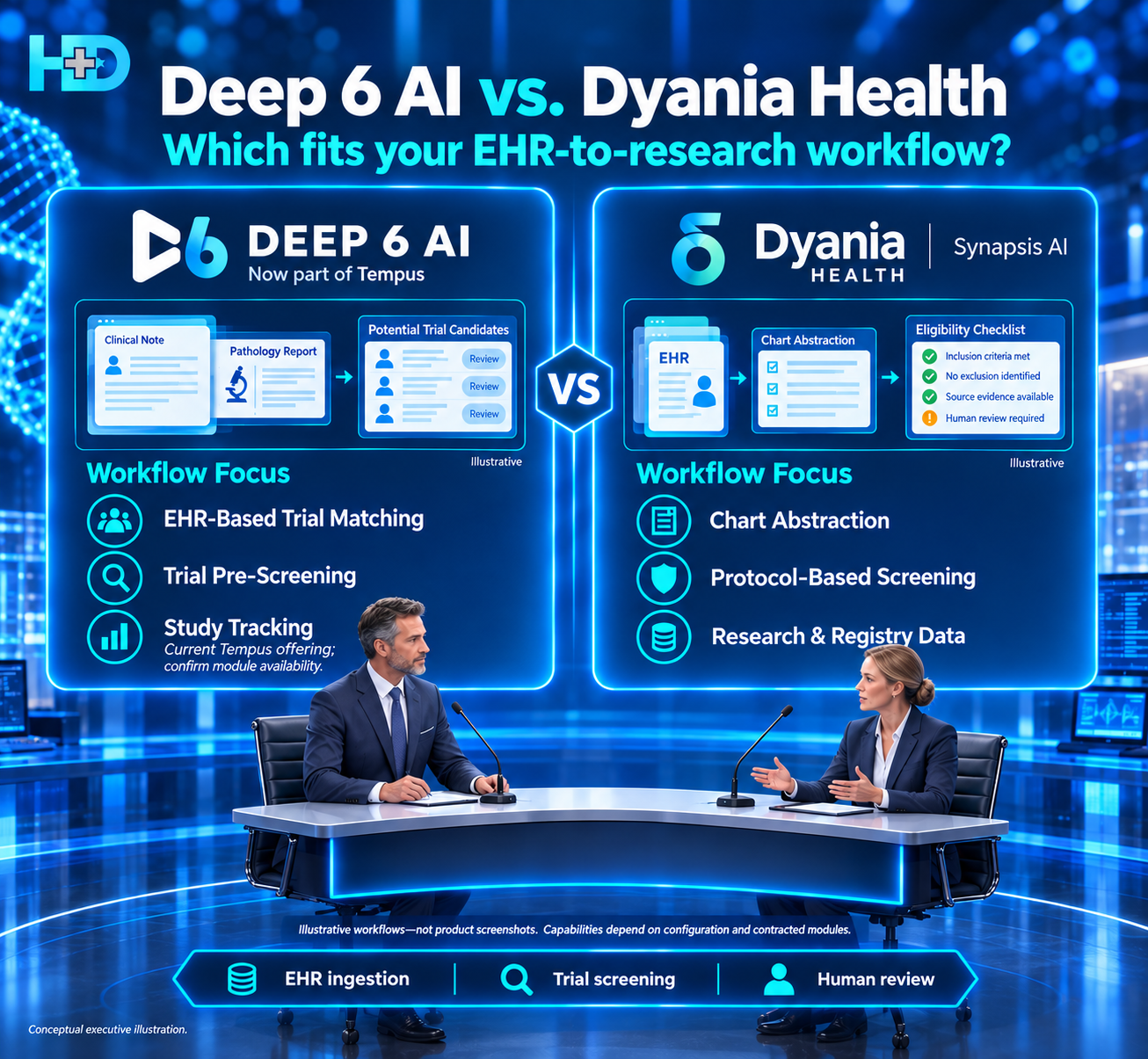
Deep 6 AI vs Dyania Health: An Operational Comparison
An operational comparison for clinical research directors, health-system data executives, and healthcare investment teams.
Research date: October 6, 2026.
The main difference between Deep 6 AI and Dyania Health is that Deep 6 AI’s established cohort-discovery and trial-matching capabilities now sit within Tempus’s evolving clinical-research offering [1], while Dyania’s Synapsis AI is explicitly positioned as a health-system-hosted chart-abstraction and clinical-reasoning system, with vendor physicians helping translate protocols into screening logic [3, 4]. Both address structured and unstructured EHR data [1, 3], but they present different procurement questions: product continuity and module availability for Deep 6/Tempus [1, 2]; local infrastructure, clinical configuration, and review responsibilities for Dyania [3, 4].
This is a two-product comparison. Its primary scope is EHR-based feasibility assessment and patient pre-screening. Not autonomous enrolment, diagnosis, or treatment selection. The products overlap directly in identifying potential clinical-trial participants from medical records [1, 3]. Dyania also documents registry abstraction, observational research, and evidence-guided care applications [3]; Tempus’s current clinical-research materials distinguish the TIME trial network from the Next Trials technology-and-services offering [2]. These adjacent capabilities should not be treated as identical products or assumed to be included in a single contract [2].
The comparison evaluates operational fit, ingestion architecture, protocol configuration, human review, integration dependencies, traceability, and use-specific validation. Evidence labels distinguish vendor descriptions, external implementation evidence, and analytical interpretation. An important limitation is that public-facing materials are not equivalent to a technical due-diligence package. The reviewed sources do not establish complete connector specifications, permission matrices, model-change controls, validation deliverables, or contractual service levels for either product.
Feature / Capability Comparison
| Feature/Capability | Deep 6 AI / Relevant Tempus Offering | Dyania Health / Synapsis AI |
| Primary target audience | Healthcare organisations and life-sciences companies; current Tempus materials address research sites and sponsors [1]. | Health systems, clinicians, researchers, and pharmaceutical sponsors [3]. |
| Principal operational use case | EHR-based patient matching and feasibility; current Next Trials adds pre-screening, portfolio workflows, and metrics [2]. | Automated chart abstraction, trial pre-screening, registry reporting, and observational research [3]. |
| Product identity | Deep 6 acquired by Tempus in March 2025; its homepage now directs buyers to Tempus [1]. Do not assume all legacy modules map unchanged to Next Trials [2]. | Synapsis AI is the core platform; Patient Finder is a named application [3, 4]. Public packaging boundaries require confirmation. |
| Architecture and deployment | Current Next Trials describes an Edge SDX connection and clinical-system-integrated workflows; hosting and tenant boundaries are not established by these pages [2]. | Vendor describes deployment behind the health-system firewall, on-premises or in private cloud, with controlled vendor access [4]. |
| Native workflow depth | Legacy Cohort Builder is externally documented; current Next Trials lists tracking, patient summaries, pre-screening, and dashboards. Self-service cohort tools are marked “coming soon” [2]. | Vendor describes daily pre-screening, individual-record review, site-based searches, dashboards, and a registry audit tool [3, 4]. |
| AI and human oversight | Deep 6 mines structured and unstructured records [1]; current TIME combines LLMs, machine learning, and clinical-team pre-screening [2]. | Medically trained LLM system plus physician-developed deterministic criteria logic; vendor physicians review errors before results reach customers [3, 4]. |
| Validation support | Public sources reviewed do not establish the supplied validation package. Current and legacy product scope must be resolved first [1, 2]. | Clinical evaluation is reported at Cleveland Clinic; that does not establish a complete customer software-validation package [5]. |
| Integration footprint | Tempus reported more than 750 Deep 6 provider locations at acquisition; Next Trials names Edge SDX [1, 2]. These are not connector-level specifications. | Vendor claims EMR-database-agnostic mapping; local infrastructure and GPU needs depend on workload [4]. |
| Governance and auditability | Rutgers documents IRB-gated disclosure to named study-team members; this is a local operating process, not proof of universal product controls. | Study reports describe auditable eligibility justifications; immutable change history and complete audit export remain unestablished [5]. |
| Key operational risk | Assuming legacy Deep 6 capabilities are generally available in the current Tempus product being purchased [2]. | Assuming local hosting or a headline accuracy figure proves lawful processing, generalisable performance, or validated research use [7]. |
Operational Workflow Comparison
The Shared Screening Scenario
Consider a health system assessing an oncology protocol that requires a diagnosis, a biomarker finding in a pathology report, a particular treatment history, and adequate recent laboratory results.
Both offerings address record-based identification of potential participants: Deep 6 through structured and unstructured EHR mining [1], and Synapsis through chart abstraction and protocol-specific reasoning [3]. Neither reviewed evidence base establishes that an AI match alone authorises outreach or proves final eligibility [6].
The following workflows are illustrative reconstructions from documented capabilities. They are not verified descriptions of every customer installation.
Trigger and Ingestion
| Operational Question | Deep 6 AI / Tempus | Dyania Health |
| What initiates screening? | Legacy use includes a feasibility request or approved participant search; current Tempus offerings support pre-screening for research opportunities [1, 2]. | A scoped protocol or clinical question; Patient Finder is described as screening changing records daily [3, 4]. |
| What enters the system? | Structured and unstructured clinical records; Next Trials describes clinical, imaging, and molecular information [2]. | Structured records plus unstructured clinical notes and reports; Cleveland Clinic’s study used notes and laboratory reports [5]. |
| How does data move? | Next Trials names Edge SDX, but the reviewed page does not specify extraction methods, interfaces, or refresh guarantees [2]. | Vendor describes mapping EMR data into an environment inside the health system; precise interface and refresh specifications require confirmation [4]. |
| What preparation is needed? | Trial criteria and patient-record access must be established; protocol configuration responsibility is not fully explained publicly [2]. | Dyania physicians assess protocols and deconstruct criteria into deterministic logic; engineers map relevant data [4]. |
For both products, a buyer should request a data-flow diagram showing the source EHR, intermediate stores, inference environment, user interface, exports, and downstream research systems. FDA guidance specifically recommends documenting clinical-investigation data flow and validating relevant transfers and interfaces according to risk [8].
“Imaging data” also needs clarification. Analysing a radiology report is not the same function as analysing the underlying scan; FDA’s CDS guidance treats medical-image analysis differently from use of reported medical information [10].
Routing and Logic
Deep 6’s externally documented Cohort Builder supports inclusion/exclusion-based searches. Current Tempus materials describe AI-assisted pre-screening and tracking, but do not establish a general-purpose, user-configurable IF/THEN/ELSE workflow engine [2].
Dyania provides a more explicit public account of protocol translation: its physicians deconstruct criteria into deterministic logic for the reasoning engine [4]. This establishes vendor-assisted clinical configuration—not a demonstrated drag-and-drop workflow builder or unrestricted customer control over that logic [4].
Decision Layer
| Stage | Deep 6 AI / Tempus | Dyania Health |
| Candidate identification | AI-supported record mining and trial matching [1, 2]. | LLM-supported abstraction combined with protocol-specific criteria logic [3, 4]. |
| Clinical pre-screening | TIME describes expert clinical-team review of matched patients [2]. This must not be assumed to accompany every legacy Deep 6 contract. | Vendor physicians review true/false positives and negatives; Cleveland Clinic also retained clinician-in-the-loop validation [4, 5]. |
| Assignment and escalation | Current materials list integrated workflows and tracking; detailed assignment rules are unestablished [2]. | Dashboards and site searches are described; detailed escalation rules are unestablished [3, 4]. |
| Human override history | Complete override/version-history behaviour is not established in reviewed materials. | Complete override/version-history behaviour is not established in reviewed materials. |
A useful demonstration should include missing evidence, conflicting notes, outdated laboratory results, and ambiguous treatment history. The procurement question is whether each product exposes uncertainty and permits defensible review. Not simply whether it produces a match.
Collaboration and Approval
Rutgers provides concrete external evidence for a Deep 6 handoff: the Clinical Trials Office performs feasibility searches. Then, after IRB approval, generates potential-participant lists and releases identifiable information only to study-team members listed in its eIRB application. This is an institutional governance workflow; it does not prove that every installation enforces the same rules natively.
For Dyania, Cleveland Clinic reports detailed justifications for inclusion and exclusion decisions, allowing research coordinators to verify eligibility [5]. The same report states that clinical-team validation remained essential [5].
Neither reviewed product evidence establishes native legally binding electronic signatures, signature-to-record linkage, or comprehensive Part 11 controls [8]. Buyers needing those functions should obtain product-specific documentation rather than interpreting a review screen, VPN login, or approval action as an electronic-signature system [8, 9].
Exceptions and Traceability
Dyania’s published implementation account is more explicit about criterion-level explanations [5]. Deep 6’s current Tempus materials describe patient summaries and pre-screening navigation, but do not establish equivalent explanation granularity in the particular product being purchased [2]. That is an evidence difference, not proof that Deep 6 lacks provenance.
For either product, request a demonstration of:
A corrected source note and the resulting re-screen.
A protocol amendment and preservation of the previous screening result.
A rejected AI conclusion with reviewer identity and reason.
A failed feed, stale record, or incomplete chart.
Export of source references, timestamps, model/configuration identifiers, and review history.
Preservation of research records when the contract ends.
These are proposed acceptance tests, not claims that either product currently fails them. Their rationale is the regulatory emphasis on traceability, change control, data-transfer integrity, and retrievable records [8, 9].
Reconstructed End-to-End Workflows
Deep 6 / Tempus Workflow
Establish contracted architecture: Establish the contracted product and permitted data connection; Next Trials currently names Edge SDX [2].
Configure protocol search: Configure a feasibility or patient-screening question using relevant protocol criteria [1, 2].
Execute record mining: Analyse available structured and unstructured records to identify potential matches [1, 2].
Process review routing: Route results through the purchased review workflow; TIME specifically describes clinical-team pre-screening [2].
Execute candidate verification: Have the authorised study team verify candidates and conduct outreach under the institution’s approved process [6].
Dyania / Synapsis AI Workflow
Define project parameters: Agree the use case, access arrangements, and research scope with the health system [4].
Translate protocol criteria: Have Dyania’s clinical team assess the protocol and translate criteria into reasoning logic [4].
Deploy and map data: Deploy in the health-system environment and map relevant EHR data [4].
Execute automated abstraction: Run abstraction and pre-screening, delivering results through application-specific dashboards [3, 4].
Verify and act on justifications: Review criterion-level justifications and verify candidates before authorised recruitment activity [5, 6].
Product Deep Dives
Deep 6 AI: System Overview and Pipeline Fit
Editorial synthesis: A feasible cohort is not a recruitment-ready list. Rutgers separates estimated patient counts from IRB-approved access to identifiable candidates.
Deep 6 should no longer be evaluated as though its ownership and commercial context were unchanged. Tempus announced its acquisition on March 11, 2025, and Deep 6’s current homepage states that it has joined Tempus [1].
The acquisition announcement describes mining real-time structured and unstructured EMR data for patient matching, recruitment, and real-world evidence [1]. It reported more than 750 provider locations spanning over 30 million patients at that time [1]. Those are dated vendor-reported footprint figures—not evidence that every location is currently accessible to every buyer or that every record can be screened under a new contract [1].
Current procurement requires distinguishing three layers:
| Layer | Evidence-Supported Role | Procurement Boundary |
| Legacy Deep 6 Cohort Builder | Feasibility assessment and potential-participant identification. | Confirm availability, support, upgrade path, and contractual continuity. |
| Tempus Next Trials | Pre-screening, patient summaries, integrated tracking, and study-performance dashboards [2]. | Confirm released modules; self-service cohort building is labelled “coming soon” [2]. |
| Tempus TIME | Trial network, expert pre-screening, and site-activation services [2]. | Do not assume network services accompany the software purchase [2]. |
Deep 6 AI: Native Workflow Capabilities
The strongest external implementation evidence reviewed is Rutgers’s operational description of Cohort Builder. It establishes a practical research-office workflow and a separation between aggregate feasibility and identified candidates. It does not provide an extraction benchmark, connector inventory, or technical permissions specification.
Current Next Trials documentation establishes vendor-described features for patient-event summaries, pre-screening navigation, tracking, and organisation-wide metrics [2]. It also identifies Edge SDX as a connection used to power Next Trials and TIME [2].
The important release-status qualification is self-service cohort building. Both current Next Trials and sponsor-facing recruitment materials attach a “coming soon” qualification to cohort-building functionality [2]. Buyers should not transfer a legacy Cohort Builder capability into a current Next Trials requirements matrix without written confirmation [2].
TIME’s public page describes a combination of LLMs, machine learning, and clinical expertise [2]. That is evidence of the current TIME service model; it does not establish the model architecture or review staffing for every Deep 6 deployment [2].
Deep 6 AI: Risks and Bottlenecks
The leading risk is product-boundary ambiguity rather than an established technical deficiency.
Confirmed qualification: Current Next Trials self-service cohort building is publicly marked as forthcoming [2].
Architecture question: Edge SDX is named, but supported source systems, feed latency, write-back, and export interfaces are not specified on the reviewed product page [2].
Continuity question: The Deep 6 homepage confirms the Tempus transition without publishing a legacy-to-current module crosswalk [1].
Validation question: The reviewed materials do not establish customer-accessible validation reports, model-version controls, or complete audit-export specifications [2].
Commercial question: No public enterprise software price was established in the reviewed product pages; obtain a quotation [2]. Rutgers’s local service fees are not vendor license prices.
For investors and M&A analysts, the defensible interpretation is that Tempus acquired an installed integration footprint and research capabilities [1]. The public announcement is not evidence of realised acquisition synergies, retained customer revenue, current module adoption, or incremental enrollment attributable to the acquired technology [1].
Deep 6 AI: Ideal Buyer Persona
Analytical fit: Shortlist the relevant Tempus offering if the requirement centres on patient matching, trial operations, and potentially the TIME network, particularly where an existing Edge SDX connection may be reusable [2]. Validate which product delivers each required capability [2].
A research director who primarily needs investigator-driven, self-service feasibility should make released cohort functionality a procurement gate [2]. An IT executive should make the exact hosting and interface architecture a gate [2]. An investor should distinguish installed connectivity from monetised recurring usage [1].
Dyania Health: System Overview and Pipeline Fit
Editorial synthesis: Explainable screening still needs clinical verification. Cleveland Clinic retained clinician-in-the-loop review in its Synapsis AI trial-screening study [5].
Dyania’s Synapsis AI is positioned as an end-to-end chart-review system deployed inside the health system’s computing environment [4]. The vendor describes on-premises or private-cloud installation, workload-dependent GPU requirements, controlled remote access, and ongoing vendor maintenance [4].
Its documented applications extend beyond patient matching to registry reporting, observational studies, feasibility assessment, and evidence-guided care pathways [3, 4]. These applications share chart-abstraction capabilities, but each intended use needs its own operational and regulatory assessment [8, 10].
The public workflow is explicitly service-assisted. Dyania physicians assess protocols, translate criteria into deterministic reasoning logic, and review false positives and negatives before sending results to customers [4]. Buyers should therefore assess both software and clinical-service delivery, not only model performance [4].
Dyania Health: Native Workflow Capabilities
The vendor describes Patient Finder as providing daily screening of changing EHRs, with an application for querying clinical questions, reviewing individual records, and searching candidates by trial site [3, 4]. It separately describes registry field abstraction and a native audit tool [3, 4].
The strongest externally published implementation evidence reviewed comes from Cleveland Clinic. Its March 2026 report describes Synapsis screening for the DepleTTR-CM ATTR-cardiomyopathy trial across 25 hospitals and 250 outpatient centres [5].
| Reported Result | What It Establishes | What It Does Not Establish |
| 1,476 patients reviewed in 1 week; 46 potential matches | Screening throughput and candidate generation in that implementation [5]. | Universal throughput or 46 confirmed eligible participants. |
| 30 matches after AI & clinician review; 29 previously unidentified | Incremental identification within the reported workflow [5]. | General recall across all missed eligible patients. |
| 96.2% accuracy across 7,700 trial questions (9 domains) | Question-level performance in the reported evaluation [5]. | Patient-level sensitivity, all-disease accuracy, or head-to-head advantage over Deep 6. |
| 7 patients enrolled in 6 days (vs 10 over 90 days traditionally) | A reported enrollment outcome in one trial setting [5]. | A controlled, generalisable estimate of enrollment uplift. |
| Justifications reported as 100% accurate & interpretable | Reviewer-assessed explanation quality in the evaluated sample [5]. | Error-free explanations in future deployments or immutable audit trails. |
The source discloses that Cleveland Clinic invested in Dyania and may benefit financially from sales. This is valuable implementation evidence, but not financially independent corroboration [5].
The underlying journal article was located, but its full text could not be retrieved during this review. The figures above are therefore attributed to Cleveland Clinic’s report, not represented as an independent reanalysis of the paper [5].
Dyania Health: Risks and Bottlenecks
The leading architectural trade-off is local deployment combined with vendor-assisted clinical configuration.
Documented dependency: Hardware requirements, including GPU capacity, depend on patient population, workload, and disease focus [4].
Documented dependency: Dyania personnel require contractor onboarding and controlled access to the health-system environment [4].
Documented dependency: Protocol logic involves Dyania’s clinical team; buyers should establish turnaround times and responsibilities for amendments [4].
Vendor claim requiring verification: “Any EMR database structure” is broader than a documented connector matrix or proven compatibility with a specific installation [4].
Governance qualification: Keeping data inside the environment does not by itself establish lawful processing, patient-rights handling, or complete GDPR compliance [7].
Evidence limitation: Broad claims of approximately 95% accuracy and sub-second record review lack a universal denominator or workload definition on the homepage [3]. They should not replace local evaluation.
An apparent integration discrepancy also needs careful handling. A 2024 founder interview described not integrating “into the EMR,” instead receiving data in a sandboxed computing environment. Current materials describe EMR integration and database mapping [4]. This may reflect different meanings of integration, architectural evolution, or implementation-specific arrangements; the public sources do not resolve it [4]. Ask whether the proposed installation uses replicated data, extracts, APIs, embedded screens, or write-back [4].
Dyania Health: Ideal Buyer Persona
Analytical fit: Shortlist Dyania when a health system wants reusable local chart-abstraction capacity across multiple research or reporting projects and accepts a vendor-assisted protocol configuration model [3, 4]. Its public materials support that positioning more explicitly than the current Deep 6 landing page [1, 3].
A buyer requiring immediate, entirely self-service protocol configuration should verify that workflow before selection [4]. A European buyer should require local-language evaluation and jurisdiction-specific deployment evidence; a statement of global coverage is not evidence of performance on a particular language, clinical documentation style, or national EHR environment [4, 7].
For investment analysis, examine deployment repeatability, clinician-service effort per protocol, local infrastructure support costs, and the proportion of revenue attributable to software versus project delivery [4]. These are diligence questions arising from the documented delivery model—not findings about Dyania’s margins [4].
Compliance and Deployment Friction
HIPAA and Patient Rights
The relevant question is not simply whether the vendor calls its system HIPAA-compliant. It is who may access identifiable records, under what authority, for which purpose, and who may contact the patient.
HHS explains that preparatory-to-research access can support identifying prospective participants, but does not permit researchers to remove PHI under that provision [6]. It also distinguishes covered-entity workforce members from outside researchers: an outside researcher cannot rely on that provision alone to obtain contact information and recruit patients [6]. A partial waiver may be relevant [6].
Consequently, cohort feasibility, identified screening, sponsor disclosure, and patient outreach need separate approval and access decisions [6]. Rutgers’s Deep 6 process illustrates one institutional separation; Dyania’s local-hosting claim does not eliminate the need for the equivalent governance process [6].
GDPR and European Deployment
GDPR remains applicable to identifiable and pseudonymised health data; pseudonymisation is not equivalent to anonymisation [7]. Relevant processing needs a lawful basis, an applicable condition for special-category data, and appropriate safeguards [7]. Research is not a blanket exemption from patient rights or security obligations [7].
For European procurement, request documented treatment of purpose limitation, minimisation, retention, access rights, controller/processor responsibilities, and any international access or transfers [7]. Evaluate whether a data-protection impact assessment is required for the intended processing [7]. Local hosting answers only part of this assessment [7].
Neither product’s reviewed public materials establish a complete Europe-specific contractual and patient-rights operating model [2, 7]. Dyania claims coverage across North America and Europe; Tempus’s reviewed TIME materials explicitly emphasise US enrollment [2]. Neither statement proves or disproves suitability for a particular European deployment [2].
GCP, Validation, and Part 11
Keep three assessments separate:
| Assessment | Buyer’s Question | Regulatory Relevance |
| Model evaluation | Does the system correctly extract and assess the intended local criteria? | Performance needs to match the defined context of use [8, 10]. |
| System validation | Do configuration, interfaces, permissions, updates, and record handling fulfil specified requirements? | FDA recommends risk-based validation [8]; EMA addresses lifecycle validation and trial-specific configuration [9]. |
| Operational oversight | Do trained people verify results and protect participant rights? | GCP addresses sponsor and investigator responsibilities and proportionate oversight [8]. |
Part 11 should not be applied indiscriminately to every EHR search. FDA’s October 2024 guidance states that it does not intend to assess EHR systems serving as RWD sources for Part 11 compliance; it describes assessing compliance once records enter the sponsor’s EDC system, while retaining sponsor responsibility for submitted data quality and integrity [8]. Other research-system records may fall within Part 11 scope according to applicable predicate rules and actual use [8].
EMA’s computerised-systems guideline explicitly includes AI used for trial recruitment and eligibility determination [9]. Its expectations cover risk-proportionate validation, metadata, audit trails, access management, and inspection access [9]. Calling a function “pre-screening” therefore does not automatically remove it from European GCP assessment [9].
Neither a published clinical accuracy result nor vendor release testing replaces the customer’s assessment of its own interfaces, protocol configuration, and regulated records [8, 9]. Blanket IQ/OQ/PQ requirements are not assigned here; the validation plan should follow the system’s intended use and documented risk [8, 9].
SaMD and Evolving AI Frameworks
Trial matching should not automatically be labelled either SaMD or Non-Device CDS. Classification depends on the actual software function, intended purpose, inputs, outputs, and users.
FDA’s January 29, 2026 CDS guidance addresses four criteria for the statutory non-device CDS exclusion, including the ability of healthcare professionals to independently review the basis for recommendations [10]. It distinguishes medical-image or signal analysis from the use of medical information such as reports [10].
Europe does not simply import that US exclusion. MDCG 2019-11 Rev.1, updated in June 2025, assesses qualification by intended medical purpose and addresses modular software. It specifically cautions that NLP search contributing to a medical purpose is not necessarily “simple search.”
This matters particularly for Dyania’s evidence-guided care pathways: a research-screening configuration and a patient-specific treatment-reassessment configuration may require different regulatory analyses [10]. That is not a finding that Synapsis is a regulated device; the reviewed sources do not establish its classification for each proposed application [10].
The regulatory framework is also evolving:
FDA’s January 2025 guidance on AI supporting drug and biologic regulatory decisions remains labelled draft and “not for implementation” on the reviewed official page [8]. Its context-of-use credibility framework is not a product approval [8].
EMA’s AI reflection paper addresses medicinal-product lifecycle uses, including clinical trials and data protection [9].
EMA and FDA announced ten joint good-AI-practice principles on January 14, 2026 [8, 9]. These are broad principles intended to underpin further guidance, not certification of either vendor [8, 9].
Friction and Risk Matrix
The entries below are documented dependencies or proposed procurement checks. Not speculative implementation ratings. The common control framework comes from FDA and EMA expectations for use-specific validation, interfaces, access, change control, and retention [8, 9].
| Operational Vector | Deep 6 AI / Tempus | Dyania Health |
| Setup and onboarding | Confirm current product, Edge SDX prerequisites, and whether TIME participation is separate [1, 2]. | Contractor onboarding, local deployment, data mapping, and clinical scoping are described [3, 4]. |
| Configuration and maintenance | Obtain module-specific responsibilities and legacy migration commitments [1, 2]. | Vendor describes ongoing maintenance and physician-assisted criteria configuration. Obtain amendment SLAs [4]. |
| Validation effort | Assess the purchased product, protocol configuration, and interfaces—not historical Deep 6 branding [8]. | Separate study performance evidence from validation of the local installation and configuration [5, 8]. |
| Integration dependencies | Edge SDX is named; connector compatibility, refresh latency, and write-back need verification [2]. | Broad EMR compatibility is claimed; precise transfer method and supported environments need verification [4]. |
| Data preparation | Test availability of required notes, reports, timestamps, and longitudinal history [9]. | Confirm mapping of each clinically relevant data type and workload-specific hardware [4]. |
| Human-review burden | TIME describes clinical pre-screening; confirm coverage and the site’s remaining workload [2]. | Both vendor physician review and local clinical validation are described. Quantify retained work [4, 5]. |
| Common user friction | No reliable, representative review dataset was established; do not invent usability complaints. | No reliable, representative review dataset was established; do not invent usability complaints. |
| Scaling constraints | Do not equate acquisition-era provider footprint with available capacity or licensed access [1]. | Hardware depends on population, project volume, and disease focus [4]. |
| Critical evidence gap | Legacy-to-current feature crosswalk; released cohort tools; hosting and audit specifications [1, 2]. | Configuration autonomy; full audit history; local-language performance; error escalation [3, 4]. |
Selection Guidance by Operational Framework
Prioritising Trial Operations and Sponsor Networks
If your priority is trial matching connected to research operations and a broader trial network, shortlist the relevant Tempus offering [2]. TIME documents clinical pre-screening and activation services; Next Trials documents pre-screening, tracking, and dashboards [2]. Specify which layer you need rather than buying against the Deep 6 name alone [1, 2].
Prioritising Local Multi-Use Chart Abstraction
If your priority is locally deployed chart abstraction reusable across trials, registries, and observational projects, shortlist Dyania [3, 4]. Its public materials describe that application range and deployment model, including vendor-assisted clinical configuration [3, 4]. Confirm infrastructure responsibilities and protocol-service turnaround before selection [4].
Self-Service Feasibility Constraints
If self-service feasibility is mandatory, make availability a contractual gate [2]. Legacy Deep 6 Cohort Builder is externally documented, while current Next Trials cohort tools are marked forthcoming [2]. Dyania describes application queries but also physician-assisted protocol logic; that does not establish unrestricted customer configuration [4].
European Deployment & Regulated RWD
If Europe-wide deployment or regulated downstream research data is mandatory, neither vendor should pass procurement on marketing evidence alone [7, 8]. Require the proposed data-flow architecture, privacy operating model, use-specific regulatory assessment, and validation package for the exact product and configuration [7, 8, 9].
Investor Diligence Perspective
For investors, the comparison is between an acquired research platform within a larger commercial ecosystem and a vendor-described local software-plus-clinical-services model [1, 4]. The decisive diligence questions are product continuity, deployment repeatability, service intensity, retained customer usage, and demonstrable enrolment or abstraction outcomes. Not the largest marketed patient denominator [1, 2].
Final Acceptance Protocol
Before signing, run a local evaluation with adjudicated charts and measure criterion-level errors, patient-level false negatives, review time, and downstream conversion separately [8]. Require a live demonstration of amendment handling, source provenance, reviewer corrections, failed feeds, and exportable history [8, 9]. These are proposed procurement controls; the reviewed evidence does not support a head-to-head accuracy ranking [8].
Source Map
All sources below were accessed on October 6, 2026. “Undated” means a reliable publication or update date was not established from the retrieved page. Vendor and partner evidence remain distinct from independent evaluation.
| Article Section or Asset | Supporting Sources and Dates | Source Type | Evidence Supported |
| Opening thesis; comparison scope | Tempus acquisition announcement, March 11, 2025; Deep 6 homepage, undated; Dyania homepage, undated | Vendor announcements & product descriptions | Ownership, product positioning, ingestion claims, local deployment, physician role [1, 3, 4]. |
| Deep 6 product layers | Tempus Next Trials, undated; TIME clinical trial matching, undated | Vendor product descriptions | Edge SDX, features, forthcoming cohort tools, clinical-service and network boundaries [2]. |
| Operational workflow & Deep 6 capabilities | Rutgers DEEP6, undated retrieved page | External institutional operating description | Actual local feasibility and IRB-gated disclosure process; not a universal product specification. |
| Dyania overview & capabilities | Dyania Healthcare Systems, undated; homepage FAQs | Vendor product & deployment descriptions | Daily screening, queries, registry abstraction, audit tool claim, deployment sequence, clinical configuration [3, 4]. |
| Dyania performance & review handoffs | Cleveland Clinic study report, March 3, 2026 | External implementation report (disclosed financial interest) | Trial-specific results, clinician verification, explanations, deployment footprint, investment disclosure [5]. |
| Dyania evidence limitation | Journal of Cardiac Failure article, March 2026 | Journal publication (full text not retrieved) | Publication identity only; numerical interpretation attributed to Cleveland Clinic’s report [5]. |
| Dyania architecture discrepancy | Moving Digital Health interview, January 15, 2024 | Vendor-founder interview hosted externally | Historical sandboxed data-delivery description; not independent technical verification. |
| Dyania European buyer qualification | Dyania About Us, undated | Vendor description | Claimed North American and European coverage; not local-language validation [3, 4]. |
| HIPAA and patient rights | HHS preparatory-research recruitment FAQ, reviewed Dec 28, 2022 | Official regulatory explanation | Distinction between preparatory access, workforce outreach, and outside-researcher contact [6]. |
| GDPR and European deployment | GDPR official text, April 27, 2016 | Binding EU regulation | Health-data processing, pseudonymisation, lawful processing, patient rights, safeguards, DPIA framework [7]. |
| GCP and operational oversight | FDA E6(R3) Good Clinical Practice, September 2025 | Final FDA guidance | Risk-based quality, proportionality, and sponsor/investigator responsibilities [8]. |
| Validation, Part 11 & risk matrix | FDA electronic systems guidance, October 2024 | Final non-binding guidance | EHR-source distinction, intended-use validation, configuration, interfaces, change control, retention [8]. |
| European validation & traceability | EMA computerised-systems guideline, March 9, 2023 | Regulatory guideline | AI recruitment scope, audit trails, agreements, lifecycle validation, access management [9]. |
| SaMD and Non-Device CDS | FDA Clinical Decision Support Software, January 29, 2026 | Final non-binding guidance | Function-specific CDS criteria, image/report distinction, independent review of recommendations [10]. |
| European software classification | MDCG 2019-11 Rev.1, June 2025 | Non-binding MDCG guidance | Intended-purpose qualification, NLP search qualification, modular software assessment. |
| Evolving AI framework | FDA drug-development AI draft guidance, Jan 2025; EMA AI reflection paper, 2024; EMA–FDA joint principles, Jan 14, 2026 | Draft guidance, reflection paper, and joint principles | Context-of-use credibility, lifecycle considerations, evolving regulatory expectations [8, 9]. |
| Deep 6 visual directive | Rutgers DEEP6; Next Trials; TIME | Editorial reconstruction | Separation of legacy cohort workflows, current software, and network services [1, 2]. |
| Dyania visual directive | Dyania homepage FAQs; Cleveland Clinic report | Editorial reconstruction | Local deployment, protocol logic, abstraction, and human review [4, 5]. |
| Conditional verdict & investor checks | Tempus and Dyania sources, interpreted against FDA/EMA guidelines | Explicit analytical synthesis | Buyer fit, commercial boundaries, and proposed acceptance tests [1, 4, 8, 9]. |
Build your clinical research AI shortlist
Deep 6 AI and Dyania Health may not be your only options. Explore the HealthyData.Science AI tools directory to find other platforms worth investigating, and build a shortlist around your EHR workflows, review requirements, and deployment constraints.
Disclaimer: This article is an independent editorial comparison and was not sponsored by either company. It is based on publicly available information reviewed on October 6, 2026. Product capabilities, availability, deployment options, and commercial terms may change. Vendor claims and reported implementation outcomes should not be interpreted as independently verified performance guarantees or evidence of regulatory compliance. This article does not constitute medical, legal, regulatory, or investment advice. Buyers should confirm requirements directly with each vendor and conduct their own technical, privacy, and validation assessments. The cover image contains fictional executive figures and illustrative workflows. Not actual company representatives or product screenshots, and does not imply vendor endorsement.
References
Tempus AI, Inc., “Tempus announces acquisition of Deep 6 AI,” Mar. 11, 2025. Accessed: Oct. 6, 2026.
Tempus AI, Inc., “Tempus Next Trials,” n.d. Accessed: Oct. 6, 2026.
Dyania Health, “Automate medical chart review,” n.d. Accessed: Oct. 6, 2026.
Dyania Health, “Healthcare systems: Unlock real-time clinical insights with AI,” n.d. Accessed: Oct. 6, 2026.
Cleveland Clinic, “AI-driven chart review accurately identifies potential rare disease trial participants in new study,” Mar. 3, 2026. Accessed: Oct. 6, 2026.
U.S. Department of Health and Human Services, “Can the preparatory research provision of the HIPAA Privacy Rule at 45 CFR 164.512(i)(1)(ii) be used to recruit individuals into a research study?,” reviewed Dec. 28, 2022. Accessed: Oct. 6, 2026.
U.S. Food and Drug Administration, “Electronic systems, electronic records, and electronic signatures in clinical investigations: Questions and answers—Guidance for industry,” Oct. 2024. Accessed: Oct. 6, 2026.
European Medicines Agency, “Guideline on computerised systems and electronic data in clinical trials,” EMA/INS/GCP/112288/2023, Mar. 9, 2023. Accessed: Oct. 6, 2026.
U.S. Food and Drug Administration, “Clinical decision support software: Guidance for industry and Food and Drug Administration staff,” Jan. 29, 2026. Accessed: Oct. 6, 2026.

Author: Stephen
Founder of HealthyData.Science · 20+ years in life sciences compliance & software validation · MSc in Data Science & Artificial Intelligence.
Follow HealthyData.Science on Google Search & AI
Get our latest healthcare and life science AI tool evaluations, regulatory updates, and buyer intelligence in your Google AI Overviews.
Add as Preferred Source