
Stephen
Founder of HealthyData.Science · 20+ years in life sciences compliance & software validation · MSc in Data Science & Artificial Intelligence.


This section helps you answer:
For Kneat Gx, we reviewed:
Across these sources, repeated themes emerge:
Reddit’s current Kneat footprint is limited and partially investment‑oriented rather than practitioner‑led, so we treat Reddit here as supporting colour, not a primary evidence source. The strongest qualitative signal comes from G2’s Kneat Gx reviews and pros/cons summaries, with Capterra providing additional confirmation that Kneat is perceived as a validation‑focused tool rather than a generic QMS.
Across G2 and Capterra, Kneat Gx is consistently praised for helping teams digitise and streamline validation activities, centralise documentation, and improve traceability and collaboration.
Recurring positive signals buyers should notice
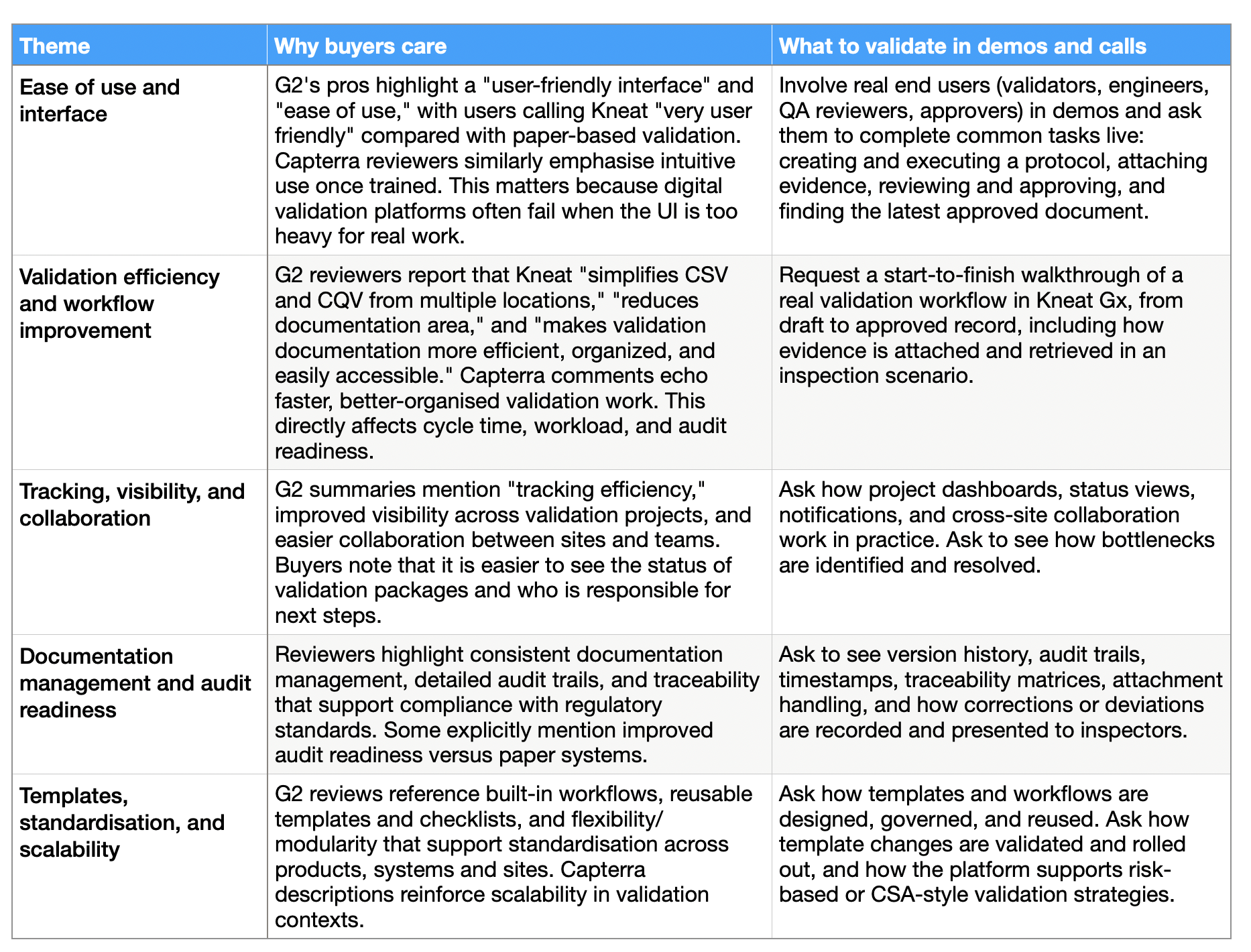
The same review data also surfaces friction themes that buyers should treat as prompts for deeper due diligence.
Recurring friction points buyers should pressure‑test
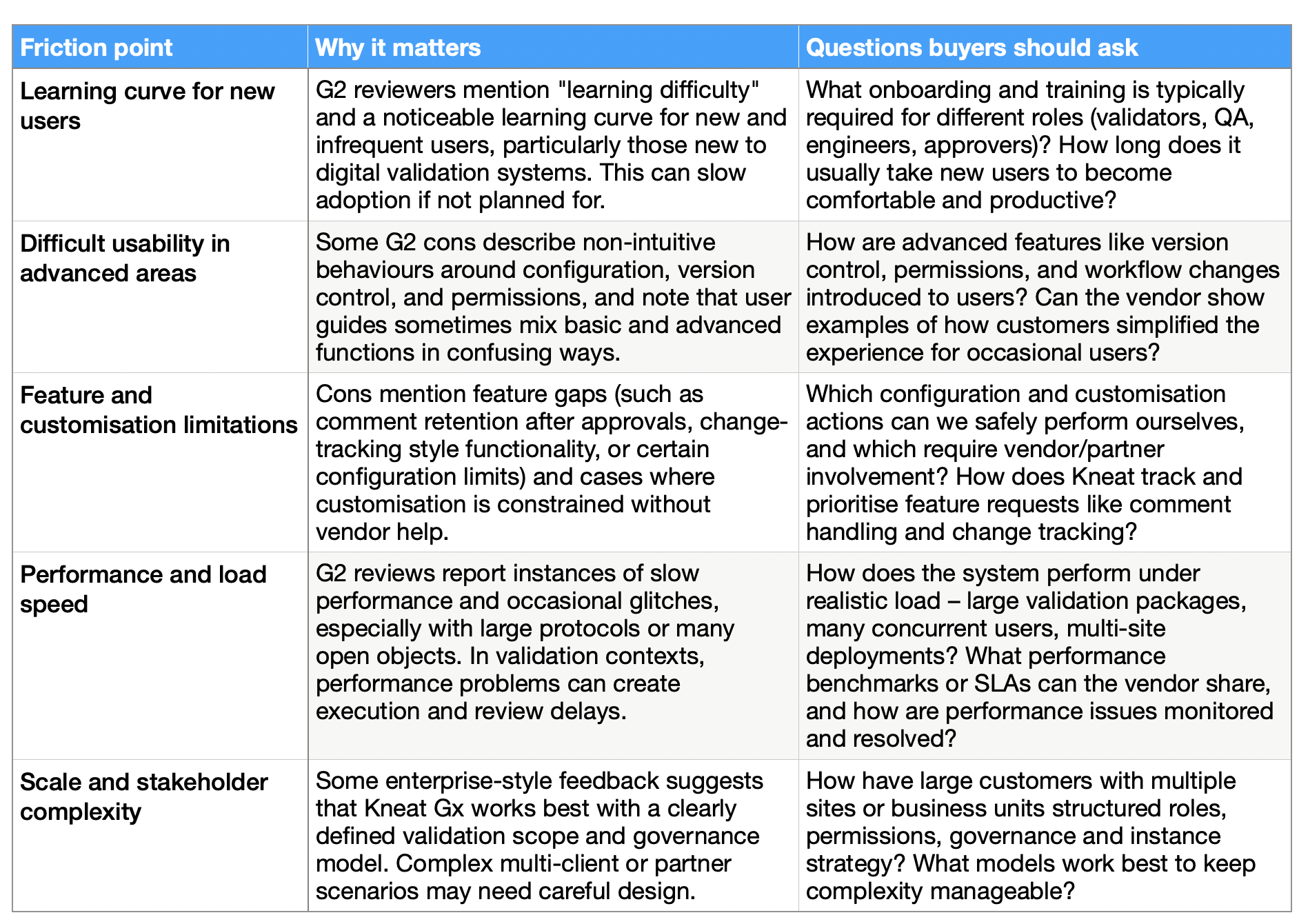
For Kneat Gx, our qualitative evidence layer is based on:
We use these sources to:
We do not:
For transparency, you can review these pages directly:
These FAQs turn the qualitative signals above into concrete, buyer‑ready questions.
Q1. How difficult is Kneat Gx to implement in practice, not just in the sales process?
Implementing Kneat Gx typically involves configuring validation workflows, migrating existing validation records, validating the system in your environment, and training users across multiple roles. Review‑site praise for efficiency comes after this groundwork is done; it is not automatic.
Ask the vendor:
Q2. What usually causes rollout delays or rework after contract signature?
Common causes in regulated projects include under‑scoped data cleaning, discovering process mismatches late, over‑customising workflows, and underestimating the effort required for validation and change management.
Ask the vendor:
Q3. How much validation work remains the customer’s responsibility?
Kneat Gx supports validation workflows, but does not remove your obligation to validate the system itself. Vendors can provide documentation and templates, but you still own user requirements, risk assessments, and acceptance testing in your context.
Ask the vendor:
Q4. How does Kneat Gx support audit readiness and inspection scenarios?
Audit‑trail and traceability features are only valuable if they make inspections easier.
Ask the vendor:
Q5. Does Kneat Gx fit our validation workflows, or do we need to adapt our workflows to fit the tool?
Kneat Gx can standardise and improve validation, but you need clarity on whether the tool supports your specific steps, roles, and edge cases.
Ask the vendor:
Q6. How configurable is Kneat Gx without creating validation or admin overhead?
Configurability that requires frequent re‑validation or specialist admin work may not be sustainable.
Ask the vendor:
Q7. Will non‑specialist users actually adopt Kneat Gx, or will QA carry the load?
G2 reviews show both praise for user‑friendliness and comments about learning difficulty, especially for less technical users. This tension is common in specialised platforms.
Ask the vendor:
Q8. Are there usability or performance issues we should know about in advance?
G2 Cons mentions usability issues and performance concerns under certain conditions. These are not disqualifying, but you should not be surprised by them later.
Ask the vendor:
Q9. How does Kneat Gx licensing work as more users, systems and sites are added?
Licensing that works well for a core validation team can become complex or expensive as more stakeholders and systems are added over time.
Ask the vendor:
Q10. Is Kneat Gx a good fit for our current stage and regulatory maturity?
Kneat Gx is often deployed in validation‑intensive pharma/biotech and advanced medtech settings. Smaller teams may benefit, but only if they are ready to own process and system governance.
Ask the vendor:
Q11. How much ongoing administration does Kneat Gx require after go‑live?
Most digital validation platforms need internal owners to manage users, templates, workflows, and change control. Under‑resourcing this function is a common cause of friction.
Ask the vendor:
Q12. How does Kneat Gx fit into our existing quality and regulatory stack?
Kneat Gx is validation‑first; many teams also run QMS/eQMS, LIMS, MES, ERP, or regulatory publishing systems.
Ask the vendor:
For a deeper dive into Kneat Gx’s core platform capabilities and evidence base, see our main Kneat Gx listing, Kneat Gx: How Life Sciences Leaders Cut Validation Time by 50% and Stay Audit-Ready.
For buyer FAQs on whether Kneat Gx’s AI‑enabled eQMS can meet pharma, biotech, and MedTech expectations for AI governance, validation, and inspection‑ready compliance, and where it may still present dealbreaker risks, see Kneat Gx Buyer FAQs: Dealbreaker Questions Answered.
To compare Kneat Gx with alternative AI eQMS platforms, see our Kneat Gx vs Alternatives: Competitive Positioning for Healthcare Buyers
For more MedTech-focused eQMS platforms, such as Kneat Gx, see our category listings.
This Qualitative Intelligence guide of Kneat Gx first appeared on HealthyData.Science and major search indexes, and is protected as original, independently curated content.
Disclaimer
This page is for information only and does not constitute regulatory, clinical, or commercial advice. The assessments and comparisons are based on publicly available information and vendor inputs at the time of writing and may change without notice. Organisations should conduct their own technical, legal, and governance due diligence before selecting or deploying any AI solutions in healthcare.