Executive Verdict
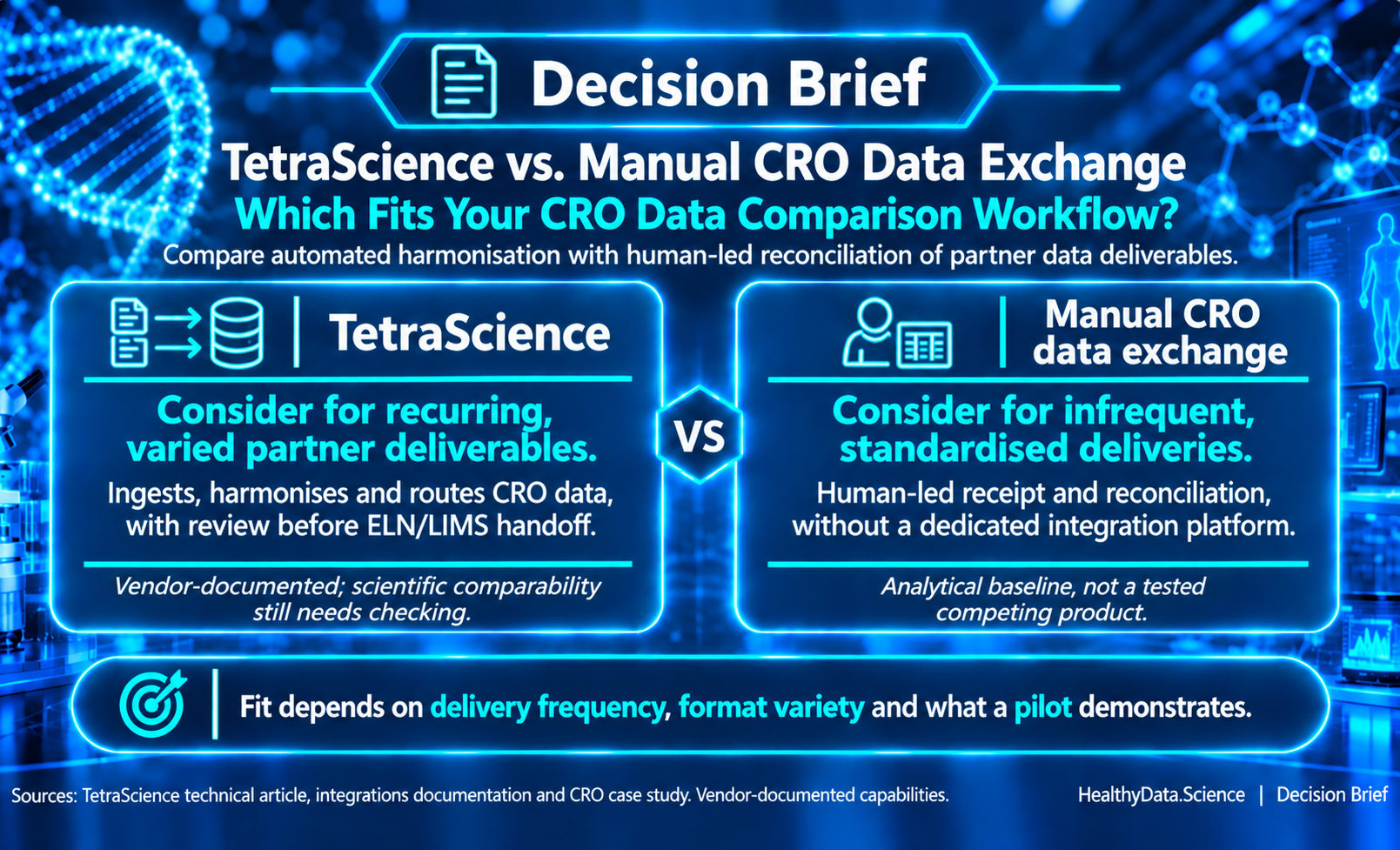
TetraScience is optimal for comparing CRO and external collaboration data when heterogeneous partner deliverables require repeatable harmonisation and downstream integration [1, 3], while manual CRO data exchange is preferred for infrequent, standardised deliveries that do not justify a dedicated integration platform. TetraScience wins for recurring cross-partner data comparison. Not because it replaces scientific review, but because it connects ingestion, structured transformation, provenance, approval, and delivery into existing systems [1, 3].
Comparison scope: No competing vendor was specified; manual file exchange and reconciliation serve as the operational baseline.
Critical Domain Insight
“Once ingested, raw data is processed through pipelines that convert it into an open, vendor-agnostic JSON file, structured using an Intermediate Data Schema (IDS).” — TetraScience technical workflow description [1].
Operationally, shared schemas enable cross-CRO comparison [1, 3], but teams must still verify that assay methods, units, endpoints, and experimental context are scientifically comparable.
Table 1: Workflow & Capability Snapshot
TetraScience capabilities reflect vendor documentation [1, 2, 3]; the manual workflow is an analytical baseline, not a tested competing product.
Specific Pros & Cons
TetraScience
Pros:
Automates monitored-folder ingestion through supported external-sharing integrations, reducing repeated downloading and uploading [1, 2, 3].
Connects, parses, and harmonizes heterogeneous ADME/PK reports; its published case study describes deployments at two clinical-stage biopharma companies [3].
Supports accept/reject review before results enter ELN/LIMS workflows, providing a defined quality gate rather than unconditional automated publication [1, 3].
Cons:
Connector availability does not eliminate infrastructure dependencies; some integrations require additional third-party licenses or infrastructure [2].
Harmonised structure does not establish scientific equivalence; schema mapping and assay-specific acceptance criteria require buyer evaluation [1].
Manual CRO Data Exchange
Pros:
Avoids dedicated integration implementation for isolated deliveries.
Allows immediate expert handling of novel report structures without first configuring a reusable pipeline.
Provides a practical baseline for measuring minutes per report, correction rates, and receipt-to-approval time.
Cons:
Repeats report checking and reconciliation, the bottleneck identified in TetraScience’s ADME/PK case study [1, 3].
Leaves reusable cross-partner structure dependent on disciplined manual mapping rather than automated harmonisation.
Decision Rule for R&D Teams
Choose TetraScience when a representative pilot demonstrates that annualised labour savings and avoided rework exceed implementation, licensing, operation, and validation costs, with every critical endpoint traceable to its source [1, 3]. Retain manual exchange when deliveries remain infrequent and consistent, or when the pilot fails predefined mapping-accuracy, exception-rate, or turnaround thresholds; these are proposed procurement gates, not published vendor benchmarks.
HealthyData Directory Links
Primary References
- TetraScience, “The external data bottleneck: How biopharmas can tame CRO/CDMO/CMO data,” company technical article. [Online]. Available: Publisher page.
- TetraScience, “Tetra integrations,” developer documentation. [Online]. Available: Technical documentation.
- TetraScience, “Driving cost-effective CRO collaboration,” case study. [Online]. Available: Case study.