
Research & Evidence Timestamp: November 2026
Research conducted: 5 November 2026. Evidence cutoff: 5 November 2026.
Capabilities, research access, commercial terms, and supporting datasets can change. Undated webpages establish what was publicly accessible during this research, not when every capability became available.
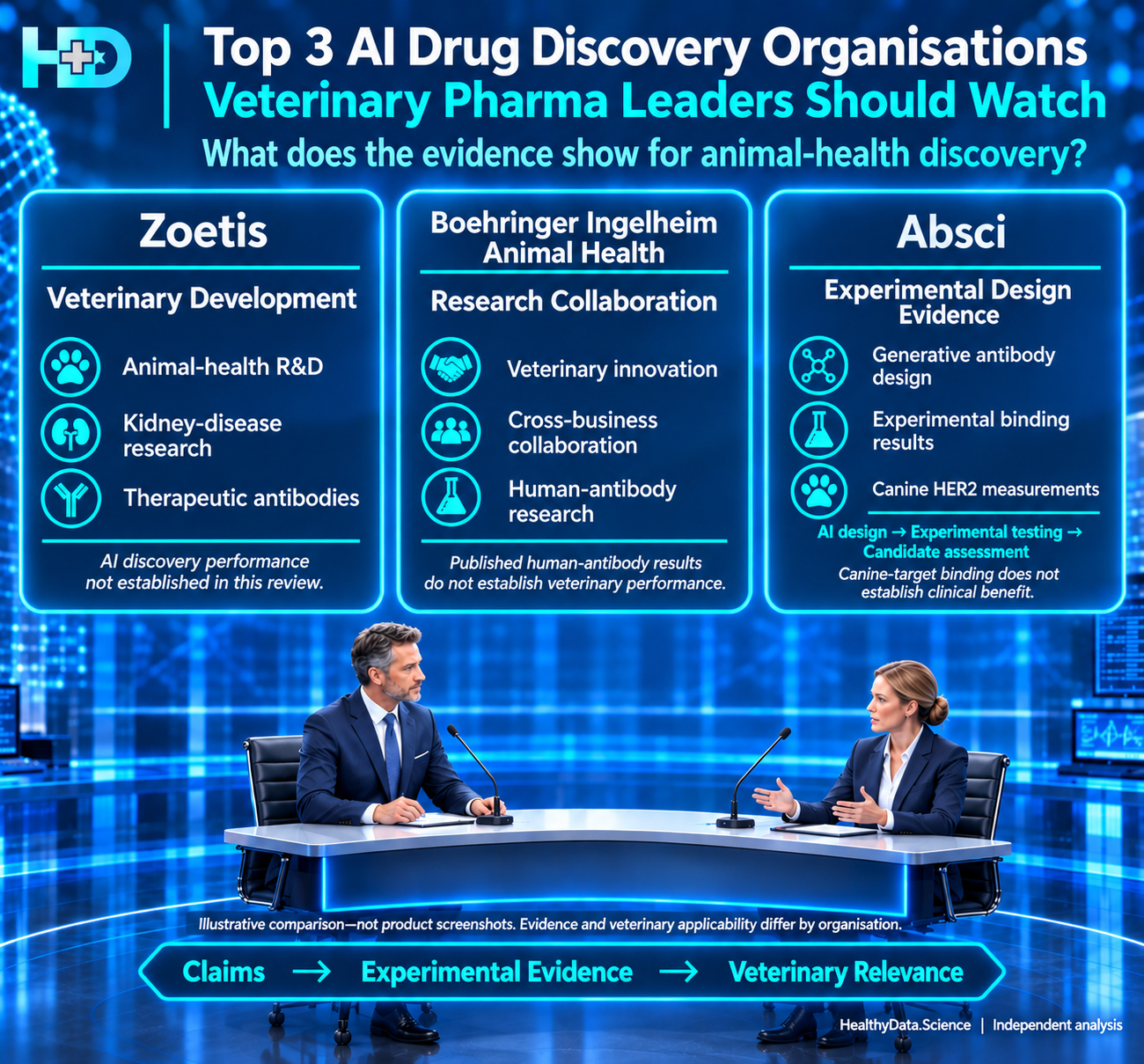
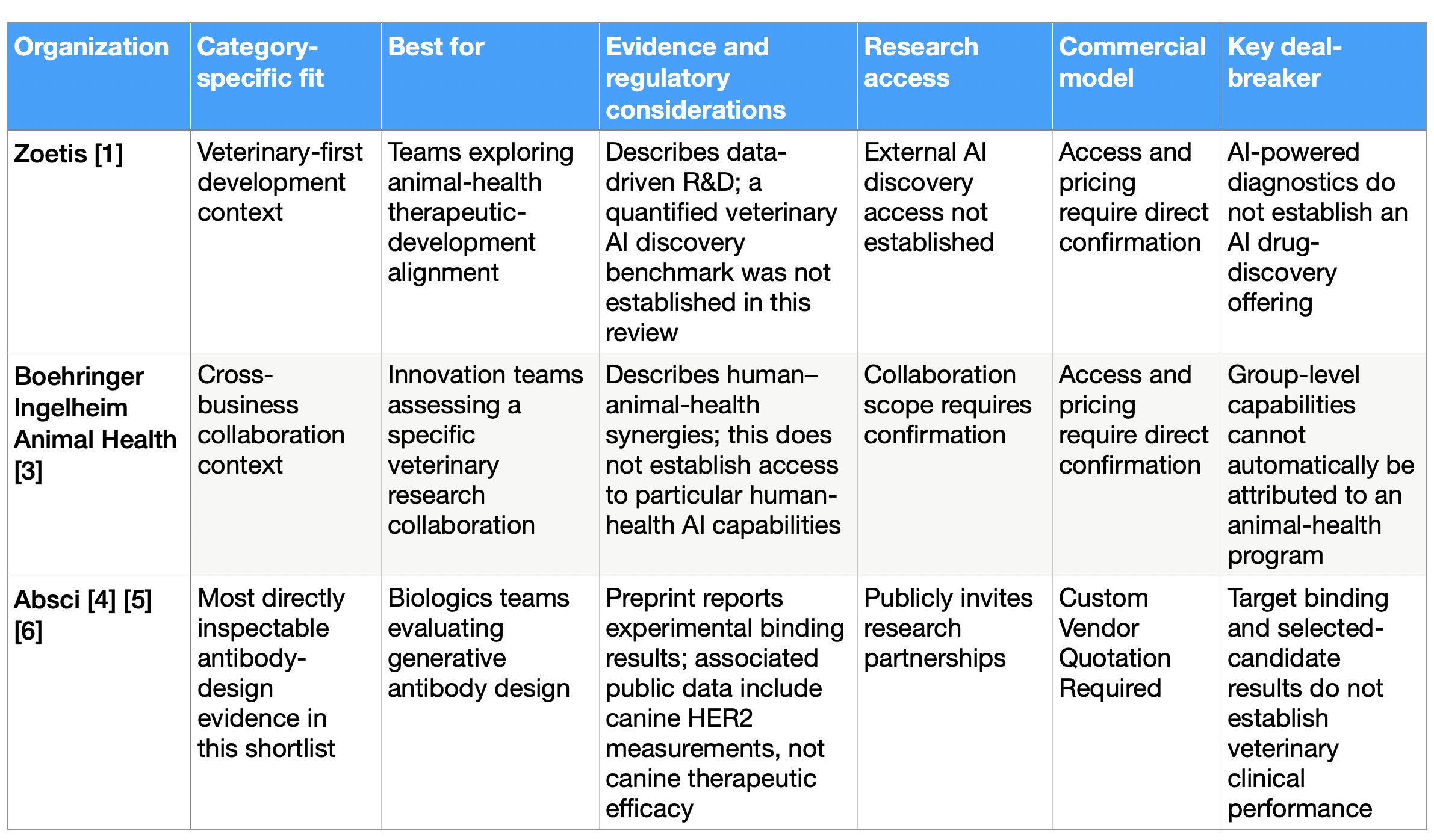
Zoetis, Boehringer Ingelheim Animal Health, and Absci offer different starting points for veterinary discovery partnerships, not three interchangeable AI applications [1, 3, 4]. Absci provides the clearest experimental design evidence reviewed, including canine HER2 binding data [4, 6]. Zoetis and Boehringer provide animal-health development contexts, but comparable public AI discovery benchmarks were not established [1, 3].
Table 1: Top 3 AI Drug Discovery Organisations for Veterinary Pharma: Evidence Comparison
Who This Guide Is For & How We Evaluated
This guide supports buyers deciding whether an organisation merits scientific diligence. Not readers seeking a prevalidated software shopping list.
-
Veterinary pharmaceutical R&D Directors and Heads of Discovery can use it to separate target discovery, biomarker analysis, antibody design, and therapeutic development.
-
Veterinary biotech founders and CSOs can use it to distinguish computational access from experimental execution and downstream development support.
-
Corporate-development and innovation teams can use it to identify the questions that must precede a licensing or collaboration discussion.
-
Computational biologists, bioinformaticians, and regulatory specialists can use it to evaluate species relevance, experimental comparators, reproducibility, and intended use.
“Top 3” identifies the user-selected editorial shortlist. The numbering is not a measured performance ranking, and the category-specific labels describe the strongest defensible fit within the sources reviewed.
The evaluation prioritises original experimental evidence, official documentation, access information, and relevant regulatory sources [1, 3, 4]. Corporate descriptions establish organisational positioning; they do not independently demonstrate model performance.
The resulting comparison is deliberately asymmetric. Absci has inspectable antibody-design results [4]. The reviewed Zoetis and Boehringer pages establish veterinary development relevance but do not supply equivalent discovery-performance measurements [1, 3].
The Animal-Health AI Discovery Challenge
Veterinary buyers need more than a convincing computational demonstration. A useful discovery workflow must address the intended species, target, disease, therapeutic format, and experimental decision, distinguishing between computational library generation [2] and species-specific validation.. This article therefore treats those elements as separate diligence requirements rather than assuming that success in one setting transfers to another.
A canine HER2 binding measurement illustrates the distinction. It can establish interaction with a canine protein under the reported assay conditions [6]. It cannot, by itself, establish tumor response, tolerability, exposure, immunogenicity, or clinical benefit in dogs. The Absci dataset contains the former measurement; it does not establish the latter outcomes [6].
Regulatory planning also remains program-specific:
- FDA describes new animal-drug application pathways
- The EMA provides veterinary development guidance covering scientific advice, clinical trials, compliance, and maximum residue limits
Those sources do not endorse any of these organisations’ AI workflows as universally acceptable.
1. Zoetis: Veterinary-First Development Context
Zoetis describes an animal-health business integrating data-driven R&D with medicines, vaccines, diagnostics, biopharmaceuticals, and digital solutions [1]. That makes it relevant to veterinary therapeutic strategy, but does not establish an externally available AI discovery platform.
-
Core Use Cases & Category Fit: Zoetis offers a veterinary-first organisational context for evaluating development alignment [1]. Its public description spans prediction, prevention, detection, and treatment, so buyers must identify which specific activities would form part of a proposed collaboration [1].
-
Intended Use & Evidence Relevance: The corporate page explicitly mentions AI-powered diagnostics [1]. That statement supports a diagnostic-innovation claim, not a claim that AI has generated or validated a therapeutic candidate [1]. A discovery article should preserve that boundary.
-
Measurable Results: A prospective veterinary AI discovery hit rate, experimentally demonstrated target-prediction improvement, and attributable discovery cost reduction were not established in the reviewed sources. Data Point Not Disclosed applies to those metrics within this evaluation.
-
Regulatory, Safety & Data Considerations: Buyers should define the investigational medicine and intended evidence package before discussing regulatory acceptability. FDA and EMA materials address veterinary development requirements, not a blanket approval of the computational methods used by a company.
-
Commercial Model & Access: Public access to a general-purpose AI discovery application was not established. Commercial access and pricing require direct confirmation; an undisclosed price should not be interpreted as proof that a particular offering is available.
-
Ideal For: Zoetis merits consideration when the buyer’s primary question concerns veterinary development alignment [1]. Its inclusion is based on documented animal-health scope, not demonstrated superiority in AI design accuracy or candidate productivity [1].
-
Transparent Limitations & Unsuitable Use Cases: The reviewed evidence does not support presenting Zoetis as a self-service computational workbench, a public target-prediction API, or a quantitatively benchmarked veterinary discovery platform [1].
What Buyers Should Request
-
Request a project-specific capability statement identifying the computational workflow, responsible team, species, target, modality, and experimental deliverables. The statement should distinguish internal capabilities from resources the proposed collaboration can access.
-
For a feline or canine kidney-disease program, request evidence connecting the proposed target to the disease mechanism. A biomarker association, diagnostic classification, or disease-risk signal should not automatically become a therapeutic target claim.
-
The useful next gate is a documented feasibility plan. It should establish what the collaboration would test, what outcome would justify further investment, and which party would own the resulting data and candidates.
2. Boehringer Ingelheim Animal Health: Cross-Business Collaboration Context
Boehringer Ingelheim Animal Health publicly emphasises veterinary innovation, partnerships, and synergies between its animal-health and human-health businesses [3]. Those statements justify collaboration diligence, not an assumption that all group-level AI resources are available for veterinary programs [3].
-
Core Use Cases & Category Fit: The organisation describes disease prediction, prevention, and treatment alongside veterinary vaccines, parasiticides, and therapeutics [3]. This supports a broad animal-health innovation context rather than a single verified AI product specification [3].
-
Intended Use & Evidence Relevance: The company’s statement about human–animal-health synergies describes its organisational approach [3]. It does not identify which model, dataset, license, or research service a veterinary buyer could actually access [3].
-
Measurable Results: A defined prospective veterinary AI discovery success rate, controlled improvement in candidate selection, and comparative discovery-cycle reduction were not established in the sources reviewed. Requires Custom Vendor Metrics for a proposed program.
-
Regulatory, Safety & Data Considerations: A collaboration should identify the studies intended to support veterinary development and the accountable sponsor. Relevant FDA and EMA sources describe application pathways and development support; they do not establish the suitability of an unspecified AI workflow.
-
Commercial Model & Access: The public material does not establish a standard AI platform subscription, customer-hosted deployment, or routine onboarding schedule. Commercial availability and pricing require direct confirmation for the actual proposed offering.
-
Ideal For: Boehringer Ingelheim Animal Health merits consideration by innovation teams exploring a defined veterinary research collaboration, particularly where the organization’s stated cross-business approach is relevant [3]. That is an editorial fit judgment, not a validated performance advantage.
-
Transparent Limitations & Unsuitable Use Cases: Buyers should not attribute a human-health AI announcement to animal-health operations without a documented connection [3]. The evidence reviewed also does not establish an independently operated veterinary discovery application [3].
What Buyers Should Request
-
Request a collaboration map showing which business unit, laboratory, external partner, and computational team would perform each activity. This should identify the party controlling data access and candidate-selection decisions.
-
Where human-derived evidence informs veterinary work, request a transfer-validation plan. The plan should explain what experiments will establish relevance to the intended animal protein, biological system, and disease.
-
The practical gate is an executable statement of work. A broad innovation narrative becomes commercially useful only when it specifies responsibilities, outputs, access rights, and advancement criteria.
3. Absci: Most Directly Inspectable Antibody-Design Evidence
Absci describes an integrated AI Drug Creation Platform combining generative design, multiparametric lead optimisation, and wet-lab experimentation [4], joining a growing body of peer-reviewed literature on deep learning-driven antibody library design [2]. Its public research offers the clearest measurable design evidence reviewed for this shortlist [4].
-
Core Use Cases & Category Fit: Absci’s documented proposition centers on biologics and antibody design [4]. Its website also describes AI-enabled target discovery using reverse immunology, but that description does not establish a veterinary-specific target-discovery service [4].
-
Intended Use & Evidence Relevance: A 2023 preprint reports antibody design against three targets and extensive experimental screening against human HER2 [4]. The associated repository also contains cross-reactivity measurements against canine HER2, creating a narrow but material animal-health connection [5, 6].
-
Measurable Results: The preprint reports screening more than 400,000 HER2-directed variants, further characterising 421 binders by surface plasmon resonance, and identifying three that bound more tightly than trastuzumab [4]. Those are reported experimental findings, not veterinary clinical results [4].
-
Regulatory, Safety & Data Considerations: The retrieved paper is a preprint whose authors disclose Absci affiliations and potential shareholdings [4]. The dataset supports scrutiny of reported laboratory measurements, not a claim of independent replication or veterinary authorisation [4, 6].
-
Commercial Model & Access: Absci publicly invites partnerships [4]. Custom Vendor Quotation Required; scope, experimental work, development responsibilities, licensing, and access rights require negotiation. The reviewed sources do not establish a standard seat-based software purchase [4].
-
Ideal For: Absci is the strongest starting point in this shortlist for teams seeking inspectable generative antibody-design evidence and willing to test its applicability to a veterinary program [4, 6]. Species-specific suitability remains a research question, not an established product attribute.
-
Transparent Limitations & Unsuitable Use Cases: The retrieved evidence does not demonstrate efficacy in dogs, feline disease performance, or veterinary development ROI [4, 6]. It also does not support treating Absci as a validated solution for canine or feline kidney-disease discovery [4, 6].
What the Canine Data Reveal
The public data report a canine HER2 binding value of 1.5 ± 1.1 nM1.5 \pm 1.1\text{ nM} for candidate 3, compared with 7.8 ± 1.6 nM7.8 \pm 1.6\text{ nM} for trastuzumab in the same cross-reactivity table [6]. The repository defines these values as means with standard deviations [6]. Lower dissociation constants indicate tighter binding, but these entries alone do not establish a statistically significant difference [6].
Candidate 3 does not outperform every comparator on every assay. The same dataset reports an ADCC EC50 of 77.88 ± 10.38 pM77.88 \pm 10.38\text{ pM} for candidate 3 versus 56.97 ± 8.84 pM56.97 \pm 8.84\text{ pM} for trastuzumab [6]. That result cautions against translating a favourable binding measurement into a general “better antibody” claim [6].
These associated data also expose a limitation in reading only an abstract. The paper’s initial screening comparison, later antibody-format measurements, and species cross-reactivity measurements are distinct analyses [4, 6]. Their values should not be combined into a single performance score [4, 6].
What Buyers Should Request
-
Request an animal-specific feasibility study defining the target sequence, antibody format, experimental system, controls, and advancement criteria. Ask separately about binding, function, developability, and species compatibility.
-
Also request the version history connecting the publication, repository, and data files. A currently accessible repository may contain additions beyond the original preprint; the publication record and dataset should not automatically be treated as a single fixed release.
Measurable Results & Evidence Gaps
These findings concern laboratory performance, not corporate scale. Most originate from one company-associated research program, so they do not establish a comparative veterinary league table.
-
More than 400,000 HER2-directed variants screened. This establishes substantial experimental testing behind the Absci report, but screening volume alone does not establish efficiency or an overall success rate [4].
-
A total of 421 binders were further characterised by SPR. This establishes quantitative biophysical follow-up. The selected characterisation set is not a defensible denominator for calculating total discovery performance [4].
-
Three binders reported to bind more tightly than trastuzumab. This establishes a favorable reference comparison in the reported screening context, not superior clinical activity or universal performance across antibody formats [4].
-
Candidate 3 canine HER2 binding: 1.5 ± 1.1 nM1.5 \pm 1.1\text{ nM}. This provides direct experimental evidence involving a canine target [6]. It does not establish canine therapeutic efficacy or statistical superiority over trastuzumab’s 7.8 ± 1.6 nM7.8 \pm 1.6\text{ nM} measurement [6].
-
Candidate 2 ADCC EC50: 14.57 ± 2.90 pM14.57 \pm 2.90\text{ pM} versus 56.97 ± 8.84 pM56.97 \pm 8.84\text{ pM} for trastuzumab. This is a functional-assay measurement in the associated dataset, not a reported canine clinical outcome [6].
-
Candidate 12 SEC high-molecular-weight fraction: 11.6%. The dataset labels this candidate as having likely non-covalent aggregate, illustrating why binding or functional performance must be considered alongside product-quality findings [6].
Table 2: Veterinary AI Drug Discovery: Evidence and Gaps Across Three Organisations
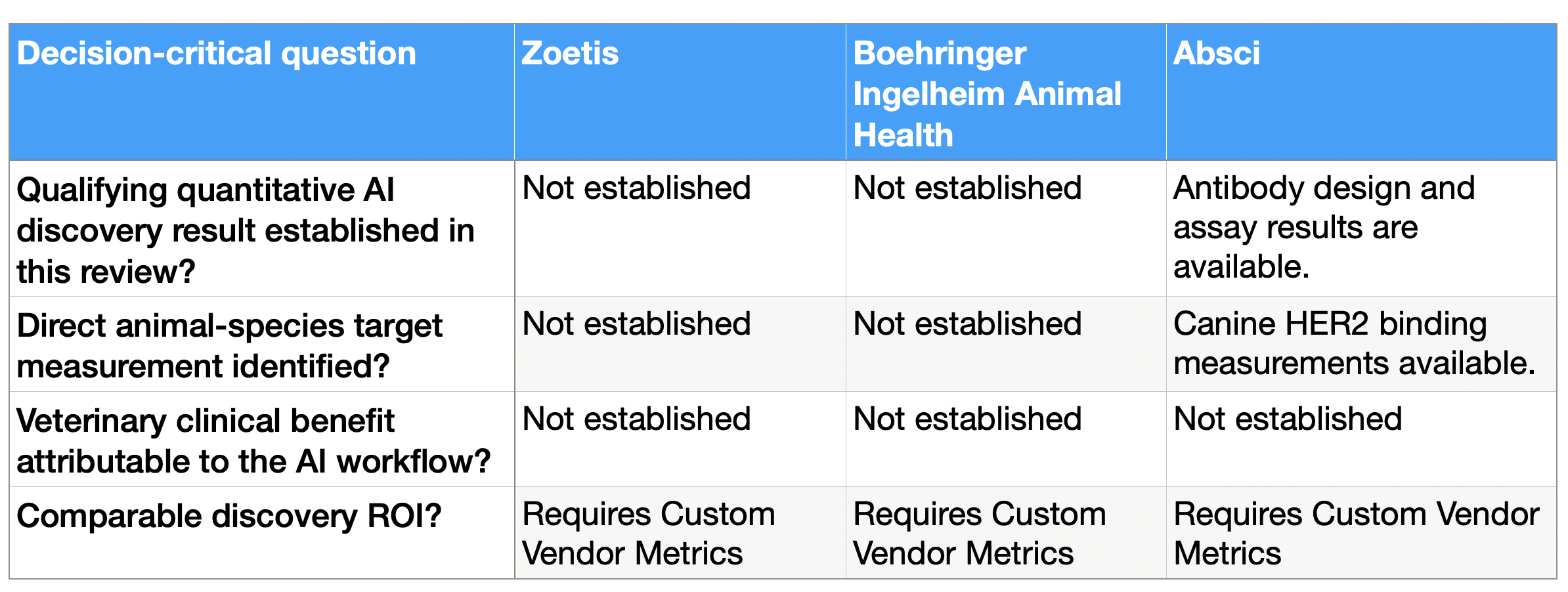
“Not established” describes this review’s findings, not proof that unpublished evidence or additional capabilities do not exist.
Decision Framework: How to Choose an Animal-Health AI Discovery Partner
-
Define the decision before the technology: Write a discovery decision statement and target product profile. Specify whether the program needs target identification, biomarker prioritisation, antibody generation, lead optimisation, or experimental candidate selection. Use the statement to decide whether the proposed organisation addresses the actual bottleneck. Do not compare a broad development partnership with a narrow design service as though both supply the same deliverable.
-
Require evidence at the intended biological level: Create a species-and-assay evidence map. Separate human-target binding, canine-target binding, species-relevant functional activity, and animal outcomes. The Absci example shows why this is important: canine protein-binding data exist, but the reviewed materials do not establish a corresponding therapeutic benefit in dogs [6]. Distinguish computational library design from downstream experimental validation [2], ensuring candidates undergo rigorous biophysical profiling before advancing.
-
Agree prospective acceptance criteria: Require an experimental plan before predictions are generated. Define the candidate denominator, controls, endpoints, replication strategy, and decision thresholds. Predefine failure as well as success. Otherwise, a project can drift from “find functional candidates” to “find an interesting association” without making that change explicit.
-
Test the access model: Request a statement of work and rights schedule. Identify whether the buyer receives sequences, raw assay data, model outputs, software access, or only a development recommendation. Distinguish scientific data publication from access to the underlying design platform. Absci’s public repository exposes research outputs; it does not itself establish unrestricted platform access [5].
-
Inspect integration through sample deliverables: Request representative files with sequence identifiers, assay metadata, units, experimental conditions, and version information. Verify that outputs can enter the buyer’s existing research environment. Require an API only when the workflow needs it. A bounded feasibility study and a continuously integrated discovery operation may require different technical arrangements.
-
Plan development requirements early: Create a regulatory development plan with veterinary specialists. FDA’s application framework and EMA’s veterinary guidance provide relevant starting points, including effectiveness expectations and scientific advice. For food-producing animals, include the relevant residue questions rather than extrapolating directly from companion-animal development. EMA explicitly includes maximum residue limits within its veterinary development support.
-
Measure value against the existing process: Build a baseline using experimental work, elapsed time, and cost. Agree how the project will count validated outputs and unsuccessful experiments. Do not estimate ROI by treating one favorable assay, a short design cycle, or a specific program timeline as a complete economic evaluation. Distinguish computational library design from downstream experimental validation [2], ensuring candidates undergo rigorous biophysical profiling before advancing.
Frequently Asked Questions
Are these three organisations equivalent AI platforms?
No. Zoetis and Boehringer Ingelheim Animal Health provide documented veterinary development contexts, while Absci explicitly describes an AI drug-creation platform [1, 3, 4]. Their inclusion supports an organisational comparison, not a like-for-like software ranking [1, 3, 4].
Does Absci have any animal-specific experimental evidence?
Yes. Its associated public dataset includes antibody-binding measurements against canine HER2 [6]. These support a narrow claim about binding to a canine target, not efficacy, safety, or successful therapeutic development in dogs [6].
Can the reported 421 binders establish an overall hit rate?
No defensible overall hit rate follows from that figure alone. The preprint describes 421 binders selected for further characterisation, so the number should not automatically be divided by the total screened library [4].
Does tighter binding establish a better veterinary medicine?
No. The retrieved data include binding, functional-assay, and developability measurements that differ across candidates [6]. A favourable result on one endpoint does not establish superiority across the remaining endpoints or clinical benefit [6].
What public evidence is still missing for a direct comparison?
This review did not establish a shared prospective veterinary benchmark, comparable experimental denominator, or common discovery-cost evaluation across the three organisations [1, 3, 4]. Buyers should request those measurements for a defined project rather than infer them from corporate descriptions.
Explore More AI Drug Discovery Approaches
Building a veterinary discovery shortlist? Explore the Drug Discovery category on HealthyData.Science for additional platform profiles and research approaches. Assess each option’s species-specific evidence, experimental capabilities, and access conditions before treating it as a fit for your program.
Editorial Independence & Disclaimer
HealthyData.Science confirms that it has no ownership, representation, affiliate, sponsorship, paid-coverage, paid-listing, or other material commercial relationship with the three organisations evaluated. This editorial comparison uses public sources reviewed on 5 November 2026 and does not constitute veterinary, regulatory, or procurement advice. Inclusion does not establish commercially available platform access, regulatory acceptance, or suitability for a particular animal disease. Company-associated experimental results are attributed to their sources and are not guaranteed outcomes. Readers should verify current evidence, capabilities, access, and terms directly.
References
[1] Zoetis, “Zoetis Research & Development,” corporate research and development webpage, n.d. Accessed: Nov. 5, 2026. [Online].
[2] N. Rajagopal et al., “Deep learning-based design and experimental validation of a medicine-like human antibody library,” Briefings in Bioinformatics, vol. 26, no. 1, Art. no. bbaf023, 2025, doi: 10.1093/bib/bbaf023. [Online].
[3] Boehringer Ingelheim, “Science & Innovation,” corporate science and innovation webpage, n.d. Accessed: Nov. 5, 2026. [Online].
[4] Absci research team, “Unlocking de novo antibody design with generative artificial intelligence,” bioRxiv, preprint, ver. 1, 2023, doi: 10.1101/2023.01.08.523187. [Online].
[5] AbSciBio, “unlocking-de-novo-antibody-design,” GitHub research repository, n.d. Accessed: Nov. 5, 2026. [Online].
[6] AbSciBio, “functionality-developability-cross_reactivity-data.csv,” experimental dataset, unlocking-de-novo-antibody-design, GitHub repository, n.d. Accessed: Nov. 5, 2026. [Online].

Author: Stephen
Founder of HealthyData.Science · 20+ years in life sciences compliance & software validation · MSc in Data Science & Artificial Intelligence.
Follow HealthyData.Science on Google Search & AI
Get our latest healthcare and life science AI tool evaluations, regulatory updates, and buyer intelligence in your Google AI Overviews.
Add as Preferred Source