
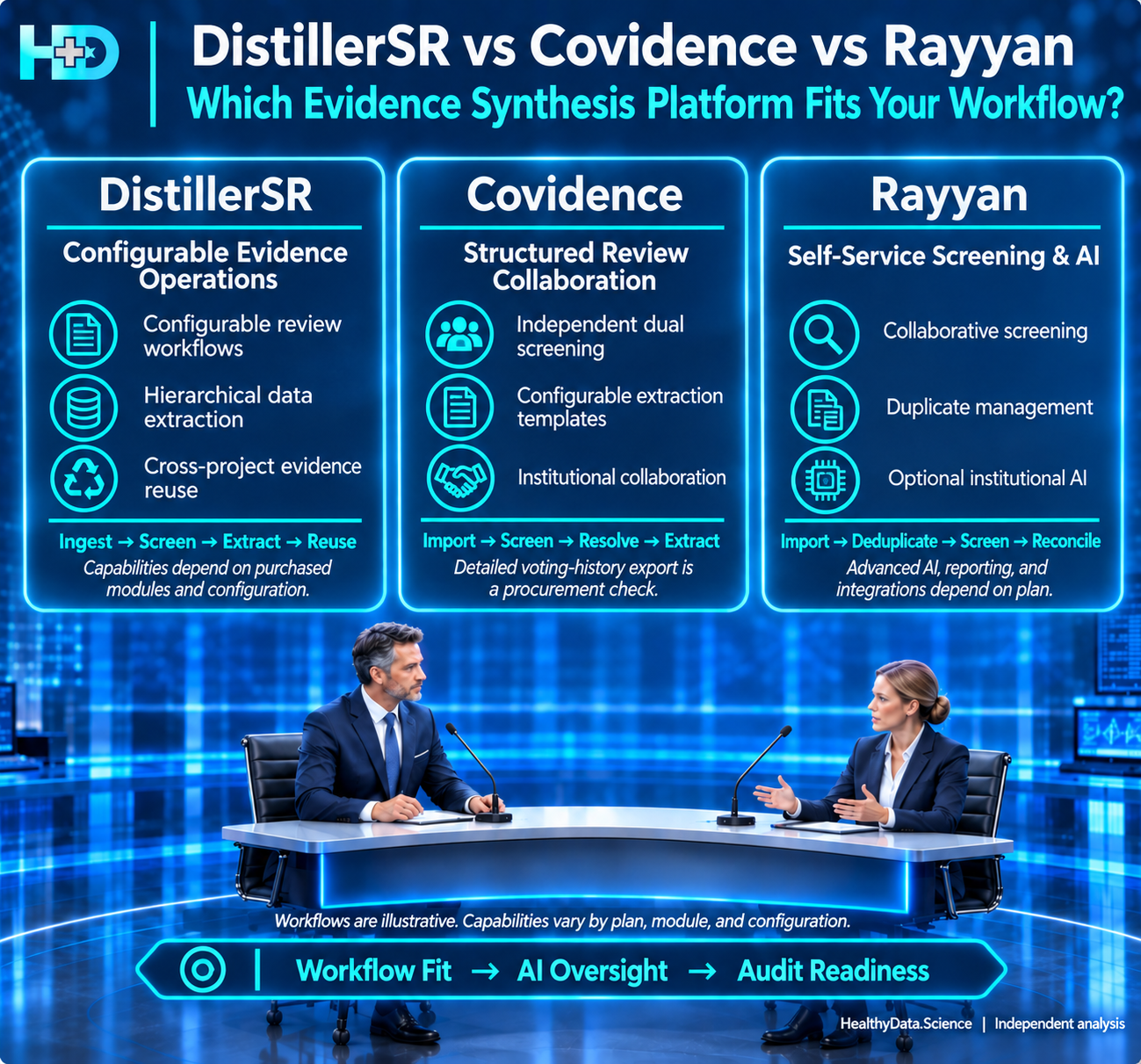
The main difference between DistillerSR, Covidence, and Rayyan
DistillerSR provides a configurable evidence-management architecture with cross-project reuse and connected surveillance workflows [1]; Covidence structures teams around a defined review pipeline with configurable extraction templates [3]; and Rayyan combines self-service screening with increasingly capable, separately packaged institutional AI workflows [6], [7], [8]. These are overlapping Evidence Synthesis Platforms, but their workflow controls, commercial boundaries, and evidence-export limitations make them materially different procurement decisions [1], [2], [3], [4], [6], [7], [8].
For a pharmaceutical, MedTech, or CRO buyer, the decisive question is not simply which platform screens abstracts fastest. It is whether the purchased configuration can preserve the decisions, extracted evidence, human corrections, and downstream handoffs needed to defend a dossier. For a university or hospital, the question is whether standardisation and central support justify institutional licensing. For frontline reviewers, it is whether the platform reduces work without moving the burden into duplicate checking, conflict administration, or extraction cleanup.
This comparison covers:
- literature-based systematic reviews
- high-volume screening
- and repeated or living-review updates.
It considers international institutional purchasing, with US electronic-record requirements and UK HTA context where relevant. Not an assumption that every academic review is a regulated computerised system.
Research date: November 16, 2026.
Public product documentation, help articles, contractual terms, pricing, independent research, and official regulatory references were reviewed. No HealthyData.Science pages were used.
The evaluation criteria are operational fit, native workflow depth, AI decision boundaries, integration architecture, traceability, deployment and configuration effort, applicable assurance responsibilities, and unresolved procurement risk. “Documented” below means explicitly described by the vendor, not independently performance-validated. Recommendations and architectural implications are labelled as analytical judgments.
Table 1: Macro comparison matrix
What the evidence does and does not establish
Independent comparative evidence is uneven. A healthcare screening-software evaluation published in 2020 found Covidence and Rayyan well aligned with user requirements, but its user survey involved only six researchers and tested software available in December 2018 [9]. DistillerSR was excluded because the investigators could not obtain a free trial; it was not tested and found inferior [9]. That study cannot establish the relative performance of today’s generative-AI features [9].
Consequently, this article does not assign a current usability or AI-accuracy winner. Detailed current help documentation is stronger evidence of workflow behaviour than an old review [3], [4], [5], [7], [8], while a vendor’s time-saving percentage remains a vendor claim unless independently corroborated [1].
Operational workflow comparison
Consider an illustrative review involving 2,000 candidate records: a team screens titles and abstracts, assesses full texts, resolves disagreements, extracts study data, and later incorporates an update search.
This scenario provides a common framework for comparing how DistillerSR, Covidence, and Rayyan organise work, apply AI, and preserve review decisions. It is not a performance benchmark or a claim that the platforms provide identical capabilities.
The comparison draws on product documentation, contractual terms, and technical help materials. – Workflow sequences are labelled as documented behaviour or illustrative reconstructions, as appropriate. Where the retained references do not establish a capability, it is treated as a procurement question rather than assumed to be present or absent.
Trigger and ingestion
DistillerSR
Documented capability: references can enter through multiple searches and connected literature sources [1]. The vendor describes scheduled imports from sources including PubMed, Embase, and RightFind, plus full-text retrieval through PMC and RightFind [1]. Its contract identifies LitConnect as a module for automated reference import and updates through emailed alerts [2]. These are configured or integrated capabilities, not proof that every subscription includes every connector [1], [2].
Human preparation remains necessary: the team must define its search strategy, ensure content rights, configure fields and review stages, and determine which references may undergo AI processing [1], [2]. DistillerSR says customers can exclude references from AI processing according to licensing terms [1], [2].
Covidence
Documented capability: references enter through supported file formats and connected review tools; deduplication runs automatically on import [3], [4]. For updates, new records can enter title/abstract screening, full-text review, or extraction, and duplicate checking compares the new file with previous imports [3], [4].
This is a concrete advantage for a repeated review, but not evidence of unattended surveillance. The documented update workflow still requires decisions about import timing, entry stage, source labels, and update tracking [3], [4].
Rayyan
Documented capability: users upload references, detect possible duplicates, and then resolve them manually or with the paid Auto-Resolver [6]. Detection and resolution are separate steps. The help documentation recommends completing imports before deduplication and resolving duplicates before screening [6].
This distinction matters for labour estimates: “duplicate detection included” does not mean the team receives a fully adjudicated reference set without inspection [6].
Routing and logic
DistillerSR
Documented capability: projects, workflows, and forms are configurable; workflow filters can assign references to reviewers [1]. Dual screening, conflict resolution, exclusion reasons, and risk-of-bias templates are described natively [1].
AI can operate at different points: reprioritising the queue, classifying records, making screening decisions, or suggesting extracted evidence [1]. The product page advertises both human-in-the-loop and fully automated modes [1]. Buyers must therefore specify the intended automation mode rather than assuming that “AI-enabled” always means recommendation-only [1].
Covidence
Documented capability: references move through defined review stages according to reviewer votes [4]. In single-reviewer mode, one vote can advance a record; in dual review, disagreements enter conflict resolution [4]. The knowledge base gives the example of a Maybe/No combination entering Resolve conflicts [4].
The architectural distinction is structured progression rather than arbitrary enterprise orchestration. Extraction templates are configurable, but that does not establish unrestricted conditional routing across organisational processes [3], [4].
Rayyan
Documented capability: teams can organise screening through everyone screening everything, randomised samples, decision-count filters, or labels [7]. Samples do not restrict access to records; communicating assignments remains the owner’s responsibility [7]. Label-based work division requires Blind Mode off, whereas sampling and decision-count approaches can preserve it [7].
ResearchPilot’s AI Reviewer is more than queue prioritisation [7]. It evaluates eligibility criteria, records criterion-level reasoning, and contributes decisions alongside human reviewers [7]. Its documented rules exclude a record when an exclusion criterion is met or an inclusion criterion is not met; otherwise, the remaining rules determine Include or Maybe [7].
Analytical implication: allowing an AI vote into consensus is a methodological change, not merely a faster interface [7]. A buyer should approve that change explicitly.
Collaboration and approval
DistillerSR
Documents simultaneous reviewing, conflict resolution, and permission-based evidence access [1]. The reviewed public materials do not, however, establish every electronic-signature control required for a particular regulated approval process [1], [2].
Covidence
Documents independent dual screening, blinding, and structured conflict resolution [4]. Publishing an extraction template makes it available to reviewers, but template publication and screening consensus should not be described as regulated electronic signatures [3], [4].
Rayyan
Provides differentiated review roles and Blind Mode [7]. Its Screening Report includes only the generating user’s decisions, labels, and notes while Blind Mode is on; turning it off enables the report to include all team members [7]. The team must manage that transition deliberately [7].
Where Part 11 applies, electronic signatures involve more than an approval button or ordinary login: the regulation addresses signer identity, signature meaning, date/time, signature-record linking, and identification controls [10]. None of these products should be declared compliant for a buyer’s intended signature process solely because it offers collaboration or SSO [1], [2], [3], [4], [6], [10].
Table 2: Exceptions, correction, and traceability
An audit log’s existence is not evidence of immutability, adequate retention, or complete exportability [1], [4], [10]. Those properties need separate examination against the intended record requirements [10].
Short workflows for procurement testing
DistillerSR
Illustrative reconstruction from documented capabilities
Configure screening stages, reviewer assignments, forms, and standard answer lists [1].
Import records or enable the purchased literature-ingestion integration [1], [2].
Run duplicate detection and the approved screening configuration [1].
Resolve disagreements and inspect any AI-assisted decisions requiring human review [1].
Extract into configured forms; use source-linked SEE suggestions if purchased [1].
Export reports and evidence, or reuse data through CuratorCR if included [1], [2]. The component capabilities are documented; this exact sequence is an editorial reconstruction, not a verified default implementation [1], [2].
Covidence
Documented workflow assembled from help materials
Import search results and allow automatic deduplication [3], [4].
Conduct screening in the selected reviewer mode [4].
Resolve conflicts and complete full-text assessment [4].
Publish the extraction template and complete extraction and quality assessment [3], [4].
Export the dataset and PRISMA output [4].
Before the next import, preserve the required update snapshot and assign update/source tracking [4]. These behaviours are documented across the review, extraction, and update guidance [3], [4], [5].
Rayyan
Documented workflow with optional institutional AI
Upload references and complete duplicate detection and resolution [6].
Set roles, eligibility criteria, Blind Mode, and work allocation [7].
Screen manually, with relevance predictions, or with enabled ResearchPilot features [6], [7].
Unblind at the approved point and reconcile human/AI conflicts [7].
Attach searchable PDFs, define extraction questions, and optionally run Auto Extraction [8].
Verify extracted answers and generate the paid Screening Report with the required Blind Mode setting [6], [7], [8]. The AI steps require the appropriate entitlement; they are not a Free-plan workflow [6], [7], [8].
DistillerSR: System overview and pipeline fit
Editorial synthesis: FDA recommends a justified, documented risk assessment for computerised-system validation; enterprise positioning does not transfer that assessment to the vendor [10].
DistillerSR is supplied by DistillerSR Inc. as a SaaS platform encompassing review software and separately scoped modules and services [1], [2]. Its contract names SEE, LitConnect, AI Classifier Manager, API integrations, and CuratorCR-related platform capabilities; the proposal determines what the customer purchases [1], [2].
Its strongest architectural distinction is the connection between configurable review work and reusable organisational evidence [1]. CuratorCR is explicitly identified as an evidence-repository module, rather than a capability buyers should assume is included in the base review licence [1], [2].
Analytical assessment: DistillerSR deserves particular consideration where a review is one recurring process inside a broader evidence operation—HEOR, medical affairs, clinical evaluation, surveillance, or multi-product evidence reuse [1]. Its value proposition is less compelling when the organisation needs only a short-lived screening workspace [1].
Native workflow capabilities and proof points
DistillerSR:
Documented capabilities include:
Configurable review projects, forms, templates, reviewer filters, and conflict resolution [1].
Input validation, form calculations, and reusable controlled answer lists [1].
Risk-of-bias templates, PRISMA reporting, customised reporting, and data export [1].
Scheduled ingestion and reports for living-review workflows [1], [2].
API-connected evidence movement and third-party integrations [1], [2].
A particularly meaningful technical distinction is hierarchical extraction [1]. DistillerSR’s solution brief describes parent-child forms for repeating data, automatic preservation of those relationships, navigation through a tree, and vertical or hierarchical reporting [1]. This is directly relevant when studies contain multiple outcomes, arms, and follow-up periods [1].
The capability is not simply “more form fields” [1]. Its documented purpose is to preserve relationships between repeating observations rather than leaving the analyst to reconstruct them after export [1].
Where AI operates
The vendor distinguishes AI Re-Rank, AI Classifiers, Smart Screening, SEE, and Smart Chat [1]. Smart Screening can make title/abstract decisions, while SEE extracts from text and tables [1]. Smart Chat can work with curated evidence, and the product page also describes connecting an organisation’s own LLM through MCP [1].
The homepage states that SEE suggestions link to their source and that uploaded references or extracted data are not used to train underlying AI models [1]. These are vendor statements, not independently verified security findings [1].
There is a material documentation boundary: the homepage emphasises human acceptance of critical extracted elements, while the product page advertises fully automated extraction as well as human-in-the-loop operation [1]. These can represent different configurations, but the public wording does not establish which human gates are mandatory in every deployment [1], [2].
The contract resolves responsibility more clearly than the marketing: AI outputs are not warranted error-free or suitable for a specific regulatory use, and the customer remains responsible for diligence, validation, and qualified approval before reliance [1], [2].
Architectural risks and implementation bottlenecks
DistillerSR:
Confirmed contractual dependencies:
AI modules and integrations depend on the purchased proposal [1], [2].
Third-party data availability, reliability, and licensing remain dependencies [1], [2].
Projects are automatically updated to the latest platform version [1], [2].
Customer validation, qualification, and testing responsibilities remain with the customer [1], [2].
AI usage above included allowances may incur additional charges; available spend caps can pause AI functionality [1], [2].
Architecture-dependent risks, not confirmed product defects:
A highly configurable extraction model needs a schema owner and change control [1], [2].
Cross-project reuse requires agreement on definitions, evidence currency, and permissible reuse [1], [2].
Connected surveillance needs reconciliation for missing, duplicated, delayed, or changed source records [1], [2].
Automatic releases require a buyer-defined change-impact and regression-testing approach [1], [2].
These are analytical consequences of the documented configuration, integration, reuse, and release model [1], [2].
Items requiring vendor confirmation include the validation deliverables available for the purchased configuration, complete audit export, retention and deletion controls, administrator privileges, AI model/version records, release-notice commitments, and any private-hosting or regional-residency options [1], [2]. These were not publicly established in the reviewed materials [1], [2].
Independent evidence limitation: the reviewed independent screening evaluation did not test DistillerSR [9]. Its findings cannot substantiate either a current usability penalty or superior enterprise performance [9].
Ideal buyer persona
DistillerSR:
Analytical recommendation: shortlist DistillerSR for a pharma, MedTech, CRO, guideline, or research organisation that needs configurable multi-stage reviews, complex repeating data, recurring updates, or cross-project evidence reuse—and can assign a platform owner or purchase configuration services [1], [2]. The documented platform and service model support that fit [1], [2].
Who should not buy it: a solo reviewer should not purchase an enterprise configuration merely because “regulatory-grade” sounds safer [1], [2]. If the actual need is basic screening and a straightforward extraction table, require a demonstrated benefit from the additional configuration, modules, or evidence-reuse infrastructure before paying for them [1], [2].
Conversely, academic affiliation alone is not a reason to exclude DistillerSR: complex research programmes can have enterprise-like workflow requirements [1], [2].
Covidence: System overview and pipeline fit
Editorial synthesis: A small independent evaluation favoured Covidence’s screening usability, but it tested 2018-era software—not current AI, enterprise governance, or extraction performance [9].
Covidence is a purpose-built review platform owned by the nonprofit Future Evidence Foundation [3], [4], [5]. Its documented pipeline covers setup, import, screening, extraction, quality assessment, and export [3], [4], [5].
Its institutional proposition centres on shared access and research capability: organisational subscriptions include unlimited reviews, users, and collaborators, administrative visibility, support, and training [3], [4], [5]. Institutional pricing requires an enquiry [3], [4], [5].
Analytical assessment: Covidence’s strongest purchasing argument is standardising how teams conduct reviews without requiring each team to design an enterprise workflow architecture [3], [4], [5]. That is different from proving it can serve as an organisation’s complete regulated evidence repository [3], [4], [5].
Native workflow capabilities and proof points
Covidence:
Documented capabilities include automatic deduplication, independent dual screening, blinding, conflict resolution, full-text exclusion reasons, extraction templates, quality assessment, and PRISMA-aligned reporting [3], [4].
The extraction edition matters [3], [4], [5]. The reviewed knowledge base distinguishes Extraction 1 and Extraction 2; capabilities should not be combined into an imaginary universal form builder [3], [5]. Extraction 2 supports text fields, single-choice items, checkboxes, tables, headings, draft/publish states, and template reuse [3].
Template changes have operational consequences [3], [4]. Republishing applies changes across studies, and the team decides whether completed records need to return to in-progress [3]. The documentation also warns that simultaneous template editing can overwrite changes [3].
Where AI operates
Covidence’s privacy guide documents extraction suggestions in both extraction tools, using external metadata and LLM extraction from full texts where reliable suggestions can be sourced and a DOI is available [5]. Suggestions are enabled by default [5].
Its automation principles state that AI contributions are displayed and can be manually overridden, and that operational models undergo ongoing evaluation [3], [5]. These are documented vendor practices, not a published independent benchmark of all automated tasks [3], [5].
The Extraction 1 intervention-suggestions article describes LLM identification of study arms and user mapping of those arms to template-defined interventions [5]. Its reported precision and recall of 97.5% are vendor-reported, task-specific figures; they should not be presented as overall extraction accuracy or expected performance on a buyer’s review [5].
Covidence states that the LLMs used do not train on, store, or distribute user-provided full-text PDF data [5]. The reviewed guide does not identify the underlying model names, model-version controls, or all processing locations [5]. Those remain procurement questions [5].
Architectural risks and implementation bottlenecks
Covidence:
Confirmed limitations:
Detailed voting history and conflict records are visible in the product but cannot currently be exported according to the reviewed help article [4]. Inter-rater reliability export is a separate function, not a substitute for a complete event history [4].
Multiple simultaneous template editors can overwrite changes [3].
Living-review update tracking can require saved PRISMA snapshots, tags, custom sources, or filenames [4].
The first limitation is especially consequential [4]. A team may be able to answer “What happened?” interactively while still being unable to deliver the exact portable record required by an external reviewer or corporate archive [4], [10].
Review-based friction: the 2020 evaluation reported positive interface experiences, but some participants considered cost a barrier and some had difficulty with help resources [9]. Those are historical observations, not evidence that the current help centre has the same problems [9].
Items requiring vendor confirmation include enterprise identity controls, data residency, retention commitments, complete exit exports, API requirements, validation-support deliverables, and whether the voting-history export limitation has changed since the cited article [3], [4], [5].
Ideal buyer persona
Covidence:
Analytical recommendation: shortlist Covidence for a university, hospital, professional society, or research department that wants a common structured review process, broad collaborator access, reusable extraction instruments, and centrally supported adoption [3], [4]. Its institutional packaging directly supports that operating model [3], [4].
Who should not buy it: an organisation requiring an exportable, detailed voting-and-conflict history should not select Covidence without resolving that requirement in a demonstration and contract [4]. The reviewed documentation explicitly identifies the limitation [4].
Nor should a team buy Covidence solely to obtain an assumed general-purpose enterprise workflow engine [3], [4]. Its documented strength is the review pipeline, not unrestricted orchestration of adjacent regulated processes [3], [4].
Rayyan: System overview and pipeline fit
Editorial synthesis: Independent reviewers found Rayyan easy to use in a small historical evaluation; that supports its screening heritage, not the validity of today’s autonomous screening decisions [9].
Rayyan is supplied by Rayyan Systems Inc [6], [7], [8]. Its current scope extends beyond lightweight abstract screening to full-text review, extraction, risk-of-bias assessment, and reporting [6], [7], [8]. However, capabilities are materially differentiated across Free, Essential, Advanced, Business/Academic, and Enterprise plans [6].
Treating “Rayyan” as synonymous with its free tier now produces a misleading comparison [6]. Equally, attributing Enterprise API access or ResearchPilot to every user exaggerates the entry-level product [6], [7], [8].
Analytical assessment: Rayyan provides a particularly accessible route into collaborative screening, but institutional procurement needs a separate evaluation of its AI voting model, ownership controls, report entitlements, and enterprise integrations [6], [7], [8].
Native workflow capabilities and proof points
Rayyan:
The Free plan lists three active reviews, two free reviewer invitations, duplicate detection, and relevance predictions [6]. Paid tiers add capabilities including automatic duplicate resolution, PRISMA diagrams, PICO extraction, expanded collaboration, and institutional management [6]. Enterprise lists SSO/SAML and API access [6].
Deduplication is operationally explicit: records are flagged, then resolved [6], [7]. Manual resolution allows keeping either record or retaining both as nonduplicates; rejected duplicates move to a Deleted state rather than being immediately erased [7]. The documentation warns that Auto-Resolver actions are irreversible [7].
Where AI operates
ResearchPilot is available on institutional plans with that capability enabled [7], [8]. Its modes distinguish dataset exploration, AI Reviewer, on-demand AI Analyzer, and full-text Auto Extraction [7], [8].
AI Reviewer enters the review as an independent blinded agent [7]. Its decisions and criterion-level reasoning become visible when the authorised user turns off Blind Mode [7]. Under consensus, human/AI disagreement becomes a conflict; under majority voting, the AI has one vote [7].
The correction mechanism deserves attention: AI Reviewer’s decision cannot be edited [7]. The documentation advises recording the human team’s final decision and rationale through labels under consensus, or adding another reviewer to break a majority tie [7].
Auto Extraction behaves differently [8]. It populates defined questions from attached searchable PDFs, highlights source text, and permits users to accept, refine, or override answers before marking the article complete [8].
These are distinct human-control models [7], [8]. “All AI suggestions can be overridden” is too imprecise to describe both [7], [8].
Architectural risks and implementation bottlenecks
Rayyan:
Confirmed limitations and dependencies:
Auto Extraction does not process articles without PDFs and cannot read scanned image-based PDFs [8].
Tables, figures, vague questions, and document quality can produce incomplete extraction [8].
Work samples do not enforce access restrictions [7].
Label-based work allocation requires Blind Mode off [7].
The paid Screening Report is unavailable on Free and is affected by Blind Mode [6], [7].
AI Reviewer can take up to 24 hours to complete a run [7].
There is also an unresolved published-source conflict [7]. The inspected AI Reviewer web article states a 2,000-reference run limit, while the help-centre API returned an updated version describing 10,000 references and five AI credits per screened reference [7]. Both versions specify a maximum of 20 combined eligibility criteria [7]. Buyers should obtain written confirmation of the tenant-specific limit and credit schedule rather than assuming either version governs the contract [7].
The privacy policy reviewed is dated September 15, 2023 [6]. It addresses personal information, international transfers, and controller/processor roles, but does not establish a sufficiently detailed current ResearchPilot model-provider, training, and prompt/output-retention specification [6], [7], [8]. That information requires confirmation; the gap is not evidence that Rayyan trains models on customer documents [6].
Independent evidence limitation: the original Rayyan paper is developer-authored [9]. It is useful evidence of product origins and early design, not independent validation of the present commercial AI suite [9].
Ideal buyer persona
Rayyan:
Analytical recommendation: shortlist Rayyan for clinicians, fellows, PhD researchers, and small teams needing collaborative screening with a low initial software commitment [6]. Evaluate institutional plans separately when central ownership, expanded collaboration, or ResearchPilot is required [6], [7], [8].
Who should not buy it: a pharma HEOR or MedTech team should not use the Free plan as its default corporate evidence system when its requirements include paid screening reports, institutional ownership, enterprise identity integration, or API connectivity [6]. Those requirements cross documented plan boundaries [6].
That is a workflow and entitlement conclusion—not a claim that NICE or FDA prohibits evidence prepared using Rayyan [6], [7], [10]. Regulatory suitability depends on the actual records, procedures, outputs, and controls, not the brand or price alone [6], [7], [10].
Table 3: Friction and risk matrix
The appropriate assurance framework starts with intended use and record risk [10]. FDA’s Part 11 guidance recommends a documented risk-based approach and distinguishes underlying record requirements from the electronic-record controls themselves [10]. Cochrane’s guidance addresses methodological reproducibility and search/selection practice; it is not a software certification scheme [1], [3], [6].
Questions in this matrix are deliberate verification requirements, not speculative low/medium/high ratings [1], [3], [6].
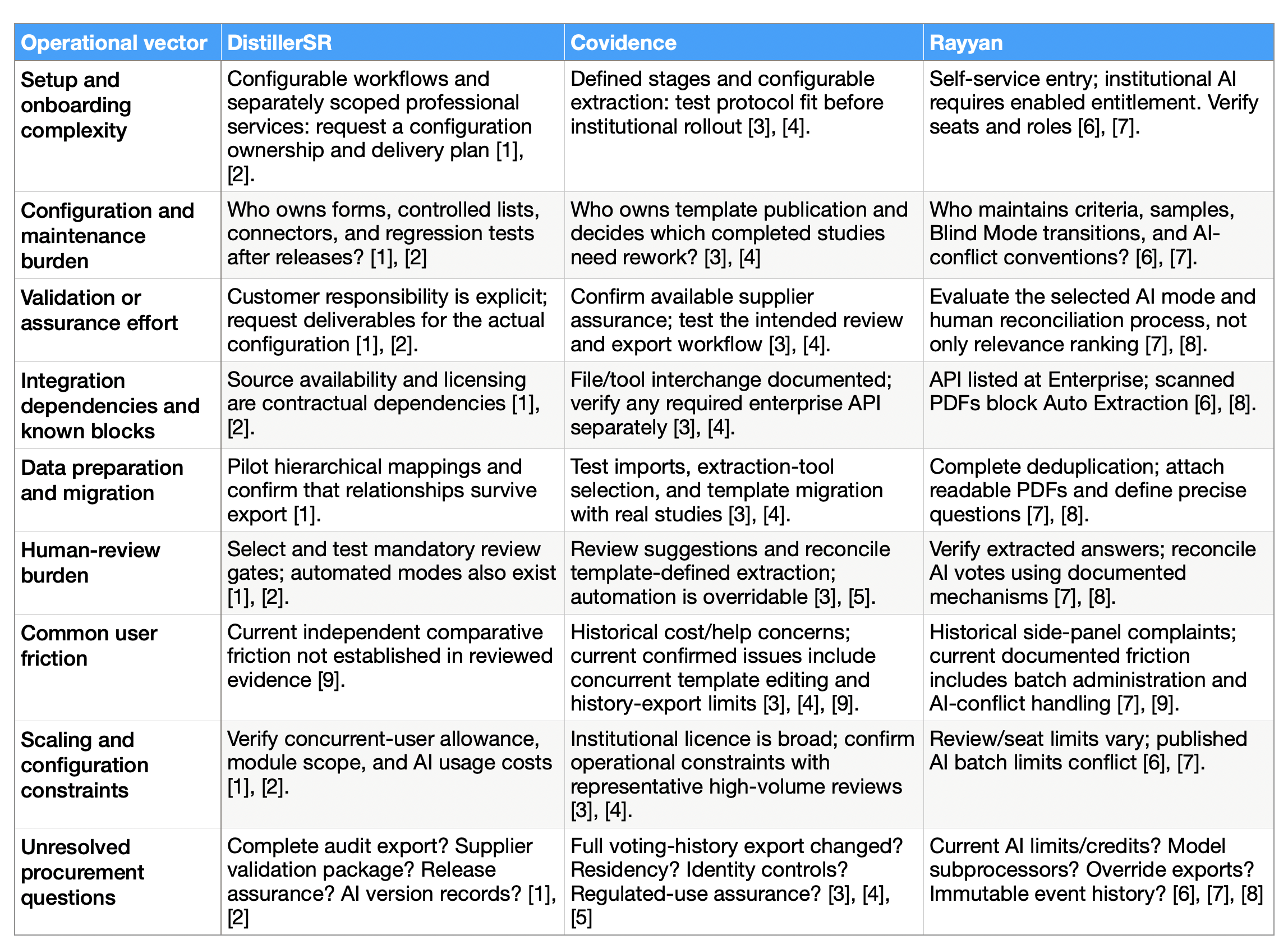
Audit readiness:
Separate the legal record from the research workflow [10].
Three distinctions should shape procurement.
- A regulatory dossier does not automatically make every upstream working record a Part 11 record [10]. FDA’s guidance specifically distinguishes submitted records and records required by predicate rules from other material used to generate a submission [10]. Applicability should be documented for the actual process [10].
2. An audit trail is not an electronic signature [10]. Where applicable, Part 11 separately addresses complete copies, retention, time-stamped change records, signer identity, signature meaning, and signature-record linking [10].
3. HTA methods and software controls are different questions. NICE’s manual governs its appraisal methods and processes; a platform’s regulatory marketing should not substitute for checking the current submission requirements and review protocol.
For these platforms, buyers should keep five assurance activities separate:
Table 4: Evidence Synthesis Platform Procurement: Assurance and Validation Questions
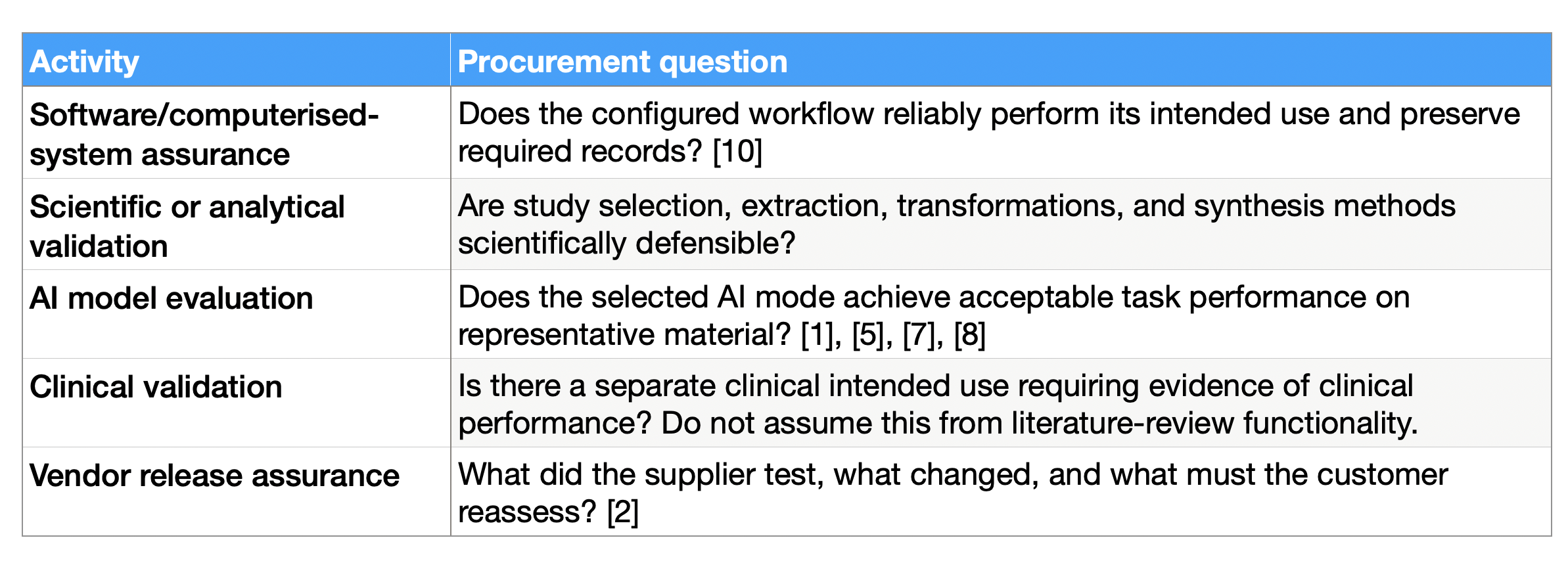
This is an editorial procurement framework, not a statement that all five apply equally or that every review requires a fixed IQ/OQ/PQ package [10]. FDA’s risk-based guidance supports tailoring assurance to intended use and record impact [10].
Calculating labour savings without accepting a marketing percentage
DistillerSR publishes customer time-saving examples [1], Covidence reports task-specific automation performance [5], and Rayyan advertises screening acceleration [7]. These figures measure different activities and are not a defensible head-to-head ROI comparison [1], [5], [7].
Use an operational pilot instead:
For the 2,000-record test, record:
Total reviewer-hours, not just elapsed calendar time.
Time spent checking duplicates [6].
Screening time per reviewer [9].
Conflict frequency and adjudication time [4], [7].
Known eligible studies missed or incorrectly excluded [9].
Extraction correction time, particularly numerical results and denominators [3], [5], [8].
Time to produce the required audit/export package [4], [10].
Time to repeat the workflow after an update search [1], [4].
These are recommended pilot measures, not published product benchmarks. A procurement team should set its methodological acceptance criteria before seeing which tool appears fastest.
Table 5: Commercial boundaries that change the business case
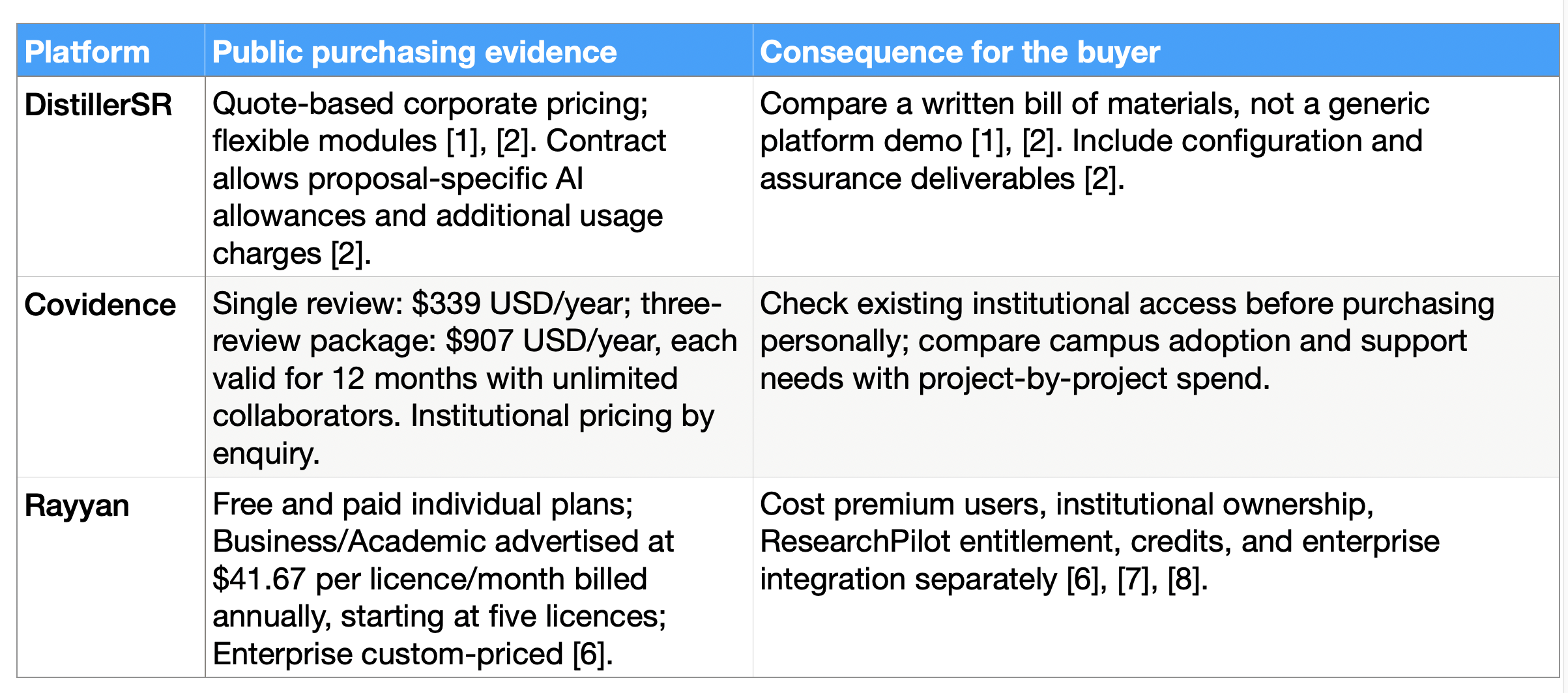
Prices are the published figures inspected on the research date, not contractual offers [6]. Rayyan’s pricing page contains different quarterly and annual presentations; buyers should verify billing cadence and the final order rather than extrapolating from one displayed monthly figure [6].
Which tool makes sense for your operational framework?
When to shortlist DistillerSR
If your organisation needs configurable multi-stage literature workflows, complex repeating extraction data, scheduled updates, and reuse across programmes, and has a platform owner or a budget for managed configuration. Shortlist DistillerSR because those capabilities are explicitly documented [1], [2].
If exportable regulated records, controlled AI review gates, or a formal supplier-assurance package are mandatory, confirm the exact deliverables before selecting it [1], [2], [10]. Its contract expressly leaves customer validation and regulatory submission responsibility with the buyer [2].
Do not buy an enterprise configuration solely to make one small academic review appear more rigorous [1], [2].
When to shortlist Covidence
If your institution needs a common review process, broad collaborator participation, configurable extraction templates, and centrally supported adoption, shortlist Covidence because its workflow and institutional packaging align with those requirements [3], [4].
If a complete exported history of votes and conflicts is mandatory, resolve that requirement before selecting it [4], [10]. The reviewed documentation says this detailed export is unavailable [4].
Do not mistake a strong academic review workflow for proof of a complete enterprise records-management architecture [3], [4], [10].
When to shortlist Rayyan
If your team needs to begin collaborative screening without an initial software fee and can operate within Free-plan limits, shortlist Rayyan [6]. If you need institutional AI, evaluate the actual ResearchPilot-enabled institutional offering rather than extrapolating from the free product [6], [7], [8].
If AI-assisted screening must preserve an easily adjudicated human final decision, test the AI Reviewer conflict-and-export workflow before purchasing [7]. Its uneditable AI vote makes that a consequential operational question [7].
Do not use the Free plan as a procurement shortcut when the requirements include paid reports, institutional ownership, SSO/SAML, or API integration [6].
When the products could be complementary
Analytical judgment: an institution could standardise routine reviews on Covidence or Rayyan while reserving DistillerSR for programmes needing configurable surveillance, hierarchical extraction, or cross-project reuse [1], [3], [6]. The documented product boundaries make that plausible, but interoperability and preservation of provenance must be tested rather than assumed [1], [3], [6].
Using multiple platforms within the same review is harder to justify unless the handoff has a measurable benefit. Each transfer should preserve identifiers, eligibility decisions, exclusion reasons, source relationships, and the evidence required to reconstruct the review [10].
The procurement checks most likely to change the decision are:
Demonstrate the required export. Include a corrected decision, resolved conflict, revised extraction field, and update search—not just a PRISMA diagram [3], [4], [7], [10].
Confirm AI authority. Establish whether AI ranks, suggests, votes, or finalises, and how human disagreement appears downstream [1], [5], [7], [8].
Contract the actual scope. Name modules, tiers, seats, credits, integrations, support, and assurance deliverables [1], [2], [6], [7].
Test an update and an exit. Preserve a review snapshot, add new evidence, then export what would remain after cancellation [1], [4], [10].
Measure net labour. Buy the workflow that reduces total effort while meeting pre-agreed evidence-quality and record requirements [9], [10].
Table 6: Source map
All sources below were accessed on November 16, 2026. “Undated” means no reliable publication/update date was displayed in the inspected page. Section groupings cover the associated substantive subheadings and matrices.
| Article section or asset | Supporting sources | Source type | What the evidence supports |
| Introduction; macro matrix; DistillerSR system overview and native capabilities | “DistillerSR Review Software,” DistillerSR Inc., undated [1]. | Vendor product documentation and claims | Configurable workflows; review stages; AI feature families; integrations; audit/version claims; CuratorCR distinction; living-review capabilities [1]. |
| Introduction; DistillerSR AI boundaries | “DistillerSR: AI-Enabled Literature Review Software,” DistillerSR Inc., undated [1]. | Vendor positioning and AI-policy claims | Source attribution, human-review statements, data isolation/training statements, content-processing controls [1]. |
| DistillerSR system overview, risks, buyer persona; friction matrix; assurance; commercial boundaries | “DistillerSR Subscription Terms,” DistillerSR Inc., version 3.7, July 8, 2026 — definitions; §§2.1–2.3, 3.2–3.3, 4.1 [2]. | Vendor contractual terms | SaaS/module scope; customer validation and approval; integration dependencies; automatic updates; user and AI-usage commercial boundaries [2]. |
| DistillerSR native capabilities; workflow; proof-asset directive | “Hierarchical Data Extraction Form: A New Approach to Capturing Repeating Data Sets in Systematic Reviews,” DistillerSR Inc., undated — “Hierarchical Data Extraction,” configuration, reviewing, and output sections [1]. | Vendor technical solution brief | Parent-child form architecture, repeated datasets, navigation keys, relational preservation, hierarchical/vertical output; basis for editorial diagram [1]. |
| DistillerSR commercial boundaries | “Software Pricing,” DistillerSR Inc., undated. | Vendor commercial information | Quote-based pricing and modular purchasing. |
| Introduction; macro matrix; Covidence system overview and workflow | “Covidence — Where trusted evidence gets made,” Covidence/Future Evidence Foundation, undated. | Vendor positioning and product overview | Ownership; staged review scope; dual screening, extraction, quality assessment, and export positioning. |
| Covidence routing; documented workflow; proof-asset directive | “FAQ: How do references move through a review?”, Covidence Knowledge Base, page updated February 23, 2026. | Vendor help documentation | Vote-dependent stage progression, single-reviewer mode, conflict example, reviewer-relative status. |
| Covidence native capabilities, implementation risks, friction matrix | “How to create, publish, and update a data extraction template in Extraction 2,” Covidence Knowledge Base, October 20, 2026 [3]. | Vendor technical help documentation | Field types, template reuse, draft/publish, republication effects, completed-study rework, simultaneous-editing warning [3]. |
| Covidence AI, governance, and procurement risks | “Data Privacy in Covidence: A Guide to PDFs and LLM Usage,” Covidence Knowledge Base, August 27, 2026 [5]. | Vendor privacy/technical statement | Extraction 1/2 suggestions, DOI condition, default enablement, data sources, LLM PDF-use statements [5]. |
| Covidence AI performance boundary | “Extraction 1 intervention suggestions,” Covidence Knowledge Base, October 22, 2026. | Vendor feature documentation and performance claim | Study-arm suggestions, user mapping, optional linkage, task-specific reported precision/recall. |
| Covidence AI oversight; assurance matrix | “Covidence’s approach to automation,” Covidence Knowledge Base, October 22, 2025. | Vendor governance policy | Manual override, evaluation approach, data handling, methodological-alignment statements. |
| Covidence traceability, risks, buyer persona; proof-asset directive; selection rules | “FAQ: Can I export the voting history and/or records of conflicts?”, Covidence Knowledge Base, October 22, 2025 [4]. | Vendor help documentation; confirmed documented limitation | In-product history visibility, unavailable detailed history/conflict export, separate reliability-data export [4]. |
| Living-review workflow; correction/traceability table; labour pilot | “How to update a review with new studies,” Covidence Knowledge Base, October 27, 2025. | Vendor implementation guidance | Update imports, cross-import deduplication, cumulative PRISMA, snapshots, tags, custom source tracking. |
| Covidence buyer persona; integration and commercial matrices | “Pricing,” Covidence/Future Evidence Foundation, undated. | Vendor commercial information | Published review/package prices, institutional enquiry, unlimited organisational users/reviews, file/tool interchange, browser deployment. |
| Introduction; macro matrix; Rayyan system overview | “AI-Powered Systematic Review & Literature Review Platform,” Rayyan Systems Inc., undated. | Vendor positioning and product overview | Current scope from import through reporting; mobile and AI positioning. |
| Rayyan packaging; macro and friction matrices; commercial boundaries; selection | “Rayyan Pricing,” Rayyan Systems Inc., undated [6]. | Vendor commercial information | Free limits; paid features; institutional ownership; ResearchPilot packaging; Enterprise API/SSO; pricing and billing presentations [6]. |
| Rayyan ingestion, work allocation, roles, traceability, and friction | “Rayyan Help Center” article collection, Rayyan Systems Inc.; individual articles updated in 2026 — “How to Detect and Manage Duplicates in Rayyan”; “How to Organize Screening Work Across Your Team”; “How to Generate a Screening Report in Rayyan”; “How to Invite and Manage Review Members in Rayyan”. | Vendor technical documentation retrieved through public help-centre API | Duplicate states and irreversible auto-resolution; sampling/access boundaries; Blind Mode; report entitlement/content; roles. |
| Rayyan AI scope and unresolved batch-limit conflict | “What is ResearchPilot™?” and associated feature articles, Rayyan Systems Inc., API records updated November 2026. | Vendor technical documentation retrieved through public API | Institutional entitlement; mode distinctions; source-linked extraction; updated 10,000-reference and credit statements that conflict with rendered article. |
| Rayyan routing, oversight, correction, risks, buyer persona; proof-asset directive | “AI Reviewer (ResearchPilot™),” Vanessa Godoy/Rayyan Help Center, rendered page dated October 11, 2026 — activation, decision rules, results [7]. | Vendor technical help documentation | Blinded AI agent; criterion logic; uneditable AI decision; consensus/majority handling; rendered 2,000-reference limit [7]. |
| Rayyan extraction workflow, confirmed limitations, assurance | “Auto Extraction (ResearchPilot™),” Vanessa Godoy/Rayyan Help Center, October 5, 2026 [8]. | Vendor technical help documentation | Required questions and PDFs; source highlighting; human revision; scanned-PDF limitation; table/figure and question-quality friction [8]. |
| Rayyan privacy and procurement uncertainties | “Privacy Policy,” Rayyan Systems Inc., last revised September 15, 2023 — §§2–3, 5, 11. | Vendor privacy policy | Personal-data use, controller/processor roles, international transfers, general retention; does not resolve current ResearchPilot-specific processing questions. |
| Evidence limitations; Covidence and Rayyan external micro-insights; historical usability/friction | Harrison et al., “Software tools to support title and abstract screening for systematic reviews in healthcare: an evaluation,” BMC Medical Research Methodology, January 13, 2020 — Methods, Results, Table 3, limitations [9]. | Independent peer-reviewed evaluation | Historical feature/usability findings, six-person survey, December 2018 testing, DistillerSR exclusion, limits on present-day inference [9]. |
| Rayyan independent-evidence qualification | Ouzzani et al., “Rayyan—a web and mobile app for systematic reviews,” Systematic Reviews, December 5, 2016. | Developer-authored peer-reviewed product paper | Early product design and evaluation; not independent validation of current ResearchPilot. |
| Workflow scope; methodological assurance; update and copyright considerations | Lefebvre et al., “Chapter 4: Searching for and selecting studies,” Cochrane Handbook version 6.5.1, chapter updated March 2025 — §§4.2, 4.5–4.6. | Authoritative methodological guidance; not statutory regulation | Information-specialist role, studies versus reports, reproducible searching/selection, licensing, documentation. |
| DistillerSR external micro-insight; audit readiness; risk framework; conditional procurement | “Part 11, Electronic Records; Electronic Signatures—Scope and Application,” FDA, September 2003; web content current August 24, 2018 — §III.B–C [10]. | Official nonbinding regulatory guidance | Predicate-rule applicability, upstream working-record distinction, risk-based validation and audit controls, retention/copying considerations [10]. |
| Signature discussion; audit-readiness framework | “21 CFR Part 11—Electronic Records; Electronic Signatures,” eCFR, displayed current through November 12, 2026 — §§11.1, 11.10, 11.50, 11.70, 11.100–11.300. | Binding regulatory text; authoritative unofficial electronic codification | Electronic-record controls, complete copies, audit trails, retention, identity and signature-record linkage. |
| HTA context and procurement boundaries | “NICE technology appraisal and highly specialised technologies guidance: the manual,” NICE, January 31, 2022; updated October 13, 2026. | Official HTA methods/process reference | Applicable appraisal-methods context; no product certification or platform endorsement inferred. |
| Labour-savings framework; buyer personas; selection rules; all editorial diagrams | Editorial analysis based on the product, contractual, methodological, and regulatory sources mapped above. | Analytical synthesis, not measured comparative evidence | Conditional fit, recommended pilot design, proposed assurance questions, architectural implications, and original visual reconstructions. |
Editorial note: These ten references provide a compact bibliography for the comparison’s principal architectural, AI, governance, and assurance claims. They do not replace the article’s additional claim-level sources for specific pricing, update workflows, or other detailed assertions. Reference evaluates historical screening functionality, not the platforms’ current generative-AI features; reference is nonbinding guidance, not a product certification.
Find the right fit for your evidence workflow
Use this comparison to narrow your shortlist, then explore the DistillerSR, Covidence, and Rayyan profiles in our Structured Data Extraction & Evidence Intelligence directory. Assess each option against your screening and extraction needs, AI oversight requirements, and expectations for traceability. Not just its feature list
References
[1] DistillerSR Inc., “DistillerSR review software,” DistillerSR. [Online]. Available: https://www.distillersr.com/products/distillersr-systematic-review-software. [Accessed: Nov. 16, 2026].
[2] DistillerSR Inc., “DistillerSR subscription terms,” ver. 3.7, Jul. 8, 2026. [Online]. Available: https://www.distillersr.com/distillersr/distillersr-subscription-terms. [Accessed: Nov. 16, 2026].
[3] Covidence, “How to create, publish, and update a data extraction template in Extraction 2,” Covidence Knowledge Base, Oct. 20, 2026. [Online]. Available: https://support.covidence.org/help/create-and-publish-a-data-extraction-template. [Accessed: Nov. 16, 2026].
[4] Covidence, “FAQ: Can I export the voting history and/or records of conflicts?,” Covidence Knowledge Base, Oct. 22, 2025. [Online]. Available: https://support.covidence.org/help/can-i-export-voting-history-slash-records-of-conflicts. [Accessed: Nov. 16, 2026].
[5] Covidence, “Data privacy in Covidence: A guide to PDFs and LLM usage,” Covidence Knowledge Base, Aug. 27, 2026. [Online]. Available: https://support.covidence.org/help/data-privacy-in-covidence-a-guide-to-pdfs-and-llm-usage-e8420512. [Accessed: Nov. 16, 2026].
[6] Rayyan Systems Inc., “Rayyan pricing.” [Online]. Available: https://www.rayyan.ai/pricing/. [Accessed: Nov. 16, 2026].
[7] V. Godoy, “AI Reviewer (ResearchPilot™),” Rayyan Help Center, Oct. 11, 2026. [Online]. Available: https://help.rayyan.ai/hc/en-us/articles/46034112564497-AI-Reviewer-ResearchPilot. [Accessed: Nov. 16, 2026].
[8] V. Godoy, “Auto Extraction (ResearchPilot™),” Rayyan Help Center, Oct. 5, 2026. [Online]. Available: https://help.rayyan.ai/hc/en-us/articles/46065925755921-Auto-Extraction-ResearchPilot. [Accessed: Nov. 16, 2026].
[9] H. Harrison et al., “Software tools to support title and abstract screening for systematic reviews in healthcare: An evaluation,” BMC Medical Research Methodology, vol. 20, Art. no. 7, Jan. 2020, doi: 10.1186/s12874-020-0897-3.
[10] U.S. Food and Drug Administration, “Part 11, electronic records; electronic signatures—Scope and application: Guidance for industry,” Sep. 2003. [Online]. Available: https://www.fda.gov/regulatory-information/search-fda-guidance-documents/part-11-electronic-records-electronic-signatures-scope-and-application. [Accessed: Nov. 16, 2026].

Author: Stephen
Founder of HealthyData.Science · 20+ years in life sciences compliance & software validation · MSc in Data Science & Artificial Intelligence.
Follow HealthyData.Science on LinkedIn
Get concise decision briefings, vendor comparisons, and regulatory AI updates for healthcare and life sciences teams.
Follow HealthyData.Science on Google Search & AI
Get our latest healthcare and life science AI tool evaluations, regulatory updates, and buyer intelligence in your Google AI Overviews.
Add as Preferred Source