
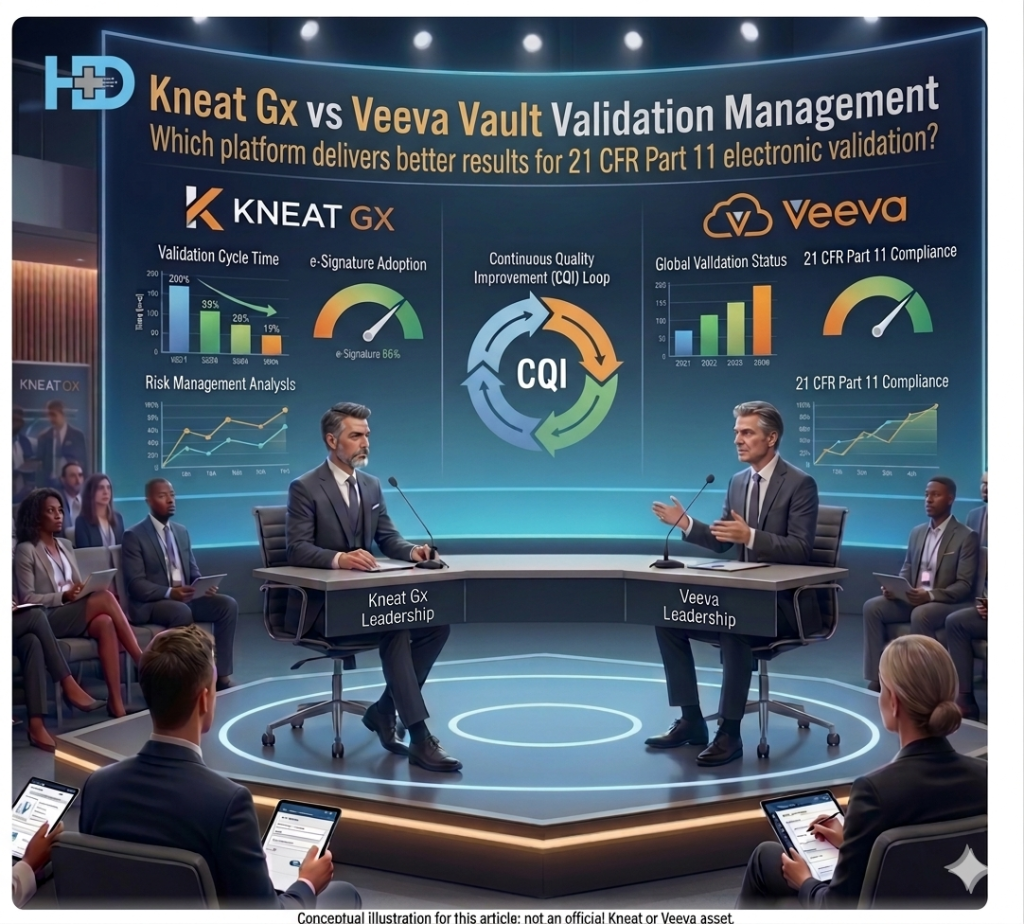
The main difference between Kneat Gx and Veeva, is that Kneat Gx is positioned in the core dataset as a validation-first execution platform with a dedicated digital validation model and reusable validation assets, while Veeva Vault Validation Management is positioned as a validation application inside a broader Vault quality architecture, making it stronger for suite-level standardisation and cross-process governance than for stand-alone validation specialisation.
For a VP or Director of QA and Quality Management, the practical decision is whether the organisation needs a validation operating layer that concentrates on URS-to-test traceability and execution depth, or a wider cloud quality stack where validation sits beside controlled documents and quality processes under common platform governance.
Evaluation criteria
This comparison evaluates both platforms on six factors: workflow flexibility, validation-lifecycle depth, integration footprint, audit trail and e-signature controls, software-validation burden, and scaling risk across regulated sites.
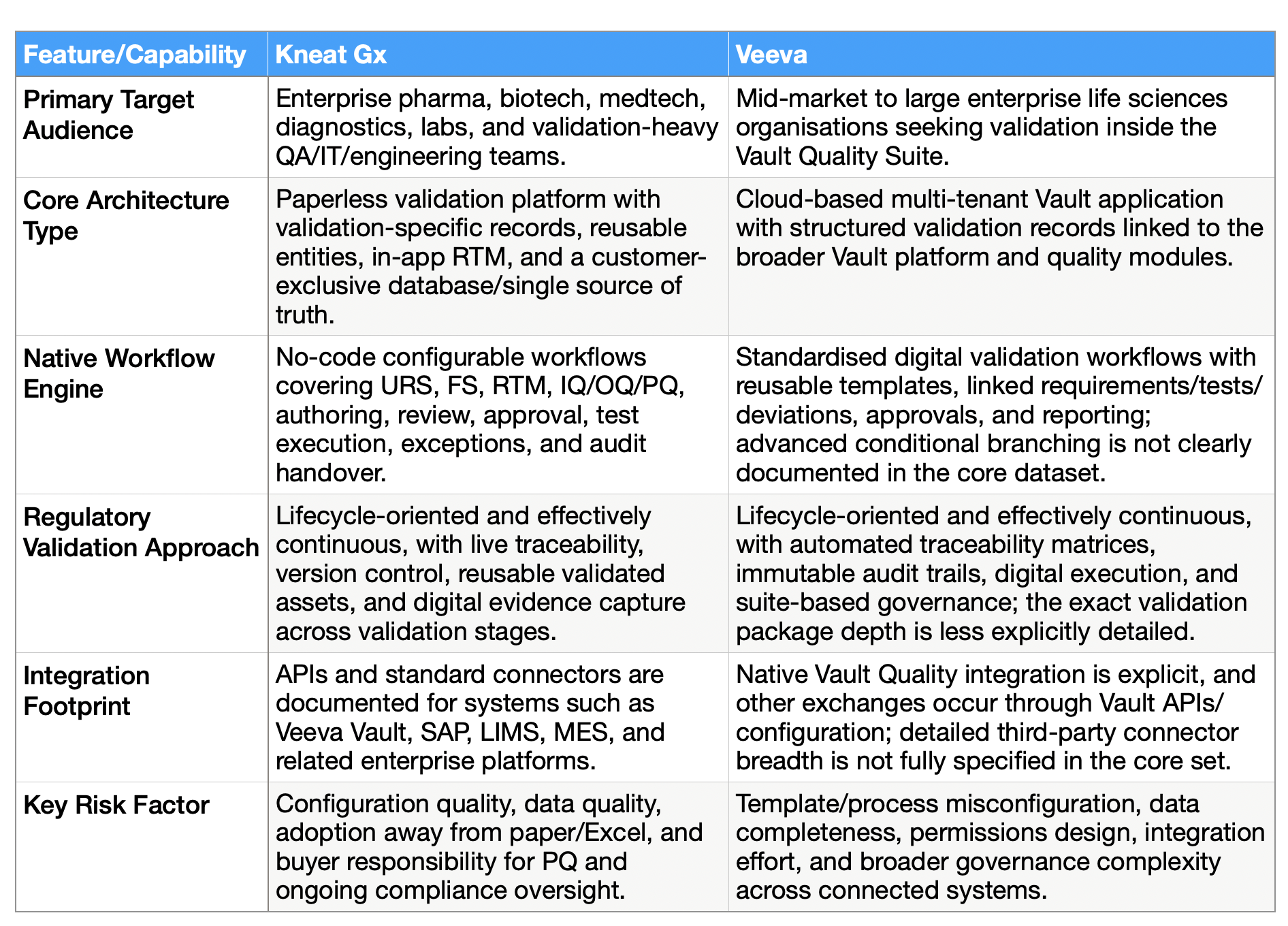
Tables 1 and 2 summarise these dimensions at a glance, while the workflow architecture and risk sections below unpack how each factor plays out in day‑to‑day use.
External compliance benchmarks are used only to test whether the documented product capabilities align with GMP expectations for lifecycle validation, data integrity, audit trails, access control, incident handling, and permanently linked electronic signatures.
In practice, this means answering the kind of question that shows up in search logs: “kneat gx vs veeva vault validation management for pharma and biotech companies needing electronic validation protocol management with 21 CFR Part 11 compliance?” Rather than treating “Part 11 compliant” as a label, the analysis looks at how each tool supports audit trails, role‑based access, and electronic signatures in real‑world validation operations.
Operational workflow comparison
Kneat Gx workflow architecture
For many pharma and biotech teams, the real question behind this comparison is “kneat gx vs veeva vault validation management for pharma and biotech companies needing electronic validation protocol management with 21 CFR Part 11 compliance?” This section therefore focuses on how each platform actually handles validation workflows, audit trails, role‑based access, and electronic signatures in day‑to‑day GxP operations, rather than treating “Part 11 compliant” as a simple checkbox claim.
Trigger & Ingestion: In the core dataset, work enters Kneat Gx as structured validation content, including URS, FS, RTM, test steps, evidence, logbooks, and change records, with API-based integration to systems such as Veeva Vault, SAP, LIMS, and MES where needed. The approved materials do not clearly evidence native complaint, CAPA, or general non-conformance intake as first-class workflow objects, so those should be treated as undocumented rather than assumed.
Routing & Logic Branching: Kneat Gx is described as no-code configurable and able to automate workflow steps across authoring, review, execution, and approval. The core sources do not explicitly confirm deep IF/THEN/ELSE branching logic, so the safest reading is that workflow configurability is proven, but highly granular conditional orchestration remains undocumented.
Collaborative Handoffs & E-Signatures: Review and approval loops occur inside the platform through controlled workflow states, role-based access, electronic signatures, and audit-ready records. EU Annex 11 requires electronic signatures to be permanently linked to their records, include date and time, and have the same impact as handwritten signatures within the company, so any buyer should test how those controls are configured in the customer environment rather than relying on a generic “Part 11-ready” claim alone.
Exception Handling, Root Cause Analysis & Auditing: The platform explicitly supports exceptions, version control, and full traceability across requirements, risks, and tests, and the source set repeatedly frames audit trails as immutable and inspection-ready. Annex 11 also requires incident reporting, root-cause identification for critical incidents, regular review of audit trails, and controlled change/configuration management, which means Kneat’s documented validation depth is a strong fit for auditability but not automatic proof of a full native CAPA/RCA engine beyond the validation domain.
Veeva workflow architecture
Trigger & Ingestion: In the core dataset, Veeva Vault Validation Management ingests structured validation inventory, requirements, protocols, tests, deviations, approvals, and related deliverables inside the Vault environment. Because it sits inside the wider Vault ecosystem, it is also positioned to connect validation records with QualityDocs and QMS processes, although the detailed intake mechanics for complaints or CAPA events are not fully described for this specific module in the approved sources.
Routing & Logic Branching: Veeva is documented as supporting standardised workflows, reusable templates, digital execution, and approvals across validation work. As with Kneat, the core dataset does not clearly prove advanced customer-defined branching logic, so buyers should treat rigid-to-moderately-configurable template governance as evidenced, and rich conditional branching as undocumented.
Collaborative Handoffs & E-Signatures: Collaborative loops are supported through shared cloud workflows, linked records, electronic signatures, and immutable audit trails on the Vault platform. Annex 11’s requirements for restricted access, recorded authorization changes, operator identity capture, and permanently linked signatures remain relevant, so the governance burden sits partly in the buyer’s role/permission design and procedural controls rather than in software functionality alone.
Exception Handling, Root Cause Analysis & Auditing: Veeva explicitly links deviations, approvals, tests, and results, and the source set describes automated traceability matrices and immutable audit trails. However, the approved material does not fully detail whether deep root-cause and corrective-action workflows are executed natively in this module or through adjacent Vault QMS processes, so that distinction must be validated during technical discovery.
AI Tool deep dives
Kneat Gx: System Overview & Pipeline Fit
Kneat Gx is described as a purpose-built digital validation platform for GxP-regulated activities such as computer system, equipment, cleaning, and method validation. Its strongest pipeline fit is in organisations where validation itself is a strategic operating problem and where management wants one governed execution layer for URS, RTM, IQ/OQ/PQ, evidence capture, and review cycles across multiple sites.
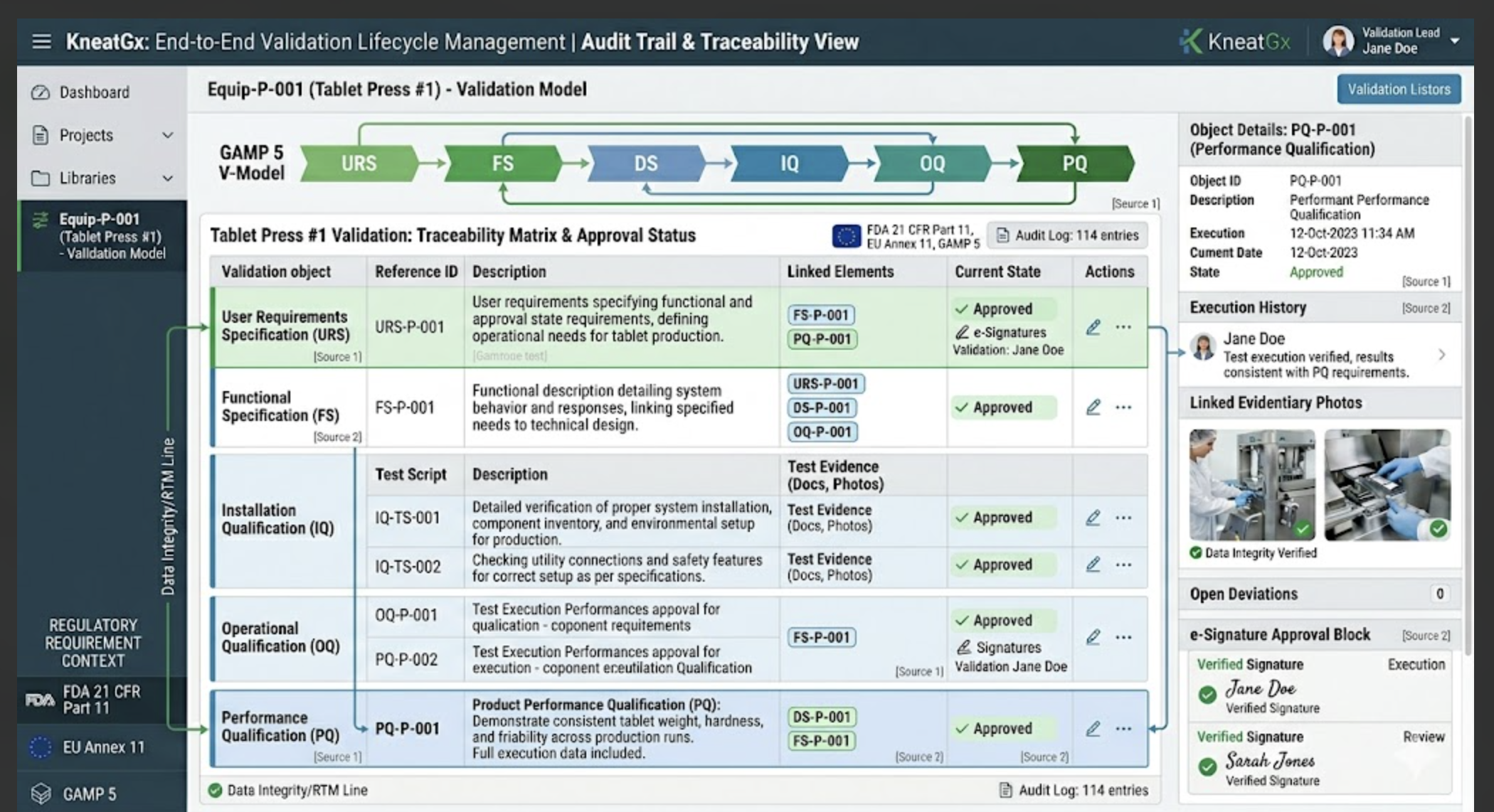
Figure 1: Conceptual Kneat Gx validation lifecycle view with URS‑to‑PQ traceability, evidence, and e‑signatures
Kneat Gx: Native Workflow Capabilities & Proof Points
The core dataset credits Kneat with no-code workflow configuration, reusable entities, in-app traceability matrices, online test execution, electronic signatures, audit trails, and support for URS, FS, RTM, and IQ/OQ/PQ within the same controlled environment. The strongest quantitative proof point is the MSD deployment summary reporting more than 50% shorter validation cycle times, reduction of process steps from 15 to 8, and consolidation from five systems to two.
Kneat Gx: Architectural Risks & Implementation Bottlenecks
The key bottlenecks are not unusual for regulated SaaS: buyers still own PQ in their own environment, data quality directly affects traceability value, integrations require governance and testing, and user adoption can stall if teams stay attached to paper or spreadsheet habits. Annex 11 reinforces that commercial off-the-shelf software still requires user-side review of supplier documentation, risk-based validation, controlled changes, periodic evaluation, and incident management, which means the software lowers validation effort but does not eliminate validation responsibility.
Kneat Gx: The Ideal Buyer Persona
Kneat Gx best fits enterprise and upper-mid-market life sciences organisations that run significant validation volume and want to standardise execution across sites, systems, equipment, and process types. It is especially well aligned to QA and validation leadership teams that want validation-specialist depth without forcing every quality workflow into one broad suite decision at the same time.
Veeva: System Overview & Pipeline Fit
Veeva Vault Validation Management is described as a cloud validation lifecycle solution inside the Veeva Vault platform for CSV, commissioning and qualification, and process-related validation use cases across regulated life sciences. Its strongest pipeline fit is in organisations already standardising on Vault, where management wants validation to inherit platform governance and operate beside controlled content and quality processes rather than as a separate specialist layer.
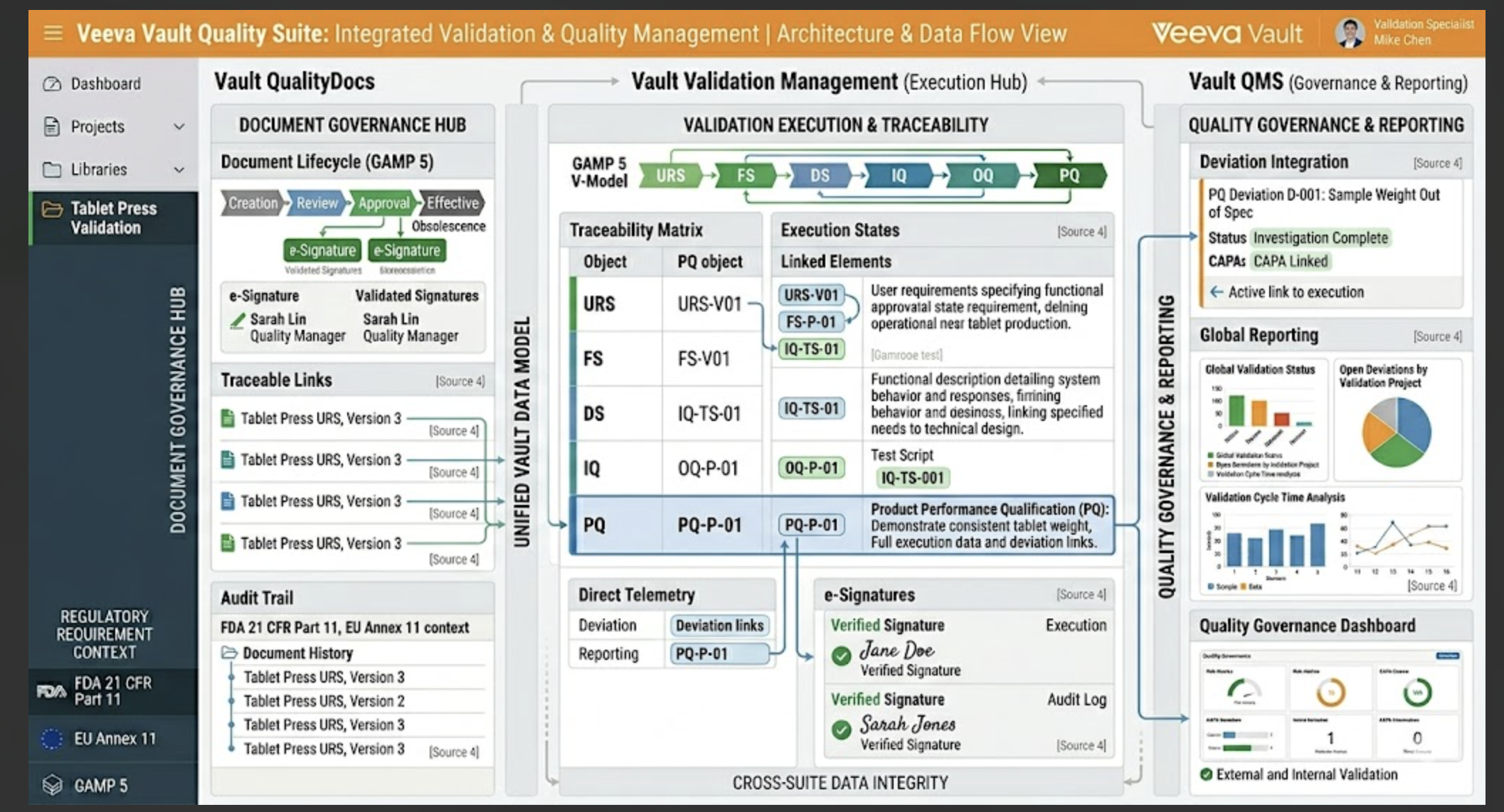
Figure 2: Conceptual Veeva Vault Quality Suite architecture view linking QualityDocs, Validation Management, and QMS
Veeva: Native Workflow Capabilities & Proof Points
The core dataset attributes to Veeva structured validation inventory, linked requirements and scripts, digital execution, deviation handling, approvals, automated traceability matrices, reusable templates, and real-time reporting. The proof base is more directional than Kneat’s cited case metric: SK Life Science is referenced for significant cost and time savings, stronger transparency, and better audit readiness, but the public source does not publish precise site-level percentages for this module.
Veeva: Architectural Risks & Implementation Bottlenecks
The main operational risks are template and workflow misconfiguration, incomplete underlying data, significant integration effort outside the Vault estate, training gaps, and permission-model design weaknesses that can undermine governance. Annex 11 makes these issues material because buyers must control access authorizations, record operator identity changes, review audit trails, manage incidents, and periodically confirm the system remains in a valid state.
Veeva: The Ideal Buyer Persona
Veeva fits quality organisations that place a premium on enterprise platform standardisation, cross-functional governance, and keeping validation close to quality documents and QMS processes. It is the stronger choice for management teams that already have Vault alignment or want their validation operating model to be part of a broader suite rationalisation strategy.
Table 2: Kneat Gx vs Veeva: Friction and Risk
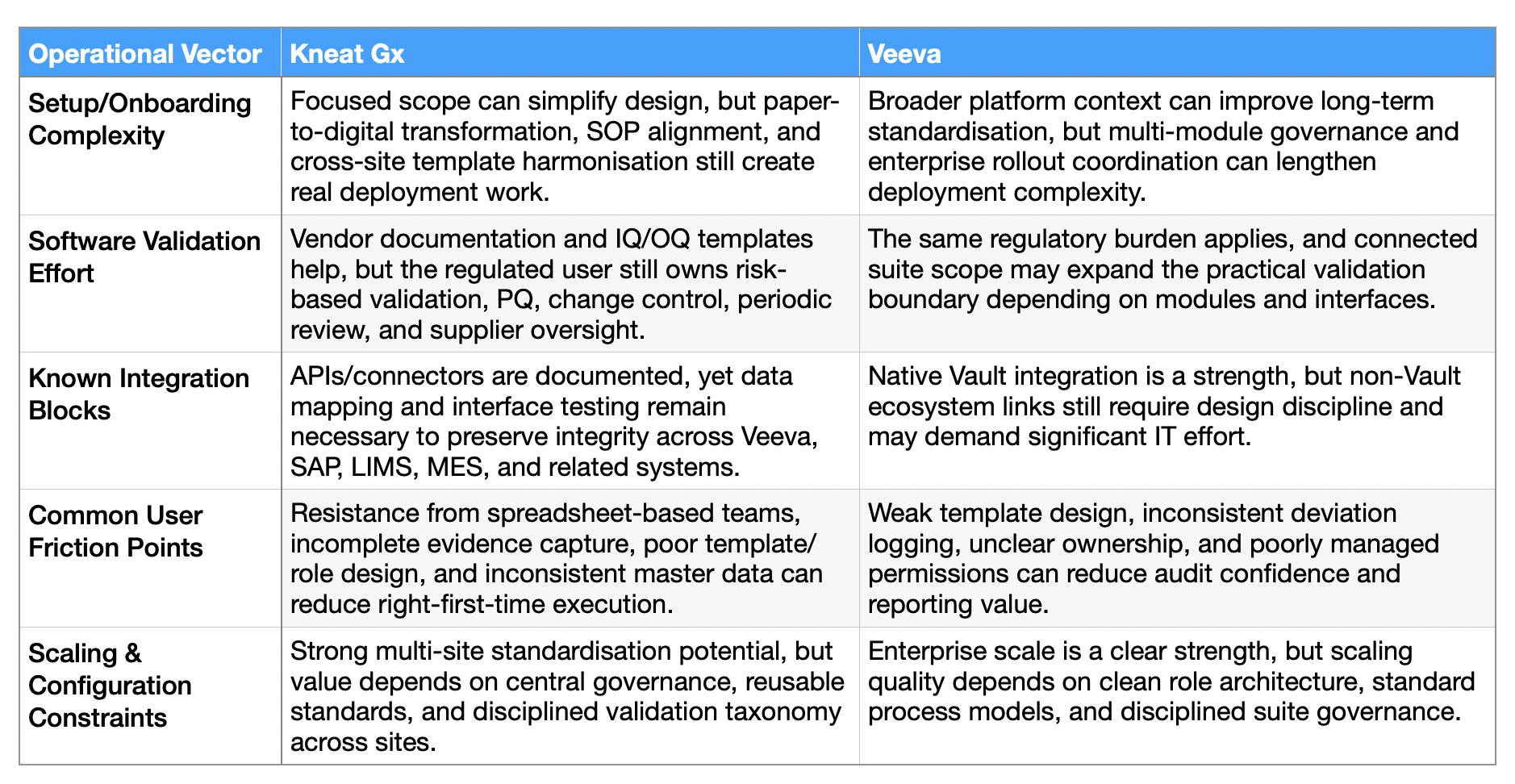
Finally: Which tool makes sense for your operational framework?
If validation execution is the primary bottleneck, and management needs a specialist platform for structured lifecycle validation, strong RTM control, and reusable validation assets across sites, then Kneat Gx is the better fit.
If the larger strategic objective is suite consolidation, common platform governance, and keeping validation tightly aligned with controlled documents and adjacent quality processes, then Veeva is the better fit.
If the business is a validation-heavy pharma, biotech, or medtech environment with strong QA/validation leadership and a need to modernise paper-heavy execution fast, then Kneat Gx is the more direct answer.
If the business is a mature enterprise prioritising platform harmonisation and willing to manage broader governance complexity to gain suite-level consistency, then Veeva is the better strategic architecture choice.
Sources & methodology
The analysis in this article draws on evidence-based artefacts published by HealthyData.Science, specifically the vendor directory listings, buyer‑grade FAQs and competitive positioning pages covering Kneat Gx and Veeva Vault Validation Management. These curated resources are used to characterise each platform’s architecture, workflow capabilities, operational risks, and suitability for different life‑science buyer segments.
Key underlying HealthyData.Science sources include:
Kneat Gx directory listing: core capabilities and validation lifecycle coverage.
Kneat Gx buyer FAQs: dealbreaker questions, implementation risks, and integration considerations
Kneat Gx vs alternatives: competitive positioning and target buyer segments
Veeva Vault Validation Management directory listing: core capabilities and suite context
Veeva buyer FAQs: dealbreaker questions, implementation risks, and integration considerations
Veeva vs alternatives: competitive positioning and target buyer segments.

Author: Stephen
Founder of HealthyData.Science · 20+ years in life sciences compliance & software validation · MSc in Data Science & Artificial Intelligence.
Follow HealthyData.Science on Google Search & AI
Get our latest healthcare and life science AI tool evaluations, regulatory updates, and buyer intelligence in your Google AI Overviews.
Add as Preferred Source